
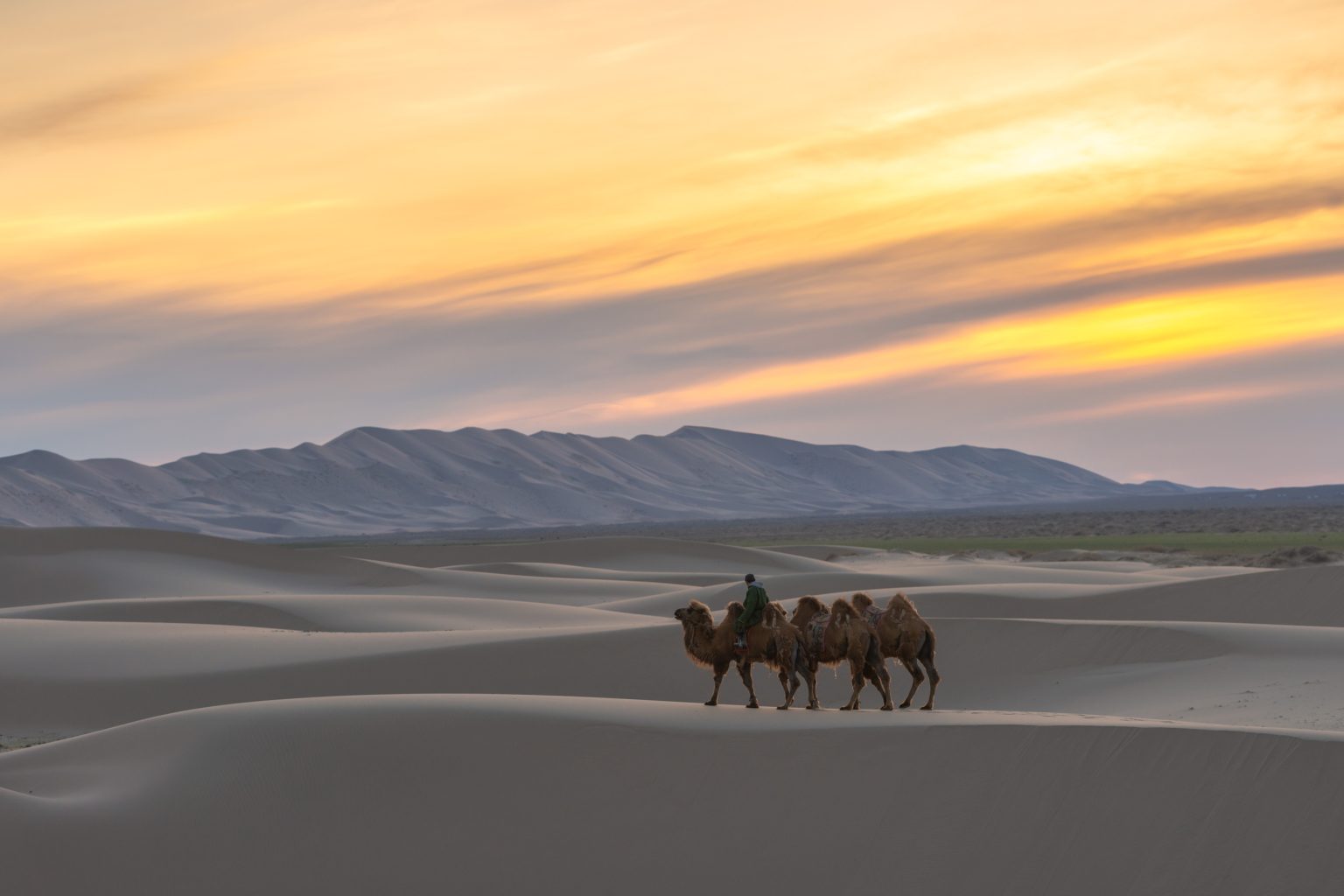
The Gobi Desert in China offers a striking mix of gravel plains, towering dunes, rocky landscapes and historic Silk Road sites. Unlike the Sahara, much of the Gobi consists of bare rock and gravel rather than vast seas of sand, creating a varied environment across northwestern China and southern Mongolia. This guide explores the region’s main attractions, including Dunhuang’s desert dunes and Buddhist heritage, the remote lakes of Badain Jaran, historic frontier sites, and practical advice for planning a desert journey.
- Understanding the Gobi Desert in China
- What to See and Do in the Chinese Gobi Desert
- 1. Explore the Singing Sand Dunes at Mingsha Shan
- 2. Discover Badain Jaran, the Desert of Lakes
- 3. Follow the Silk Road Heritage of the Hexi Corridor
- 4. Take a 4×4 Adventure in Inner Mongolia
- 5. Experience Desert Camping and Stargazing
- Weather in the Gobi Desert and the Best Time to Visit
- What to Pack for the Gobi Desert
- How to Reach the Gobi Desert in China
- Culture and Life in the Gobi Desert
- How to Travel Safely and Responsibly in the Gobi
- A Five-Day Itinerary for the Gobi Region of China
- Days 1 to 2: Dunhuang and the Desert Dunes
- Day 3: Yumen Pass and the Western Hexi Corridor
- Day 4: Travel Toward Jiayuguan
- Day 5: Jiayuguan or Zhangye
- Want to Visit Badain Jaran Instead?
- Why the Gobi Desert Is Worth Exploring
Understanding the Gobi Desert in China
The Gobi is one of Asia’s largest desert regions, extending across southern Mongolia and northern China. Its Chinese landscapes include parts of Inner Mongolia, Gansu and Xinjiang, although the exact boundaries depend on how the wider desert region is defined.
Rather than a continuous expanse of sand, the Gobi features gravel plains, rocky plateaus, mountain edges, dry valleys and isolated dune fields. These contrasting landscapes have shaped travel and settlement across the region for centuries.
Gobi Desert facts
- Elevation: Many areas sit at roughly 900 to 1,500 metres, although elevations vary considerably across the wider region.
- Climate: Summers can be extremely hot, while winter temperatures may fall well below freezing. Conditions depend on location and altitude.
- Rainfall: Much of the desert receives less than 200 millimetres of precipitation annually, with substantial local variation.
- Landscape: Expect gravel plains, exposed rock, dry basins, isolated dunes and rugged mountain scenery.
- Travel conditions: Remote areas may have few services, limited mobile coverage and long distances between settlements.
Despite its harsh climate, the Gobi supports wildlife and plant communities adapted to dry conditions. It is also home to pastoral communities and settlements with long-standing connections to the region’s trade routes.
What to See and Do in the Chinese Gobi Desert
1. Explore the Singing Sand Dunes at Mingsha Shan
Near Dunhuang in Gansu Province, Mingsha Shan is one of the best-known dune landscapes in western China. Its name is commonly translated as Singing Sand Mountain, referring to the sound that dry sand can produce under certain conditions.
The nearby Crescent Moon Spring, or Yueyaquan, forms a distinctive oasis beside the dunes. The area combines desert scenery with the history of Dunhuang, a major centre along the ancient Silk Road.
Things to do in Dunhuang:
- Ride a camel through designated routes across the dunes, where local operators offer organised excursions.
- Try sandboarding if the activity is available under the current site rules and weather conditions.
- Visit Crescent Moon Spring to see the oasis and its traditional buildings.
- Explore the Mogao Caves, a UNESCO World Heritage Site renowned for Buddhist murals, sculptures and centuries of religious art.
- Watch the changing colours of the dunes in the early morning or late afternoon.
The period from spring through autumn is often suitable for visiting, but temperatures, wind and visitor numbers vary. Summer afternoons can be particularly hot, so plan outdoor activities around the conditions.
Dunhuang is a strong choice for travellers who want desert scenery, cultural attractions and established visitor facilities in one destination.
2. Discover Badain Jaran, the Desert of Lakes
The Badain Jaran Desert lies on the Alxa Plateau in Inner Mongolia. It is known for its immense dunes, distinctive landforms and lakes nestled between sandy ridges. In 2024, the desert landscape was inscribed on the UNESCO World Heritage List as Badain Jaran Desert: Towers of Sand and Lakes. The listed area includes exceptional dune formations and numerous inter-dunal lakes.
Some dunes reach extraordinary heights. UNESCO identifies the tallest stabilised sand mega-dune in the property as having a relative height of approximately 460 metres, rather than a simple height of 500 metres above sea level.
Highlights of Badain Jaran include:
- Inter-dunal lakes: The desert contains many lakes, most of which are saline. Their colours and water levels vary with local conditions.
- Giant dunes: Climbing a dune can reveal sweeping views across the surrounding sand sea, but steep slopes and loose sand make some ascents demanding.
- Badain Jaran Temple: This remote Buddhist temple is an important cultural landmark within the desert landscape. Access should be arranged as part of a suitable local excursion.
- Desert photography: Contrasts between sand, water and sky make the area especially rewarding for photographers.
Badain Jaran is not an easy place to explore independently. Much of the remote desert has no paved roads, and access commonly requires a suitable 4×4 vehicle, experienced local drivers and advance planning. Overnight stays and camping arrangements should be confirmed with an authorised local operator.
Travellers should not assume that every lake is accessible or suitable for camping. Routes, permissions and conditions can vary, and the area’s fragile water systems and ecosystems require careful protection.
3. Follow the Silk Road Heritage of the Hexi Corridor
The Hexi Corridor in Gansu Province connects several important historical sites between the mountains and the desert. For centuries, it served as a major passage for traders, travellers, religious communities and military forces moving between China and Central Asia.
Dunhuang is one of the best-known stops, but the wider corridor contains several other places worth considering.
Historic sites to include in a regional itinerary:
- Mogao Caves: Near Dunhuang, these caves preserve Buddhist art and manuscripts associated with the development of Silk Road culture. Visitor access is managed, and advance booking is advisable.
- Yumen Pass: Also known as Jade Gate Pass, this frontier site is associated with historic routes through the western Hexi Corridor.
- Jiayuguan Pass: This major Ming-era frontier fortification is linked to the western end of the Ming Great Wall and offers insight into China’s historic defensive system.
- Zhangye Danxia National Geopark: Known for its colourful rock formations, this attraction provides a different landscape from the sandy dunes and gravel plains commonly associated with the Gobi.
These attractions are spread across a substantial area. Allow time for road transfers and check opening arrangements before setting out. Some sites lie far from major towns, and not all are practical to combine in a short visit.
For history enthusiasts, the region offers a chance to understand how desert geography influenced trade, settlement and defence over many centuries.
4. Take a 4×4 Adventure in Inner Mongolia
A 4×4 desert adventure in Inner Mongolia can reveal landscapes that are difficult to reach by ordinary road transport. Depending on the route, travellers may cross open gravel plains, visit dune fields, pass seasonal vegetation and explore remote areas with local guides.
Alxa League is a useful regional base for planning excursions into desert landscapes, including areas associated with Badain Jaran. Ejina Banner is better known for its seasonal poplar forests and desert-edge scenery, especially during autumn, rather than for a single continuous network of unrestricted off-road trails.
What a guided 4×4 excursion may include:
- Driving on approved desert tracks with experienced local operators.
- Visiting remote viewpoints and selected dune landscapes.
- Learning about the area’s geography, wildlife and pastoral traditions.
- Photographing changing light across the desert.
- Arranging an authorised overnight stay where suitable facilities are available.
Routes and access permissions vary. Do not assume that a rental car can enter remote dune areas or that all tracks are open to visitors. Before departure, confirm the vehicle requirements, expected driving time, fuel arrangements, weather forecast and emergency communications.
Wildlife sightings, including desert foxes, are never guaranteed. Keep a respectful distance from animals and livestock, and avoid disturbing local communities.
5. Experience Desert Camping and Stargazing
The Gobi’s dry climate and remote landscapes can provide excellent opportunities for desert stargazing, particularly away from settlements and artificial lighting. Clear skies are not guaranteed, however, and wind, dust, cloud cover and seasonal temperatures can affect the experience.
Possible areas to consider include:
- Badain Jaran: Remote desert landscapes and dunes, with overnight arrangements requiring advance confirmation.
- Dunhuang and its surrounding region: A more accessible base for combining desert excursions with established accommodation.
- Ejina and parts of western Inner Mongolia: Suitable for exploring desert-edge scenery and, where conditions permit, darker night skies.
Activities to consider:
- Photographing the Milky Way when skies are clear and conditions are suitable.
- Joining an organised overnight excursion with a qualified local operator.
- Learning about local pastoral life through a responsible, community-based experience.
- Taking an early-morning walk in an authorised area after checking the route and weather.
Traditional Mongolian gers are associated with Mongolian pastoral culture, but not every desert camp offers authentic traditional accommodation. Ask operators about the type of lodging, facilities and cultural activities included rather than assuming all camps provide the same experience.
Remote camping requires careful preparation. Bring appropriate insulation, protect camera equipment from dust, and make sure someone knows your route and expected return time.
Weather in the Gobi Desert and the Best Time to Visit
The Gobi has a strongly continental climate, with large temperature differences between seasons and sometimes between day and night. The best time to visit depends on whether you plan to explore established attractions, travel across remote dunes or photograph seasonal scenery.
Spring: April to June
Spring can offer more moderate daytime conditions than midsummer, although strong winds and dust are possible. Temperatures may still drop sharply after sunset.
This season can suit sightseeing around Dunhuang and selected desert excursions, provided you check local forecasts.
Summer: July to August
Summer brings long days and can be very hot in lower desert areas. Remote journeys require particular attention to water, shade, vehicle condition and the timing of outdoor activities.
Start hikes and other strenuous activities early, and avoid assuming that every desert area has the same temperature or rainfall pattern.
Autumn: September to October
Autumn is often a popular period for desert travel because daytime conditions can be more comfortable than in midsummer. Ejina’s poplar forests are especially well known for their golden autumn colours, although the precise timing varies each year.
Book transport and accommodation early if travelling during busy seasonal periods.
Winter: November to March
Winter can bring severe cold, snow in some locations and difficult travel conditions. Remote desert journeys require appropriate equipment, experienced support and careful route planning.
For many first-time visitors, May to October provides a practical starting window, but no single season is ideal for every destination. Check the local forecast and current access information before booking.
What to Pack for the Gobi Desert
Packing should reflect the season, the length of the trip and whether you will stay near established towns or travel into remote desert terrain.
Essential items
- Layered clothing, including a warm jacket for cold evenings.
- A scarf or face covering for wind and blowing dust.
- A wide-brimmed hat, sunglasses and high-SPF sunscreen.
- Comfortable walking shoes or sturdy hiking boots.
- Reusable water bottles and sufficient drinking water for the planned route.
- Offline maps, a GPS device or a phone with downloaded navigation data.
- A power bank, charging cables and spare camera batteries.
- Personal medication, basic first-aid supplies and emergency contact details.
Additional equipment for remote trips
- A suitable sleeping bag and sleeping mat if camping is confirmed.
- A headlamp or torch with spare batteries.
- Dust protection for cameras, phones and other electronics.
- Extra food and emergency supplies for journeys with limited services.
- Satellite communication or another reliable emergency communication option where mobile coverage is unavailable.
Water requirements depend on the temperature, physical activity and length of the journey. Ask your guide or tour operator for a route-specific supply plan, and carry a reserve for delays. Never rely on finding drinkable water in the desert.
Secure tents and loose equipment against strong winds. If travelling by 4×4, leave vehicle preparation, recovery equipment and tyre-pressure decisions to people familiar with the vehicle and local terrain.
How to Reach the Gobi Desert in China
The most practical arrival point depends on which part of the desert you want to explore. The Chinese Gobi is a broad region, not a single attraction with one convenient entrance.
Dunhuang and Gansu Province
Dunhuang is a useful base for Mingsha Shan, Crescent Moon Spring and the Mogao Caves. Travellers can compare flight and rail connections through larger transport hubs such as Lanzhou or Xi’an, depending on their departure point and current schedules.
Zhangye is another base in Gansu, particularly for visitors interested in the Danxia landforms and the wider Hexi Corridor.
Badain Jaran and Alxa
Access to the Badain Jaran Desert is generally arranged through regional gateways in Alxa and nearby parts of Inner Mongolia. The final journey into remote dunes often requires a suitable 4×4 and a driver familiar with the terrain.
Confirm the exact meeting point, transfer duration, accommodation and access permissions with the operator before travelling.
Xinjiang and the Western Desert Region
Urumqi is a major transport hub for parts of Xinjiang and can serve as a starting point for trips in the wider region. However, the Gobi and the Taklamakan are distinct desert regions, so an itinerary should identify the actual destination rather than treating them as interchangeable.
Public transport may reach regional towns, but it will not necessarily take you to remote dunes or desert camps. Organised transfers are often the practical option for the final leg.
Culture and Life in the Gobi Desert
The Gobi is not an uninhabited wilderness. Its wider region includes towns, rural settlements and communities whose livelihoods and traditions have adapted to dry conditions. Mongolian pastoral traditions are especially important in parts of the region, while communities in China’s different provinces have their own languages, customs and histories.
Cultural experiences may include:
- Learning about pastoral life and livestock herding through a locally organised visit.
- Trying regional food and milk-based drinks where they are part of the host community’s traditions.
- Exploring Buddhist heritage at established religious and historic sites.
- Discovering the history of Silk Road settlements, trade and travel.
- Visiting seasonal cultural events when they are open to visitors.
Practices vary between communities, so avoid treating every resident of the Gobi as part of a single culture. Ask permission before photographing people, follow guidance at religious sites, and choose experiences that respect local customs and provide a fair benefit to hosts.
The desert also has important natural history. Fossils and dinosaur discoveries have helped researchers understand ancient ecosystems, although fossil sites may be protected and should not be explored or disturbed without permission.
How to Travel Safely and Responsibly in the Gobi
Remote desert travel requires preparation because services can be widely spaced and conditions may change quickly.
- Stay on authorised routes. Fragile desert surfaces and biological soil crusts can take a long time to recover from vehicle damage.
- Use experienced local guides for remote dunes, unfamiliar tracks and multi-day expeditions.
- Carry enough water, food and fuel for the confirmed route, including a reserve for unexpected delays.
- Check weather and access conditions before departure, especially during strong winds, extreme temperatures or winter weather.
- Share your itinerary and expected return time with someone who is not travelling with you.
- Take all rubbish away and avoid contaminating lakes or other water sources.
- Respect wildlife and livestock. Do not approach, feed or chase animals.
- Follow local rules at protected areas, archaeological sites, temples and camping locations.
The lakes and dune systems of Badain Jaran are particularly sensitive to environmental pressures. Choose operators who follow site regulations, manage waste responsibly and avoid unnecessary disturbance.
A Five-Day Itinerary for the Gobi Region of China
The Gobi is too extensive to cover thoroughly in five days, and the main attractions are spread across a wide area. A practical itinerary should focus on one regional corridor rather than trying to combine Dunhuang, Jiayuguan, Zhangye and remote Badain Jaran in a rushed circuit.
Days 1 to 2: Dunhuang and the Desert Dunes
Day 1: Arrive in Dunhuang, settle into your accommodation and visit Mingsha Shan and Crescent Moon Spring. Choose a camel ride or another permitted activity according to the weather and available time.
Day 2: Visit the Mogao Caves with a pre-arranged ticket. If time allows, explore Dunhuang’s local museums or other nearby Silk Road heritage sites.
Day 3: Yumen Pass and the Western Hexi Corridor
Arrange a day trip to Yumen Pass or another accessible historic site in the western Hexi Corridor. Check travel times and opening conditions in advance, as some attractions require a substantial road transfer from Dunhuang.
Return to Dunhuang if the route and transport arrangements make this practical.
Day 4: Travel Toward Jiayuguan
Travel east along the Hexi Corridor toward Jiayuguan. Allow enough time for the journey and any planned stops. Visit the Jiayuguan Pass fortification if arrival time and opening hours permit.
Day 5: Jiayuguan or Zhangye
Choose one main activity based on your onward transport. You could explore more of Jiayuguan’s historical sites or continue toward Zhangye to visit the Danxia landforms. Avoid adding multiple distant attractions simply to fit them into the final day.
Want to Visit Badain Jaran Instead?
Badain Jaran is better planned as a separate expedition from the Dunhuang and Jiayuguan route. Allow additional time for transfers, local arrangements and travel through remote dunes. Confirm the itinerary with a specialist operator before booking, particularly if you want to visit the lakes or stay overnight.
Why the Gobi Desert Is Worth Exploring
The Gobi Desert in China brings together vast open landscapes, distinctive dune systems and a rich record of Silk Road history. Dunhuang offers an accessible introduction through Mingsha Shan, Crescent Moon Spring and the Mogao Caves, while Badain Jaran rewards travellers prepared for a more remote and carefully organised journey.
Whether your interests lie in desert photography, historic trade routes, 4×4 excursions or quiet night skies, the key is to choose a realistic route and leave enough time to experience each place properly. Respect for local communities and fragile desert environments helps preserve the landscapes that make the Gobi such a distinctive part of China’s natural and cultural heritage.