
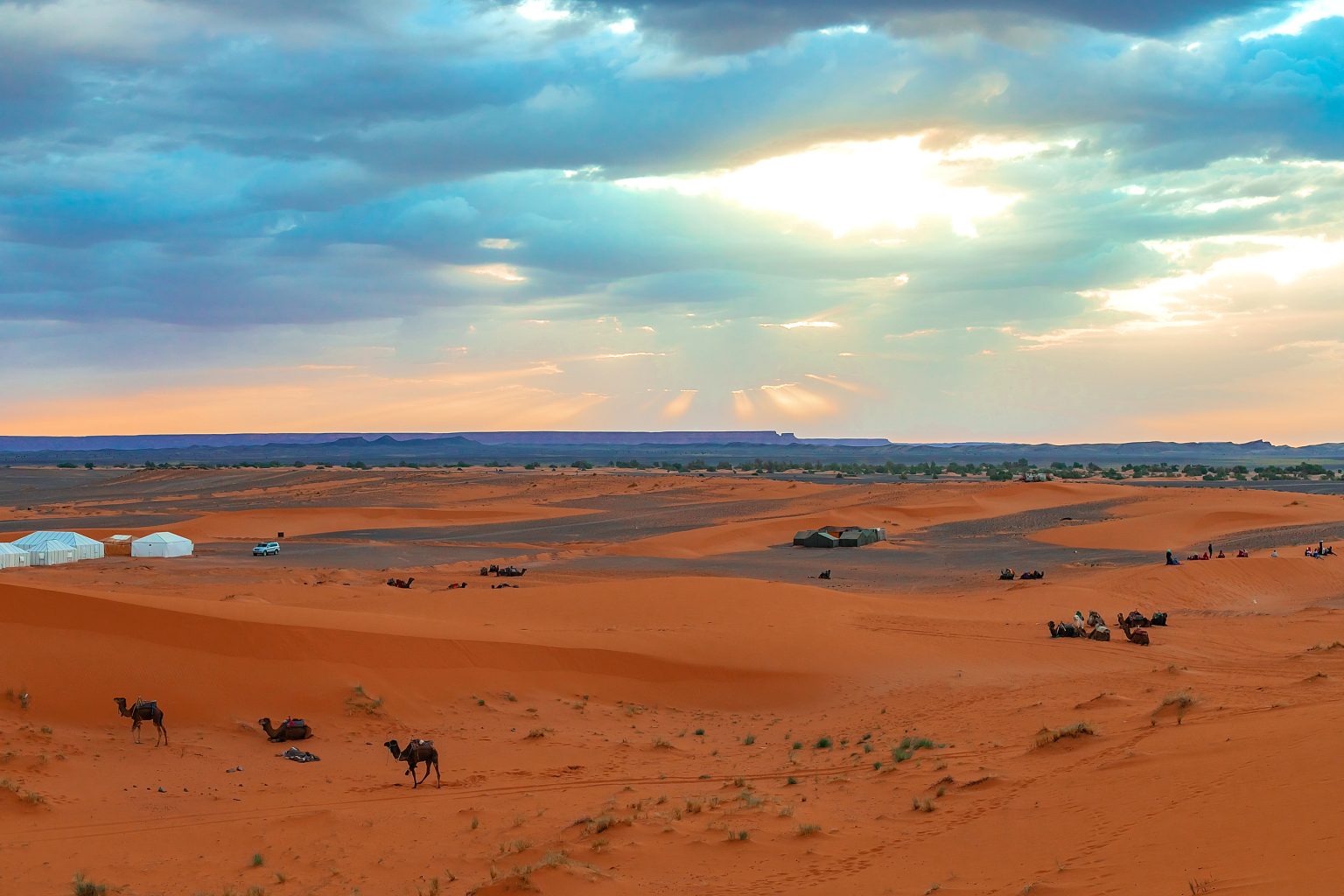
The Sahara Desert in Morocco offers a range of camping experiences, from overnight stays among the towering dunes of Erg Chebbi to remote desert excursions around Erg Chigaga. As the sun sets, the sand changes colour, temperatures begin to fall and the night sky opens above the landscape. Desert camping in Morocco combines outdoor exploration with regional food, music and opportunities to learn about local communities. This guide to Morocco Sahara desert camps explains where to stay, what to expect, when to travel and how to plan a responsible visit.
- Why Camping in the Moroccan Sahara Is Special
- Best Places to Camp in Morocco’s Sahara
- Types of Desert Camps in Morocco
- What to Pack for Desert Camping in Morocco
- Best Time to Camp in the Moroccan Sahara
- Amazigh Heritage and Desert Hospitality
- Sustainable Desert Camping
- Prices and Booking Tips for Moroccan Desert Camps
- Stargazing and Photography Tips
- Safety Tips for a Sahara Camping Trip
- Plan Your Moroccan Sahara Camping Experience
Why Camping in the Moroccan Sahara Is Special
Camping in Morocco’s Sahara brings together striking landscapes and different ways to experience the desert. Some camps focus on comfort, with furnished tents and private bathrooms, while simpler bivouacs offer fewer facilities and a more basic overnight stay.
The experience varies by location, camp and itinerary, but common highlights include:
- Stargazing: Away from bright urban lighting, clear nights can offer excellent views of the stars.
- Sunrise and sunset: The changing light across the dunes creates opportunities for walking and photography.
- Local food and hospitality: Many camps serve Moroccan meals, often including tagine, bread and mint tea.
- Music and cultural activities: Some operators arrange live music or introductions to local traditions, depending on the programme.
- Different accommodation styles: Options range from simple tents with shared facilities to luxury accommodation with private bathrooms.
- Outdoor adventures: Camel rides, guided walks and 4×4 excursions are available through many operators.
A desert camp is a tourism experience, and its facilities and cultural programme should be checked before booking. The traditions of Amazigh communities, Saharan nomadic groups and Gnawa musicians are distinct, so no single camp represents every aspect of Moroccan desert culture.
Best Places to Camp in Morocco’s Sahara
Merzouga and the Erg Chebbi Dunes
Merzouga is one of Morocco’s best-known gateways to the Sahara. The village lies beside Erg Chebbi, a large dune field in south-eastern Morocco where some dunes rise to around 150 metres. The area offers a wide range of accommodation and organised excursions.
Many camps are reached from the edge of the dunes by camel or 4×4, depending on their location and the package booked. The journey, transfer arrangements and time spent travelling across the sand vary between properties.
Activities commonly offered around Merzouga include:
- Camel rides: Travel into the dunes with a local handler, often timed for sunset or sunrise.
- 4×4 excursions: Explore suitable desert tracks and surrounding landscapes with an experienced driver.
- Sandboarding: Try descending suitable dunes where an operator provides equipment and guidance.
- Evening meals: Enjoy Moroccan dishes at the camp, with the menu depending on the accommodation.
- Stargazing: Observe the night sky when conditions are clear and artificial lighting is limited.
- Photography: Capture the changing colours of the dunes during the cooler hours.
Merzouga has accommodation for different budgets, but the label “luxury” does not guarantee a particular standard. Before booking, check whether your tent has a private bathroom, hot water, electricity, heating or air conditioning, and whether transfers and meals are included.
For travellers who want a comfortable first desert experience, Erg Chebbi offers a broad choice of organised camps. Those seeking greater solitude should compare the location of each camp, rather than relying only on photographs or its advertised category.
Erg Chigaga via M’Hamid El Ghizlane
Erg Chigaga, reached from the M’Hamid El Ghizlane area, offers a remote desert setting with extensive dunes and long stretches of open terrain. It is farther from established services than the main camping areas around Merzouga, and reaching many camps involves a substantial off-road journey.
Access usually requires a suitable 4×4 with an experienced driver, or another arrangement organised by the camp. A camel expedition may be available through specialist operators, but multi-day treks and independent access should be arranged in advance.
Experiences may include:
- Guided 4×4 journeys through the desert.
- Camel excursions where offered.
- Overnight stays in simple or luxury tented camps.
- Traditional Moroccan meals and tea.
- Music or cultural activities organised by the host.
- Stargazing away from major towns.
Facilities vary considerably. Some camps use solar power, while others may have limited electricity, charging times or mobile reception. Do not assume that every camp has no signal or electricity, or that all facilities are available throughout the night.
Erg Chigaga is best suited to travellers who want a more remote experience and are comfortable with longer transfers and fewer services. Confirm the route, expected journey time, meals, communication arrangements and emergency procedures before departure.
Zagora and the Draa Valley
Zagora is a useful base for exploring the Draa Valley and the desert landscapes around M’Hamid El Ghizlane. The wider area includes palm groves, settlements, dry plains and smaller dune areas, offering a different experience from the extensive dune field of Erg Chebbi.
A stay around Zagora can work well for travellers with limited time, particularly those following a route through the Draa Valley. However, the town itself is not surrounded by the same type of towering dunes found at Erg Chebbi, and reaching more remote desert areas may require additional transport.
Possible activities include:
- Exploring the Draa Valley’s palm groves and traditional settlements.
- Visiting local markets and learning about regional products.
- Taking a guided camel ride or 4×4 excursion where available.
- Spending a night at a camp or accommodation outside the town.
- Learning about local food and cultural traditions through a host-led experience.
If your main goal is to sleep among large sand dunes, check the precise location of the camp and the journey needed to reach it. A desert-themed stay near Zagora does not necessarily mean the accommodation is deep in the dunes.
Types of Desert Camps in Morocco
Moroccan desert accommodation ranges from basic bivouacs to high-comfort tented properties. Facilities, environmental practices and included activities differ, so compare the details rather than relying on category names alone.
Simple Desert Camps
Simple camps generally provide basic tents, bedding and shared facilities. Meals may include dinner and breakfast, while camel transfers or other activities may be sold separately.
They can suit budget travellers and those who value a straightforward overnight experience. Check bathroom arrangements, access to drinking water, charging facilities and the temperature expected at night.
Comfort Camps
Comfort camps typically provide furnished private tents and a broader set of facilities. Depending on the property, they may offer proper beds, private or shared bathrooms, hot showers and a dining area.
These camps can suit couples, families and small groups who want an outdoor setting without giving up every convenience. Confirm which amenities are available in the specific tent category you book.
Luxury Desert Camps
Luxury camps often provide spacious tents, private bathrooms, upgraded bedding and restaurant-style meals. Some offer private terraces, heating or cooling systems, dedicated transfers and additional services.
The standard varies between properties, and luxury does not automatically mean the camp is isolated from other visitors. Check photographs of the actual accommodation, recent reviews, bathroom facilities and the exact location.
Independent or Nomadic-Style Camping
Independent camping requires more preparation and should only take place where access and overnight stays are permitted. Travellers need to arrange their own equipment, food, water, navigation and safety provisions.
A camp marketed as “nomadic-style” is not necessarily operated by a nomadic community. If cultural authenticity matters to you, ask who runs the experience, who leads the activities and how local people participate.
What to Pack for Desert Camping in Morocco
Desert temperatures can change considerably between daytime and nighttime. Packing for both conditions helps make an overnight stay more comfortable.
Essential Items
- Lightweight clothing: Breathable layers are useful during warm days.
- Warm jacket or fleece: Winter nights can be very cold, especially in open desert areas.
- Scarf or head covering: Useful for sun and wind protection.
- Hat, sunglasses and sunscreen: Important throughout the year.
- Reusable water bottle: Carry enough drinking water for transfers and activities.
- Closed shoes: Suitable for walking over uneven ground and sand.
- Sandals: Convenient around the camp, depending on the facilities.
- Personal medication and a small first-aid kit: Bring what you may need during the journey.
- Lip balm and personal toiletries: Dry air and wind can make these useful.
- Phone charger or power bank: Charging access varies between camps.
Optional Equipment
- Tripod: Useful for night-sky photography.
- Camera or binoculars: Helpful for landscapes and wildlife observation.
- Headlamp or flashlight: Convenient around camp after dark.
- Offline maps: Useful when travelling through areas with limited mobile reception.
A tent and sleeping bag are necessary only if you are arranging independent camping. For a booked camp, confirm whether bedding, towels and toiletries are supplied before packing extra equipment.
Best Time to Camp in the Moroccan Sahara
The most comfortable period for many desert camping trips is generally October to April, when daytime temperatures are often more manageable than during the height of summer. Conditions vary by location and year, and nights can be cold even when the afternoons are warm.
October and November
These months can offer a balance of comfortable daytime conditions and cooler evenings. They are popular for outdoor excursions, so check availability and book ahead for busy dates.
December to February
Winter can be a good time for walking and exploring the dunes during the day, but nights may become very cold. Choose a camp with suitable bedding and ask whether heating or additional blankets are available.
March and April
Spring can be suitable for camping, with warmer daytime temperatures and cooler nights. Conditions vary, so carry sun protection and warm layers.
May and June
Temperatures rise, particularly during the middle of the day. Early starts and late-afternoon activities can be more comfortable, but check the forecast before planning strenuous excursions.
July to September
Summer heat can be intense, especially in exposed areas and away from shaded accommodation. Consider whether the conditions suit your travel plans, and avoid strenuous activity during the hottest hours.
For many visitors, October through April is a useful planning window. The best dates depend on the destination, the type of camp and your tolerance for heat and cold.
Amazigh Heritage and Desert Hospitality
The Sahara region of Morocco is home to diverse communities, including Amazigh communities and groups with long histories of pastoralism, trade and movement across arid landscapes. Their languages, customs, music and daily lives are not identical, and practices differ between places and families.
At some camps, visitors may be offered mint tea, Moroccan meals, regional music or explanations of local life. These activities can provide an introduction to the area, but a tourism programme should not be treated as a complete representation of the region’s cultural heritage.
To make a visit more respectful:
- Greet hosts politely: A greeting such as “Salam Alaikum” is widely understood.
- Ask before taking photographs: This is particularly important when photographing people, performers or private spaces.
- Respect local customs: Follow your host’s guidance on dress, seating and shared spaces.
- Support local businesses: Consider buying crafts or using services provided by local people.
- Ask questions thoughtfully: Give hosts the opportunity to explain their own experiences rather than assuming that one custom applies everywhere.
Gnawa music has its own history and cultural context, distinct from other regional Amazigh and Saharan traditions. If a camp advertises a performance, ask what style of music is included and who is performing.
Sustainable Desert Camping
Desert environments are vulnerable to waste, water shortages and damage caused by vehicles. Responsible choices help protect the landscape and support the communities who live and work in the region.
- Choose camps with clear environmental practices: Ask how the property manages water, energy and waste.
- Reduce single-use plastic: Carry reusable items where practical.
- Take waste back with you: Do not leave rubbish in the dunes or along desert tracks.
- Respect wildlife: Avoid feeding animals or approaching them for photographs.
- Stay on permitted routes: Off-road driving can damage vegetation and fragile surfaces.
- Support local guides and artisans: Choose services that provide meaningful opportunities for local people.
- Use water carefully: Fresh water is a valuable resource in arid areas.
- Respect archaeological and cultural sites: Do not remove objects or enter restricted areas.
Solar panels or the label “eco-camp” do not automatically guarantee sustainable operations. Ask about specific practices when this is important to your choice.
Prices and Booking Tips for Moroccan Desert Camps
Desert camp prices vary according to location, season, accommodation standard, group size and the services included. A simple camp with shared bathrooms can cost considerably less than a premium tent with a private bathroom and dedicated transport.
As a broad planning guide, travellers may encounter approximate prices such as:
- Standard camps: Around €30–€70 per person per night.
- Comfort camps: Around €60–€150 per person per night.
- Luxury camps: Around €150–€350 or more per person per night.
These are indicative estimates rather than guaranteed current rates. Some properties charge per tent instead of per person, and package prices may include meals, camel transfers or 4×4 transport. Remote camps and exclusive bookings can cost more.
Before booking:
- Check what the price includes: Confirm dinner, breakfast, transfers, camel rides, taxes and drinks.
- Verify the camp’s location: Ask how far it is from the village or dune edge and how the transfer works.
- Review bathroom and power facilities: Confirm whether the bathroom is private and whether hot water and electricity are available.
- Check cancellation terms: Weather, transport and itinerary changes can affect desert trips.
- Book through a reliable source: Use the camp’s official website or a reputable tour operator, and verify the reservation details in writing.
- Ask about local employment and environmental practices: Choose a property that can explain its approach clearly.
Prices can change, especially around holidays and high-demand periods. Request a current quote for your travel dates before treating any figure as a booking budget.
Stargazing and Photography Tips
The dunes around Merzouga and remote areas near Erg Chigaga can provide attractive conditions for night-sky photography when the sky is clear and artificial lighting is limited.
For better results:
- Plan around sunset and sunrise: The low angle of the sun reveals texture and shadows across the dunes.
- Check the moon phase: A darker sky around the new moon can make faint stars easier to see.
- Use a tripod: A stable camera helps with longer exposures.
- Choose a wide-angle lens: This can capture both the dunes and the night sky.
- Protect your equipment: Keep cameras and lenses covered when not in use to reduce exposure to sand.
- Keep lighting low: Avoid disturbing other campers or wildlife with bright lights.
- Use a sky-map app: Apps can help identify constellations, especially if downloaded before entering areas with limited reception.
Do not assume that every camp offers complete darkness or an unobstructed horizon. Ask about nearby lighting and the camp’s layout if night photography is a priority.
Safety Tips for a Sahara Camping Trip
Desert travel requires preparation, even when the overnight stay is arranged by a tour operator.
- Use an experienced driver or guide: Remote dunes and off-road routes are not suitable for every vehicle or driver.
- Share your itinerary: Let your accommodation or a trusted contact know your planned route and return time.
- Check travel insurance: Confirm that your policy covers the activities you intend to do, including relevant off-road excursions.
- Stay hydrated: Drink water regularly, even when cooler temperatures make thirst less noticeable.
- Protect electronics from sand: Use sealed bags or protective cases.
- Follow camp instructions: Ask about emergency procedures, night-time movement and local hazards.
- Check weather and road conditions: Wind, heat or other conditions can affect travel plans.
- Avoid unplanned solo excursions: Do not walk far into unfamiliar dunes without a guide, navigation and a suitable safety plan.
If you are travelling to a remote area such as Erg Chigaga, confirm the transfer arrangements and expected journey time before departure.
Plan Your Moroccan Sahara Camping Experience
Camping in Morocco’s Sahara can mean an activity-filled stay among the dunes of Erg Chebbi, a remote excursion around Erg Chigaga or a shorter visit based around Zagora and the Draa Valley. Each area offers a different combination of landscapes, access, accommodation and activities.
Choose your destination according to the time you have available, the level of comfort you prefer and the type of desert experience you want. Confirm current prices and facilities, prepare for changing temperatures and support local businesses where possible.
A well-planned night in the Sahara is not only about the tent or the view. It is also an opportunity to appreciate the region’s landscape and cultural diversity while travelling with care and respect.