
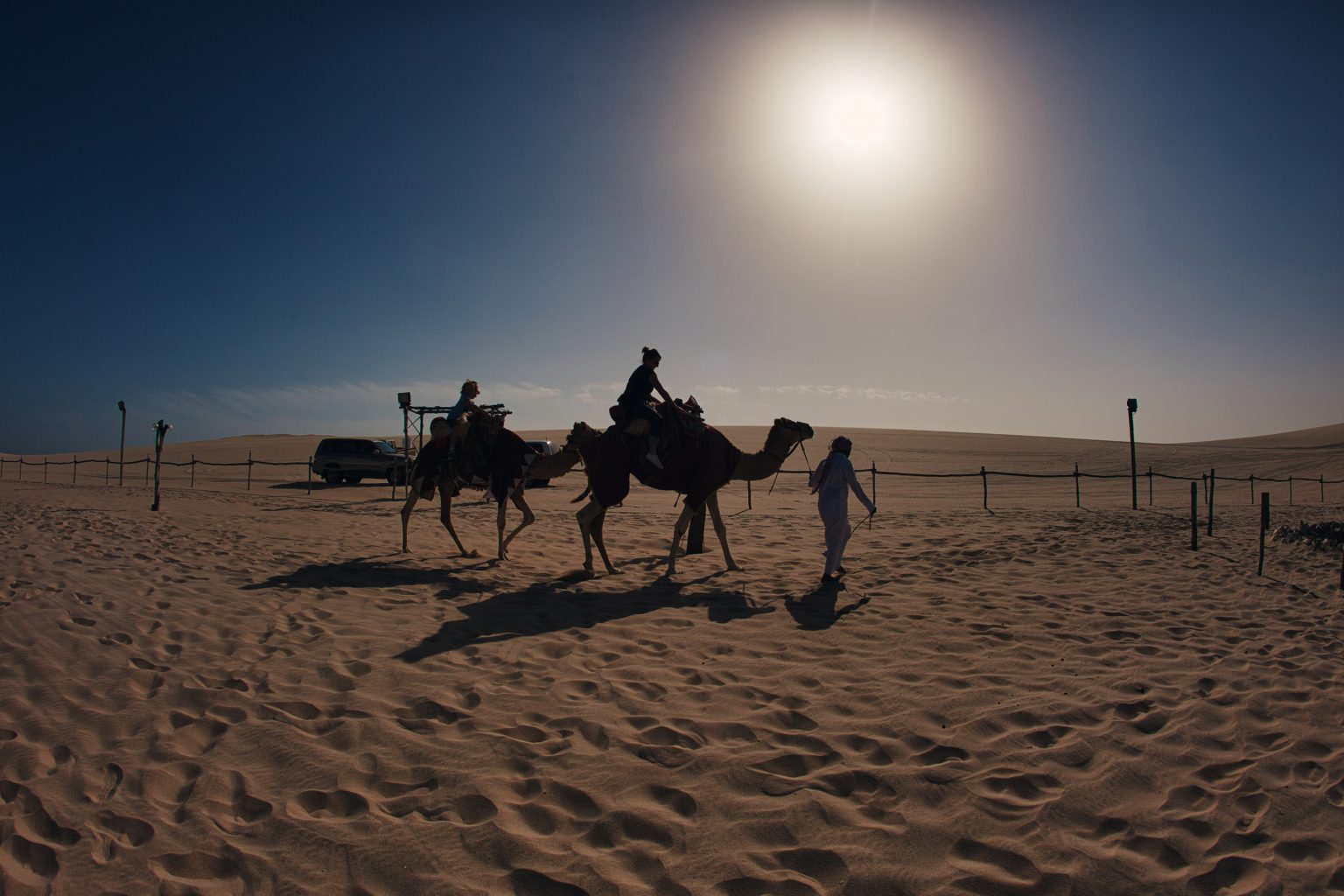
The first light of dawn spreads across the dunes as a camel walks steadily over the sand. The air is cooler, the landscape is quiet, and the changing sunlight reveals subtle shades of gold across the desert. From the camel’s back, the pace feels slower, offering time to notice the terrain and enjoy the open landscape.
- Why Camel Trekking Matters in Qatar
- Best Places for Camel Trekking in Qatar
- Mesaieed and Sealine Desert
- Khor Al Adaid, the Inland Sea
- Al Shahaniya and Qatar’s Camel Racing Heritage
- Zekreet and Western Qatar
- What to Expect During a Camel Ride
- The Cultural Connection Between Camels and Bedouin Heritage
- What to Bring for Camel Trekking in Qatar
- Best Season for Camel Trekking in Qatar
- Responsible and Respectful Camel Trekking
- Planning a Camel Trekking Experience in Qatar
- Experience Qatar’s Desert at a Slower Pace
Camel trekking in Qatar offers a different way to explore the country’s desert environment. Camels have long played an important role in the Arabian Peninsula, helping people travel across arid landscapes and transport goods between settlements. Today, guided camel rides give visitors an opportunity to experience this heritage while discovering Qatar’s dunes and coastal scenery.
Whether you are visiting for a short ride or combining the experience with a desert safari, choosing the right location, season, and operator can make your Qatar desert experience more comfortable and rewarding.
Why Camel Trekking Matters in Qatar
Camels have historically been important to communities across the Arabian Peninsula. Their ability to travel through dry environments made them valuable for transportation, trade, and everyday life. Their place in regional heritage is reflected in traditional poetry, racing, breeding, and cultural events.
For visitors, camel riding in Qatar provides a slower alternative to motorized desert activities. Instead of crossing the dunes in a 4×4 vehicle, riders can experience the landscape at walking pace and observe the patterns of the sand more closely.
Some guided experiences also introduce visitors to local traditions and camel care. Depending on the operator, a ride may include refreshments, cultural explanations, or time for photographs. These additions are not included in every tour, so it is worth checking what the package offers before booking.
Early morning and late afternoon rides are often appealing because the light is softer and temperatures are generally more comfortable than around midday.
Best Places for Camel Trekking in Qatar
Mesaieed and Sealine Desert
Located south of Doha, the Mesaieed and Sealine area is one of Qatar’s best-known destinations for desert activities. Visitors can find camel rides alongside other experiences, including guided 4×4 excursions, sandboarding, and desert camping.
The surrounding dunes provide a classic desert setting for short rides, photographs, and sunset views. Sealine is also a common starting point for guided journeys toward Khor Al Adaid, although camel riding and longer desert excursions may be offered as separate activities.
This area is a practical choice for first-time visitors, families, and travelers who want to combine a camel ride with other desert experiences.
Before booking, confirm the ride’s duration, whether children can participate, and whether the camels are available at the selected time.
Khor Al Adaid, the Inland Sea
Khor Al Adaid, widely known as the Inland Sea, lies in southeastern Qatar, where large sand dunes meet a tidal inlet of the Arabian Gulf. The area is a protected nature reserve and appears on UNESCO’s Tentative List of World Heritage Sites. It is one of the country’s most distinctive landscapes. <Cite refs={[“turn893187search0″,”turn893187search10”]}/>
Visitors often explore the area through guided desert safaris from the Sealine region. Camel rides may be available as part of selected experiences, but the exact activities and locations depend on the operator.
The combination of dunes and water makes the Inland Sea especially attractive to photographers. If camel riding is a priority, ask whether the tour includes an actual ride at Khor Al Adaid rather than only a 4×4 journey to the viewpoint.
Access to the reserve requires suitable off-road transport and an experienced driver. Independent visitors should not assume that an ordinary road leads directly to the shoreline.
Al Shahaniya and Qatar’s Camel Racing Heritage
Al Shahaniya, northwest of Doha, is closely associated with Qatar’s camel racing tradition. It is a useful destination for travelers interested in the role of camels in contemporary Qatari culture, particularly the sport of camel racing.
A visit to the racing area is different from a conventional desert trek. Visitors should check access arrangements, event schedules, and opportunities to observe the camels before traveling.
If you want to ride a camel as well as learn about racing, confirm whether a suitable riding experience is available nearby. Do not assume that observing racing camels automatically includes a guided trek.
Zekreet and Western Qatar
Western Qatar is known for its distinctive rock formations, open landscapes, and desert scenery around Zekreet and Ras Abrouq. These areas offer a different setting from the tall sand dunes of southeastern Qatar.
They are worth considering for a broader desert excursion, particularly if you are interested in photography, natural formations, or cultural attractions. However, camel trekking is not a standard activity at every site in western Qatar.
Ask local operators whether camel rides are offered at an approved location and whether the experience can be combined with a visit to the surrounding landscape. This helps avoid planning an itinerary around an activity that may not be available on the day.
What to Expect During a Camel Ride
Most introductory camel rides are relatively short, making them suitable for travelers who want to try the activity without committing to a long expedition. The actual duration, route, and level of assistance depend on the provider.
A typical experience may include:
- A short introduction to mounting and dismounting safely.
- Instructions from the handler or guide before the camel begins moving.
- A guided ride across a designated area of sand.
- Stops for photographs, depending on the route and tour schedule.
- Optional refreshments or cultural activities when included in the booking.
Mounting and dismounting can feel unfamiliar because a camel rises and kneels in stages. Follow the handler’s instructions, hold the provided support securely, and remain seated until you are told to move.
If you have mobility limitations, back problems, balance concerns, or are traveling with young children, discuss suitability with the operator before booking. Ask about age and weight restrictions, available assistance, and whether a shorter ride is possible.
The Cultural Connection Between Camels and Bedouin Heritage
Camels have traditionally been important to many Bedouin communities across the Arabian Peninsula. They supported travel, transport, and livelihoods in environments where water and other resources could be scarce. Their importance continues through camel breeding, racing, and cultural events in Qatar and neighboring countries.
Some guided experiences introduce visitors to aspects of this heritage, including how camels are handled and cared for. Guides may also explain local customs and the history of desert travel, although the content varies between tours.
Arabic coffee, known as gahwa or kahwa, and dates are widely associated with hospitality in Qatar. Some desert experiences offer them to guests, but refreshments are not guaranteed as part of every camel ride.
Approach cultural activities with curiosity and respect. Listen to your guide, ask before photographing people, and remember that traditions vary between families and communities rather than following one universal set of practices.
What to Bring for Camel Trekking in Qatar
A little preparation can make a camel ride more comfortable, particularly when the activity takes place in an exposed desert environment.
Useful items include:
- Lightweight clothing: Choose breathable fabrics that cover your shoulders and legs comfortably.
- Sun protection: Bring sunscreen, sunglasses, and a hat or scarf.
- Suitable footwear: Closed shoes are useful for walking on sand and around the riding area.
- Drinking water: Carry enough for the activity and any additional time spent outdoors.
- Camera or phone: Protect electronic devices from fine sand and dust.
- Small bag: Keep personal belongings secure without carrying unnecessary weight.
- Power bank: Useful if you plan to spend several hours on a desert excursion.
Avoid bringing loose objects that could fall during the ride. Ask the handler where to store bags and other belongings, and avoid approaching or feeding camels without permission.
Best Season for Camel Trekking in Qatar
The cooler months, generally from November to March, are often the most comfortable period for outdoor desert activities in Qatar. Temperatures vary from day to day, and winter evenings can be considerably cooler than afternoons.
November to March: These months are usually a good choice for camel rides, desert walks, and longer excursions. Morning and late-afternoon departures can provide more comfortable conditions.
April and May: Temperatures rise, so earlier departures may be preferable. Check the forecast and confirm that the operator adjusts its schedule when conditions become too hot.
June to September: Summer heat can make outdoor activities uncomfortable and potentially dangerous, especially around midday. If rides are offered, ask about the timing, shade, water breaks, and the operator’s heat-related safety policy.
October and April can provide transitional conditions, but the weather varies. Rather than relying on a fixed temperature range, check the forecast for your travel dates and follow the operator’s advice.
Responsible and Respectful Camel Trekking
Responsible travel means considering both animal welfare and the surrounding environment. Before booking, ask how the camels are cared for, whether they receive adequate rest and water, and how rides are adjusted during hot weather.
Look for operators that:
- Provide appropriate handling and assistance when mounting and dismounting.
- Avoid working animals during unsafe heat or when they appear unwell.
- Explain the ride clearly and provide suitable equipment where needed.
- Respect protected areas and keep visitors on permitted routes.
- Allow time for breaks rather than rushing the experience.
Visitors also have a role to play. Follow instructions, avoid shouting or sudden movements around the animals, and never pull at a camel’s reins or attempt to feed it without permission. Take all rubbish with you and respect wildlife and other visitors.
A responsible operator should be willing to answer reasonable questions about the animals and the conditions under which the ride takes place.
Planning a Camel Trekking Experience in Qatar
A simple half-day itinerary can combine a camel ride with time to explore the desert around Sealine. Begin with a morning pickup or arrange transport to the meeting point specified by your operator. After arriving, meet the handler, receive the riding instructions, and take a short guided ride if conditions permit.
You can then spend time photographing the dunes or enjoying another activity included in your booking. Some operators offer refreshments or additional desert experiences, while others provide camel riding as a separate, shorter activity.
For travelers interested in the Inland Sea, ask about a combined itinerary that includes a guided 4×4 journey toward Khor Al Adaid. Confirm whether the camel ride takes place at Sealine or another designated location, as the two activities may not occur at the same site.
Before finalizing your plans, check:
- Pickup and return arrangements from Doha.
- The exact location of the camel ride.
- The duration and cost of the activity.
- What is included in the booking.
- Age restrictions and any health or mobility requirements.
- Weather-related cancellation policies.
- Whether food, drinks, or overnight accommodation are included.
This approach helps you build a realistic itinerary without assuming that every desert safari includes the same activities.
Experience Qatar’s Desert at a Slower Pace
Camel trekking offers a quieter way to discover Qatar’s desert landscapes and learn about the historical role of camels in the Arabian Peninsula. Around Sealine and Mesaieed, visitors can arrange short rides among the dunes, while selected excursions may combine camel riding with a journey toward the Inland Sea.
The best experience is one that suits your interests, takes place in appropriate conditions, and treats the animals responsibly. With a suitable guide and realistic expectations, camel trekking in Qatar can add a meaningful cultural and outdoor experience to a visit, offering a different perspective on the country beyond its cities and modern landmarks.