
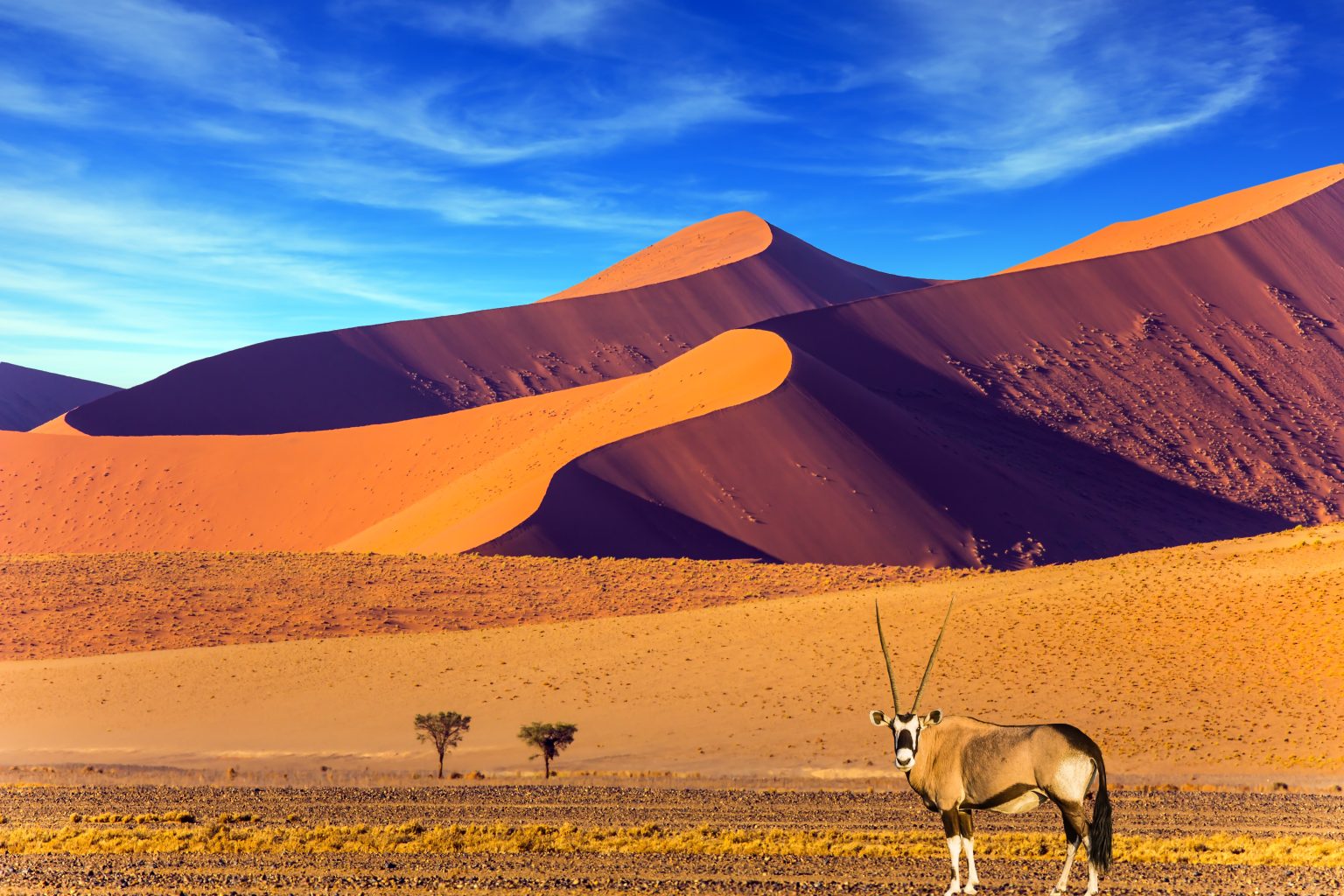
The Namib Desert stretches along the southwestern edge of Africa, beside the Atlantic Ocean. With its vast horizon and extensive fields of red and orange dunes, it is widely considered one of the oldest deserts on Earth, with its formation dating back more than 55 million years.
- Where Is the Namib Desert Located?
- A Landscape of Sand, Fire, and Water
- Climate of the Fog-Born Desert
- Wildlife and Plants of the Namib Desert
- People and History of the Namib
- Top Things to Do in the Namib Desert
- Suggested 2-Day Namib Desert Itinerary
- Where to Stay in the Namib Desert
- Practical Travel Tips
- Hidden Gems of the Namib
- A Desert Shaped by Time and Climate
The Namib is known for the striking contrast between its dry interior, towering dunes, and the cool Atlantic fog that regularly reaches the coast. The name Namib comes from the Nama language and is commonly translated as “vast place,” reflecting the scale of this remarkable desert.
Standing on a dune at sunrise offers wide views across the surrounding landscape, with shifting colors, long shadows, and almost no signs of development in many areas. It is one of the defining experiences of traveling through Namibia.
Where Is the Namib Desert Located?
The Namib Desert runs for more than 2,000 kilometers (1,200 miles) along Namibia’s Atlantic coastline, stretching from the Orange River in the south to southern Angola in the north.
Geographic reference: 24°S, 15°E
Area: approximately 81,000 km² (31,000 sq mi)
It lies between:
- The Atlantic Ocean to the west
- The Great Escarpment and the Kalahari Desert to the east
Main gateways include Swakopmund on the coast, Sesriem and Sossusvlei for access to the major dune areas, and Lüderitz in the south, known for its historic diamond-mining sites and isolated coastal landscapes.
A Landscape of Sand, Fire, and Water
The Namib is defined by strong contrasts between its dry desert interior and the cold waters of the Atlantic.
The Dunes of Sossusvlei
Some of the tallest dunes on Earth rise here, reaching nearly 380 meters (1,250 feet). At sunrise, dunes such as Dune 45 and Big Daddy take on shades of orange and copper as the changing light moves across their slopes.
Deadvlei
Deadvlei is a white clay pan scattered with the dark remains of camel thorn trees, some estimated to be around 900 years old. The trees died after changes in the nearby river system, but the extremely dry conditions slowed their decomposition. The contrast between the white pan, dark trees, and surrounding dunes makes it one of the Namib’s most recognizable landscapes.
The Skeleton Coast
A foggy Atlantic shoreline marked by shipwrecks, whale bones, and seal colonies, the Skeleton Coast is one of Namibia’s most remote coastal regions. Its combination of dunes, rocky shorelines, fog, and ocean has given the area a distinctive appearance.
Namib-Naukluft National Park
One of Africa’s largest protected areas, the park encompasses shifting dunes, dry riverbeds, rugged mountains, and extensive desert plains.
Kuiseb Canyon
A dramatic natural divide between the rocky desert and the dune fields, Kuiseb Canyon was shaped by seasonal water flows over long periods of geological time.
Parts of the Namib have also been used as analogues for Martian landscapes in scientific research because of their extreme dryness, geological formations, and surface conditions.
Climate of the Fog-Born Desert
The Namib Desert climate is among the driest on Earth, yet coastal fog provides an important source of moisture for many plants and animals.
Annual rainfall: 5–100 mm
Daytime temperatures: 25–40°C
Night temperatures: 5–10°C
The cold Benguela Current helps produce dense coastal fog that can move inland and provide moisture to organisms adapted to these conditions. The best time to visit is generally April to October, when temperatures are cooler and conditions are more comfortable for desert activities.
Wildlife and Plants of the Namib Desert
Despite its extreme conditions, the Namib supports a range of highly specialized plants and animals.
Plants
- Welwitschia mirabilis, a distinctive desert plant that can live for over a thousand years
- Nara melons, an important food source for wildlife and some local communities
- Lichens that can obtain moisture from coastal fog
Animals
- Oryx (Gemsbok), well adapted to hot and dry conditions
- Springbok and ostriches roaming the open plains
- Desert-adapted elephants that move along dry riverbeds in search of water and vegetation
- Hyenas, jackals, and foxes that are often more active at night
- Namib geckos, adapted to the desert environment and able to obtain moisture from fog
- Flamingos and brown hyenas found in parts of the wider coastal region
The survival of these species depends on adaptations to extreme heat, limited water, and major changes between day and night conditions.
People and History of the Namib
The Namib has influenced human settlement, movement, trade, and resource use for thousands of years.
Indigenous Cultures
The Nama and Himba peoples possess extensive knowledge of the surrounding environment, reflected in traditional practices, local resources, and ways of adapting to arid conditions.
Kolmanskop Ghost Town
Once a diamond-mining settlement near Lüderitz, Kolmanskop was later abandoned as diamond production declined. Today, sand has entered many of its former buildings, creating one of Namibia’s most distinctive historic sites.
Ancient Rock Art
Sites such as Twyfelfontein, with engravings dating back thousands of years, provide evidence of prehistoric human activity in the region. The rock art includes depictions of animals, human figures, and other symbols.
Top Things to Do in the Namib Desert
- Climb Dune 45 at sunrise for expansive views across the dune field
- Walk through Deadvlei, one of the most photographed landscapes in Namibia
- Explore the Skeleton Coast and its remote coastal scenery
- Take a scenic flight over the dunes and coastline from Swakopmund
- Join a 4×4 safari through Namib-Naukluft National Park
- Try quad biking and sandboarding near Swakopmund
Suggested 2-Day Namib Desert Itinerary
Day One
Morning: Visit Sossusvlei and climb Dune 45
Afternoon: Explore Deadvlei and Sesriem Canyon
Evening: Dinner and stargazing at a desert lodge
Day Two
Morning: Drive through Namib-Naukluft toward Swakopmund
Afternoon: See the flamingos at Walvis Bay and visit Kuiseb Canyon
Evening: Walk along the Atlantic coast at sunset
Where to Stay in the Namib Desert
Luxury: Wolwedans Dune Camp, Sossusvlei Desert Lodge
Mid-range: Namib Desert Lodge, Desert Quiver Camp
Budget: Sesriem Campsite, Swakopmund backpacker lodges
These accommodation options range from remote desert camps and lodges to more affordable stays in and around Swakopmund, giving travelers different ways to experience the region.
Practical Travel Tips
- Best months: April–October
- Fly to Windhoek, then drive or join a guided tour
- Bring sunscreen, sturdy shoes, and protection from wind and dust
- Entry permits are required for national parks
- Mobile connectivity can be limited in remote areas
Hidden Gems of the Namib
- Kolmanskop, the sand-filled ghost town near Lüderitz
- Twyfelfontein, known for its ancient rock engravings
- Sandwich Harbor, where high dunes meet the Atlantic Ocean
- Moon Landscape near Swakopmund, a rugged area shaped by ancient geological processes
A Desert Shaped by Time and Climate
The Namib Desert stands out for its combination of extreme aridity, towering dunes, coastal fog, and diverse desert life. Its landscapes have developed over millions of years, while plants and animals have evolved specialized ways to survive with very little rainfall.
From the dunes of Sossusvlei and the clay pan of Deadvlei to the Skeleton Coast and the historic sites around Lüderitz, the Namib offers a wide range of experiences across one of Africa’s most distinctive desert regions.
For travelers, its appeal lies in the variety of landscapes within a single desert: towering dunes, dry valleys, fog-covered coastlines, wildlife, archaeological sites, and some of the clearest night skies in southern Africa.