
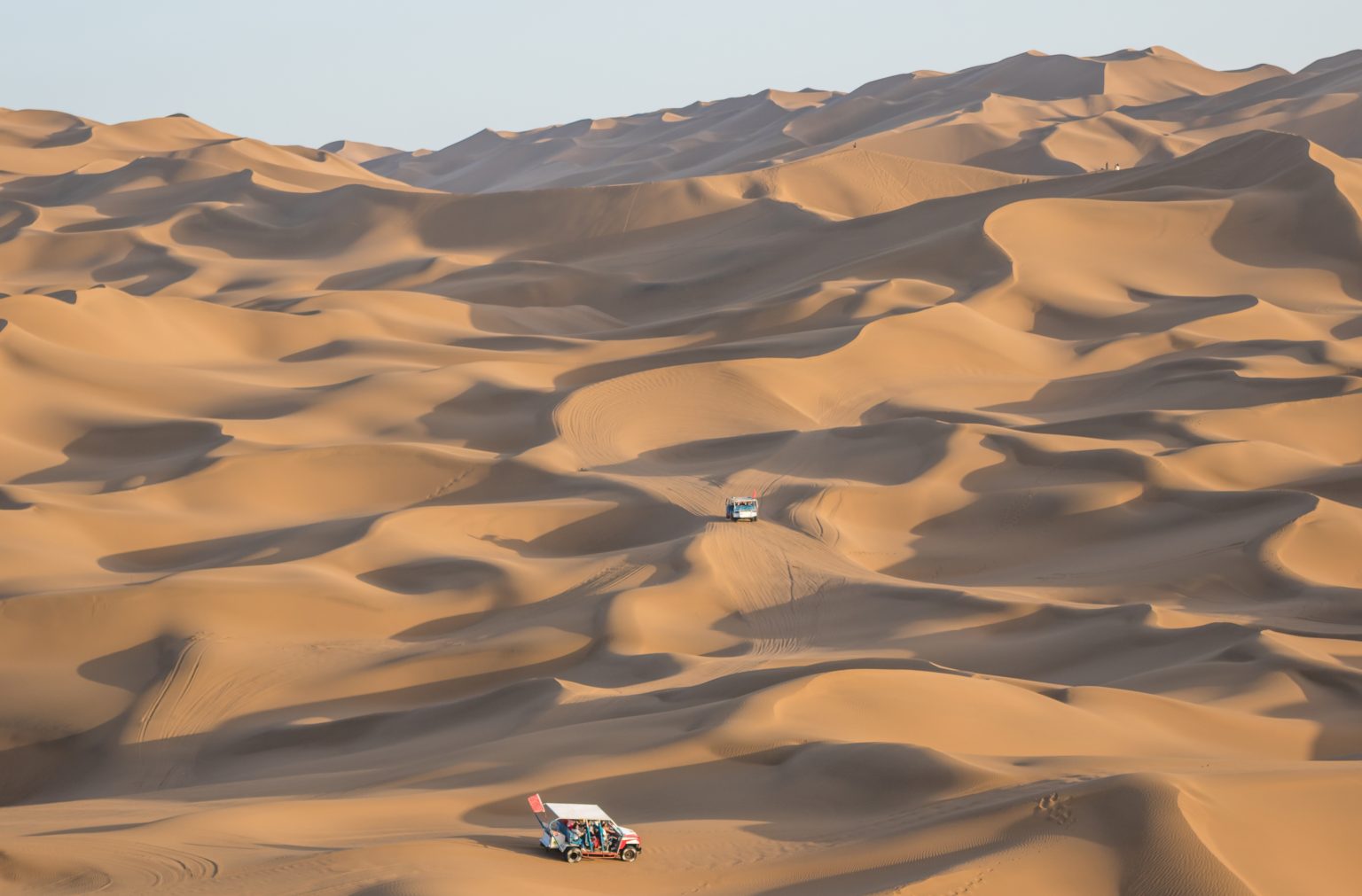
Deep within China’s Xinjiang Uyghur Autonomous Region, the Taklamakan Desert unfolds as one of the most extreme and remote landscapes on Earth. It is the largest desert in China and among the most extensive sand deserts in the world.
- Where Is the Taklamakan Desert Located?
- The Landscape: An Ocean of Shifting Dunes
- Climate: Among the Harshest on Earth
- Flora: Life at the Edge of Extinction
- Fauna: Survivors of the Sand
- The Desert That Shaped the Silk Road
- Cities Buried by Sand
- Crossing the Desert Today: The Taklamakan Desert Highway
- Things to Do in the Taklamakan Region
- Where to Stay
- Suggested 2-Day Taklamakan Itinerary
- Hidden Gems
- Practical Travel Tips
- A Desert Shaped by Time
Its name is believed to come from an ancient Uyghur expression meaning “Once you enter, you will never return.” The phrase reflects the desert’s long history as a difficult and dangerous landscape to cross.
Covering more than 337,000 km², the Taklamakan is a vast sea of rolling dunes, some rising over 300 meters high. Its size, isolation, and history have made it one of the most distinctive deserts in Central Asia.
Where Is the Taklamakan Desert Located?
The Taklamakan Desert lies in the heart of the Tarim Basin, in northwestern China.
Geographic boundaries:
- North: Tian Shan Mountains
- South: Kunlun Mountains
- West: Pamir Mountains
- East: Lop Nur Basin
Coordinates: approximately 38°N, 83°E
Completely encircled by mountains, the Taklamakan is one of the most isolated deserts on the planet. This natural enclosure contributes to its extreme climate and limited access.
Historically, travelers avoided its interior. Instead, the Silk Road curved around its edges, connecting settlements through oasis towns rather than crossing the desert’s central areas.
The Landscape: An Ocean of Shifting Dunes
More than 85–90% of the Taklamakan consists of mobile sand dunes, making it one of the world’s largest continuous sand seas.
Key features include:
- Vast barchan dunes shaped like crescent moons
- Long linear dune ridges stretching for kilometers
- Wind-carved corridors that shift constantly
- Seasonal rivers such as the Hotan, Yarkand, and Aksu, which vanish into sand before reaching the basin’s center
The desert’s colors shift with light and season, from pale gold to deep amber. At night, temperatures drop sharply, and the landscape becomes remarkably quiet.
Climate: Among the Harshest on Earth
The Taklamakan endures an extreme continental desert climate.
- Annual rainfall: less than 20 mm
- Summer temperatures: up to 45–50°C
- Winter temperatures: down to −20°C
- Sandstorms: frequent, powerful, and unpredictable
These conditions make the Taklamakan one of the most challenging desert environments to travel through.
Best time to visit: April to October
Winter travel is possible but extremely demanding.
Flora: Life at the Edge of Extinction
Vegetation is scarce and survives mainly along desert margins and river corridors.
Notable plant species:
- Populus euphratica (Euphrates poplar), twisted and ancient, thriving along dry riverbeds
- Tamarisk shrubs, stabilizing sand and tolerating high salinity
- Halophytes, adapted to salt-heavy soils
These plants help stabilize the desert margins and provide habitat for wildlife around river corridors and oasis areas.
Fauna: Survivors of the Sand
Despite the harshness, the Taklamakan shelters rare and resilient wildlife.
Key species include:
- Wild Bactrian camels, among the rarest mammals on Earth
- Jerboas and desert rodents
- Tibetan sand foxes
- Heat-adapted reptiles
- Golden eagles and desert raptors
Most animals are nocturnal, avoiding the brutal daytime heat.
The Desert That Shaped the Silk Road
The Taklamakan was never crossed lightly. Instead, it redirected travel and trade across Central Asia.
Oasis Cities Along the Desert’s Edge
Thriving centers emerged along its perimeter:
- Kashgar
- Khotan
- Yarkand
- Aksu
These oases became hubs of:
- Silk, jade, and spice trade
- Buddhism and later Islam
- Art, scholarship, and cultural exchange
Caravans followed the northern and southern Silk Road routes, guided by stars, wells, and inherited knowledge.
Cities Buried by Sand
Within the Taklamakan lie archaeological sites that were preserved by the region’s dry conditions.
Famous buried sites include:
- Loulan, once a powerful kingdom near Lop Nur
- Niya, a Silk Road settlement preserved beneath the desert sands
- Dandan Oilik, a Buddhist center later covered by sand
Artifacts discovered include:
- Manuscripts
- Textiles
- Coins
- Wooden legal documents
The dry desert environment helped preserve materials that would have deteriorated much faster in wetter conditions.
Crossing the Desert Today: The Taklamakan Desert Highway
Modern engineering finally created a route through the desert’s interior.
The Taklamakan Desert Highway:
- Length: 552 km
- Route: Luntai to Hotan
- Innovation: Vegetation belts irrigated by groundwater to stabilize sand
It stands as one of the world’s most ambitious desert roads.
Things to Do in the Taklamakan Region
- Drive the Taklamakan Desert Highway
- Explore Kashgar Old City and its famous Sunday Bazaar
- Visit Hotan, historic center of jade trade
- Join guided expeditions to Niya and Loulan ruins
- Stargaze under some of Asia’s darkest skies
Where to Stay
- Hotels and guesthouses in Kashgar
- Oasis lodges in Hotan
- Expedition camps for guided desert journeys
Luxury is limited, but travelers can still find comfortable accommodation in the region’s main oasis cities.
Suggested 2-Day Taklamakan Itinerary
Day 1
- Morning: Explore Kashgar Old City
- Afternoon: Travel along the desert’s edge toward Yarkand
- Evening: Overnight in Hotan oasis lodge
Day 2
- Morning: Enter the Taklamakan Desert Highway
- Afternoon: Stop at observation points inside the sand sea
- Evening: Return to Hotan or continue guided expedition
Hidden Gems
- Niya archaeological site, half-buried and rarely visited
- Lop Nur Basin, a vanished lakebed
- Remote Populus euphratica forests
- Night skies with minimal artificial light
Practical Travel Tips
- Travel with experienced guides
- Carry ample water and supplies
- Expect limited or no mobile coverage
- Permits may be required
- Respect Uyghur culture and customs
A Desert Shaped by Time
The Taklamakan Desert has played an important role in the history of Central Asia. Its shifting dunes covered settlements, while its harsh conditions influenced the routes used by traders and travelers for centuries.
Today, the desert remains a remote and demanding environment, but the roads, archaeological sites, oasis towns, and surrounding landscapes make the region accessible to travelers with careful planning.
For those who visit, the Taklamakan offers a rare combination of desert scenery, Silk Road history, archaeology, and Central Asian culture.