
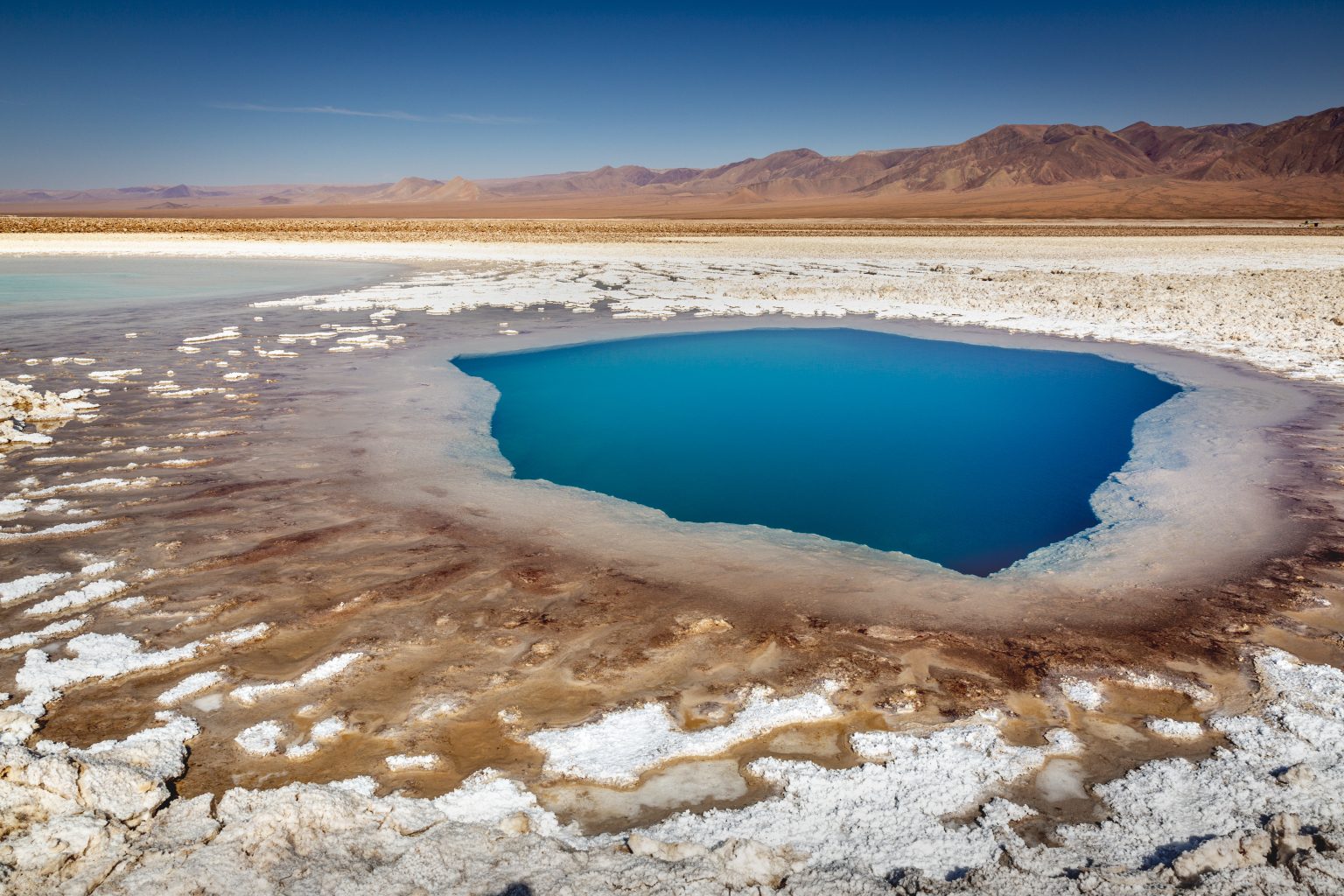
Under the high sun of northern Chile, where the air grows thin and the land turns blindingly white, lies a vast salt world shaped by evaporation and time.
The Salar de Atacama, Chile’s largest salt flat, is not a lake of water but a shimmering desert of salt, minerals, and sky.
- Where Is Salar de Atacama Located?
- How the Salar de Atacama Was Formed
- Best Time to Visit Salar de Atacama
- How to Get to Salar de Atacama
- Top Things to Do in Salar de Atacama
- 1. Flamingos at Laguna Chaxa
- 2. Lagunas Miscanti and Miñiques
- 3. Toconao Village
- 4. Tebinquinche and Cejar Lagoons
- 5. Sunset Over the Salt Flat
- Suggested 2-Day Salar de Atacama Itinerary
- Where to Stay Near Salar de Atacama
- Cultural and Environmental Importance
- Practical Travel Tips
- Hidden Gems Near Salar de Atacama
- The White Heart of the Atacama
Framed by Andean volcanoes and dotted with lagoons filled with flamingos, it feels both fragile and eternal.
This is a place where color emerges from emptiness, and silence carries weight.
The Salar de Atacama is not merely scenic.
It is one of South America’s most powerful expressions of nature’s balance between harshness and life.
Where Is Salar de Atacama Located?
The Salar de Atacama lies in the heart of the Atacama Desert, within Chile’s Antofagasta Region.
- Distance from San Pedro de Atacama: 55 km south
- Coordinates: 23°S, 68°W
- Elevation: 2,305 meters (7,562 ft)
Covering approximately 3,000 km², it is:
- The largest salt flat in Chile
- The third largest in the world, after Salar de Uyuni (Bolivia) and Salar de Arizaro (Argentina)
Despite its size, the Salar feels intimate, surrounded by volcanoes, lagoons, and high desert silence.
How the Salar de Atacama Was Formed
Millions of years ago, meltwater and rain from the Andes flowed into a closed basin with no outlet to the sea.
As the water evaporated under extreme desert conditions, thick layers of salt, lithium, and potassium were left behind.
Over time, this process created:
- A hard white salt crust
- Subsurface lithium-rich brine, among the largest reserves on Earth
Today, the Salar is both a geological archive and a living ecosystem, proving that even the driest places can sustain life.
Best Time to Visit Salar de Atacama
The Salar can be visited year-round, but each season offers a different mood.
- April to October (dry season): 10–25°C, clear skies, ideal for photography and flamingo viewing
- January to March (summer): 15–30°C, occasional rain, brighter colors, fewer visitors
Sunset is the highlight of any visit.
As the light softens, the salt turns gold, the mountains blush purple, and the sky feels impossibly wide.
How to Get to Salar de Atacama
From San Pedro de Atacama:
- Driving time: about 1 hour
- Route: paved roads via Route 23 toward Toconao
Most visitors join half-day or full-day tours, often combined with nearby lagoons and villages for a complete Altiplano experience.
Top Things to Do in Salar de Atacama
1. Flamingos at Laguna Chaxa
Located on the northern edge of the salt flat, Laguna Chaxa is part of the Los Flamencos National Reserve.
Here, three species of flamingos coexist:
- Chilean flamingo
- Andean flamingo
- James’s flamingo
Their pink silhouettes against white salt and blue sky create one of the Atacama’s most iconic scenes.
2. Lagunas Miscanti and Miñiques
Rising above 4,000 meters, these deep-blue lagoons sit beneath volcanic peaks and golden grasslands.
Sacred to the Lickan Antay (Atacameño) people, they offer a sense of stillness and scale that feels otherworldly.
3. Toconao Village
Just north of the Salar, Toconao is a traditional oasis village built from white volcanic stone.
Highlights include:
- An 18th-century church and bell tower
- Artisan crafts made from desert materials
- A quiet rhythm shaped by water, shade, and time
It shows how life endures at the desert’s edge.
4. Tebinquinche and Cejar Lagoons
These hypersaline lagoons allow effortless floating, similar to the Dead Sea.
- Laguna Cejar: turquoise water, ideal for floating
- Tebinquinche: famous for mirror-like reflections at sunset
Swimming here is brief but unforgettable.
5. Sunset Over the Salt Flat
As evening arrives, flamingos glide silently across the lagoons.
The Andes darken, the wind slows, and the desert exhales.
It is a moment that resists description, where color, silence, and space align.
Suggested 2-Day Salar de Atacama Itinerary
Day 1: Salt and Life
- Morning: Visit Toconao village and artisan markets
- Afternoon: Explore Laguna Chaxa and flamingo habitats
- Evening: Sunset at Tebinquinche Lagoon
Day 2: Altitude and Color
- Morning: Drive to Lagunas Miscanti and Miñiques
- Afternoon: Float in Laguna Cejar
- Evening: Return to San Pedro for stargazing
Where to Stay Near Salar de Atacama
In San Pedro de Atacama:
- Explora Atacama: luxury and expert-guided excursions
- Hotel Cumbres: modern desert design with spa
- Lodge Altiplánico: eco-friendly and comfortable
- Hostal Katarpe: locally owned and budget-friendly
Most accommodations offer direct tours to the Salar and surrounding lagoons.
Cultural and Environmental Importance
The Salar de Atacama is not only scenic but ecologically sensitive.
It supports:
- Thousands of flamingos
- Andean foxes
- Microorganisms adapted to extreme salinity
For the Lickan Antay people, the Salar is sacred, a place where Pachamama speaks through wind, salt, and reflection.
Scientific research here also informs studies of climate change and even Mars-like environments.
Practical Travel Tips
- Visit early morning or late afternoon for best light
- Altitude ranges from 2,300–4,000 m → hydrate well
- Bring warm layers, sunscreen, sunglasses, and water
- Cash is required for lagoon entrance fees
- Never feed wildlife or walk on restricted salt areas
- Drones are prohibited near flamingo nesting zones
Hidden Gems Near Salar de Atacama
- Socaire Village: ancient terraces and traditions
- Laguna Lejía: high-altitude turquoise lagoon
- Quebrada de Jerez: green canyon with fruit trees
- Cordillera de la Sal: dramatic sunrise viewpoints
- Baltinache Lagoons: lesser-known salt pools for floating
The White Heart of the Atacama
The Salar de Atacama may look empty at first, but it supports a surprising variety of life. Salt, wind, lagoons, and birdlife all form part of this unique landscape.
What makes the Salar special is the contrast between its harsh conditions and the life that has adapted to them. Standing on the white salt crust with the Andes on the horizon gives you a clear sense of just how vast and remote this part of the Atacama Desert really is.
For visitors, the Salar is a place to experience the landscape at its own pace, from flamingo-filled lagoons to wide-open views and dramatic mountain light.