
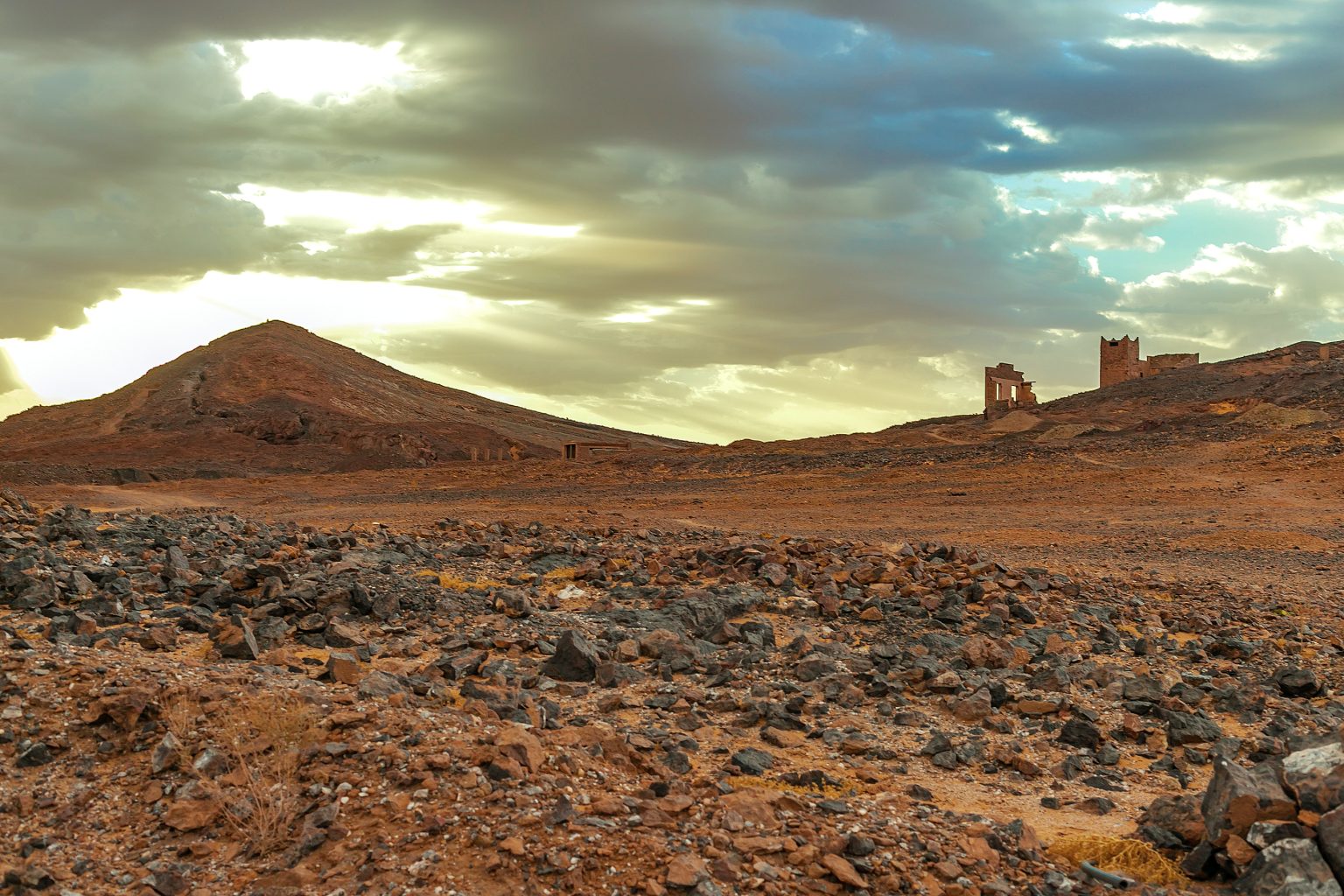
In southern Morocco, between Zagora and M’Hamid El Ghizlane, the Hamada du Drâa offers a very different view of the Sahara. Instead of vast fields of sand, this region is dominated by rocky plains, gravel, dry valleys, plateaus, and scattered desert vegetation.
- Where Is the Hamada du Drâa Located?
- The Terrain of the Hamada du Drâa: Rock, Space, and Stillness
- Climate: The Sahara at Its Most Extreme
- Life on the Stone Plateau
- Nomadic Heritage: A Culture of Endurance
- Things to Do in the Hamada du Drâa
- 1. 4×4 Desert Exploration
- 2. Visit Nomadic Families
- 3. Fossil and Mineral Discovery
- 4. Stargazing and Sunset Watching
- 5. Journey Toward Erg Chigaga
- Suggested 2-Day Hamada du Drâa Itinerary
- Where to Stay Near the Hamada du Drâa
- Practical Travel Tips
- Hidden Places of the Hamada du Drâa
- A Different Side of Morocco’s Sahara
The landscape forms part of the wider Sahara and has long been crossed by nomadic communities and desert travelers. Today, it offers a chance to explore a less familiar side of southern Morocco, with 4×4 routes, fossil sites, traditional desert communities, clear night skies, and access toward Erg Chigaga.
Where Is the Hamada du Drâa Located?
The Hamada du Drâa lies in southern Morocco, between the fertile Draa Valley and the towering dunes of Erg Chigaga.
- Coordinates: 29.8°N, 5.9°W
- Elevation: 450–600 meters (1,500–2,000 ft)
Key distances:
- About 100 km north of Zagora
- Around 40 km from M’Hamid El Ghizlane
- Southwest of the Draa Valley
- Northeast of the Erg Chigaga dunes
Covering more than 30,000 square kilometers, the Hamada forms part of the wider Sahara that extends across southern Morocco and into Algeria.
This is a stone desert, not a landscape dominated by sand dunes.
The Terrain of the Hamada du Drâa: Rock, Space, and Stillness
Among Morocco’s desert landscapes, the Hamada du Drâa is known for its broad rocky plains and rugged terrain.
Instead of large dune fields, the landscape includes:
- Vast areas of rock and gravel
- Eroded mesas and rocky plateaus
- Dry wadis shaped by occasional water flow
- Scattered acacia trees adapted to the arid conditions
Under the strong desert sun, the ground can take on shades of charcoal, grey, brown, and bronze. The open terrain also creates long views across the plateau, with few natural features interrupting the horizon.
Climate: The Sahara at Its Most Extreme
The Hamada du Drâa has an extremely dry desert climate, with very hot summers and much cooler winter nights.
- Annual rainfall: less than 50 mm
- Summer temperatures: 47–50°C
- Winter nights: 5–10°C
The best time to visit is generally November to March, when daytime conditions are more manageable.
The air is very dry, winds can strengthen quickly, and temperatures can fall considerably after sunset. Visitors should be prepared for significant temperature changes between day and night.
Life on the Stone Plateau
Despite the harsh conditions, plants and animals have adapted to the limited water and extreme temperatures of the Hamada.
Desert Plants
- Acacia trees providing occasional shade
- Tamarisk shrubs with extensive root systems
- Lichens and other hardy plants growing in sheltered rock crevices
Desert Wildlife
- Camels, well adapted to long journeys across arid terrain
- Jerboas and fennec foxes, mainly active at night
- Lizards and snakes adapted to the rocky environment
- Ravens and other desert birds that can be seen above the plateau
Most wildlife is easier to spot during the cooler parts of the day or after sunset.
Nomadic Heritage: A Culture of Endurance
For centuries, Amazigh (Berber) and Arab nomads have travelled across the Hamada du Drâa, using routes that connected southern Morocco with areas farther into the Sahara.
These routes once carried:
- Gold and salt
- Pilgrims and long-distance caravans
- Goods and stories between Timbuktu and Marrakech
Today, some nomadic families still move through parts of the region, depending on seasonal conditions and access to water.
Hospitality remains an important part of desert culture. Sharing mint tea with a local family can provide visitors with a valuable opportunity to learn about life in one of Morocco’s most remote environments.
Things to Do in the Hamada du Drâa
1. 4×4 Desert Exploration
Cross rocky plains, fossil areas, dry valleys, and other remote landscapes by off-road vehicle from Zagora or M’Hamid.
A 4×4 is particularly useful for reaching areas that are difficult to access by conventional vehicles.
2. Visit Nomadic Families
Meet nomadic families, share tea, hear traditional songs, and learn about a way of life adapted to movement, limited water, and long distances.
Visits should always be arranged through a local guide and carried out with respect for privacy and daily routines.
3. Fossil and Mineral Discovery
Fossils found in parts of the region provide evidence of ancient marine environments and the geological changes that shaped the area.
Local guides can help visitors identify fossil-bearing areas and explain the geological history of the surrounding landscape.
4. Stargazing and Sunset Watching
With very little artificial light in remote areas, the Hamada du Drâa can offer excellent conditions for stargazing.
At sunset, the rocky landscape changes color as the light becomes softer, making the wide plateau particularly attractive for photography.
5. Journey Toward Erg Chigaga
Many travelers cross parts of the Hamada on their way to Erg Chigaga, combining rocky desert landscapes with the large sand dunes farther west.
This route offers a useful contrast between Morocco’s stone and sandy desert environments.
Suggested 2-Day Hamada du Drâa Itinerary
Day 1 – Exploring the Stone Desert
Morning: Depart from Zagora or M’Hamid by 4×4
Afternoon: Cross rocky plains and fossil zones
Evening: Camp in a remote desert area and enjoy tea under the stars
Day 2 – Desert Routes and Erg Chigaga
Morning: Explore dry wadis and former caravan routes
Afternoon: Continue toward Erg Chigaga or return to M’Hamid
Evening: Return to your camp or continue to your next destination
Where to Stay Near the Hamada du Drâa
Near M’Hamid
- SaharaSky Camp
- Erg Lihoudi Camp
In Zagora
- Sirocco Kasbah
- Lamane Riad
Wild Camping
Wild camping is best suited to experienced travelers with appropriate equipment and local guidance. Remote areas offer few services, so preparation is essential.
Practical Travel Tips
- Best season: November to March
- Vehicle: 4×4 recommended for remote routes
- A local guide is strongly recommended
- Carry at least 5 liters of water per person per day
- Bring sunscreen, a hat, scarf, and sunglasses
- Respect nomadic camps and private wells
- Avoid traveling into remote areas without reliable navigation and communication equipment
Hidden Places of the Hamada du Drâa
- Jebel Bani Mountains, known for their rugged ridges and geological formations
- Fossil fields containing evidence of ancient marine environments
- Lake Iriki and the Maider Plains, which can change considerably after periods of rainfall
- Traditional wells used by nomadic communities and travelers across the region
A Different Side of Morocco’s Sahara
The Hamada du Drâa shows that the Moroccan Sahara is far more varied than its famous sand dunes suggest. Its rocky plains, fossil areas, dry valleys, wildlife, and nomadic routes create a landscape with a very different character from the dune fields around Erg Chigaga.
For travelers based in Zagora or M’Hamid El Ghizlane, the Hamada can be part of a wider desert journey that combines geological sites, 4×4 exploration, local culture, stargazing, and the dunes of Erg Chigaga.
Rather than being simply a route between destinations, the Hamada du Drâa is a destination in its own right, offering a closer look at the rocky landscapes and desert environments that make southern Morocco so diverse.