
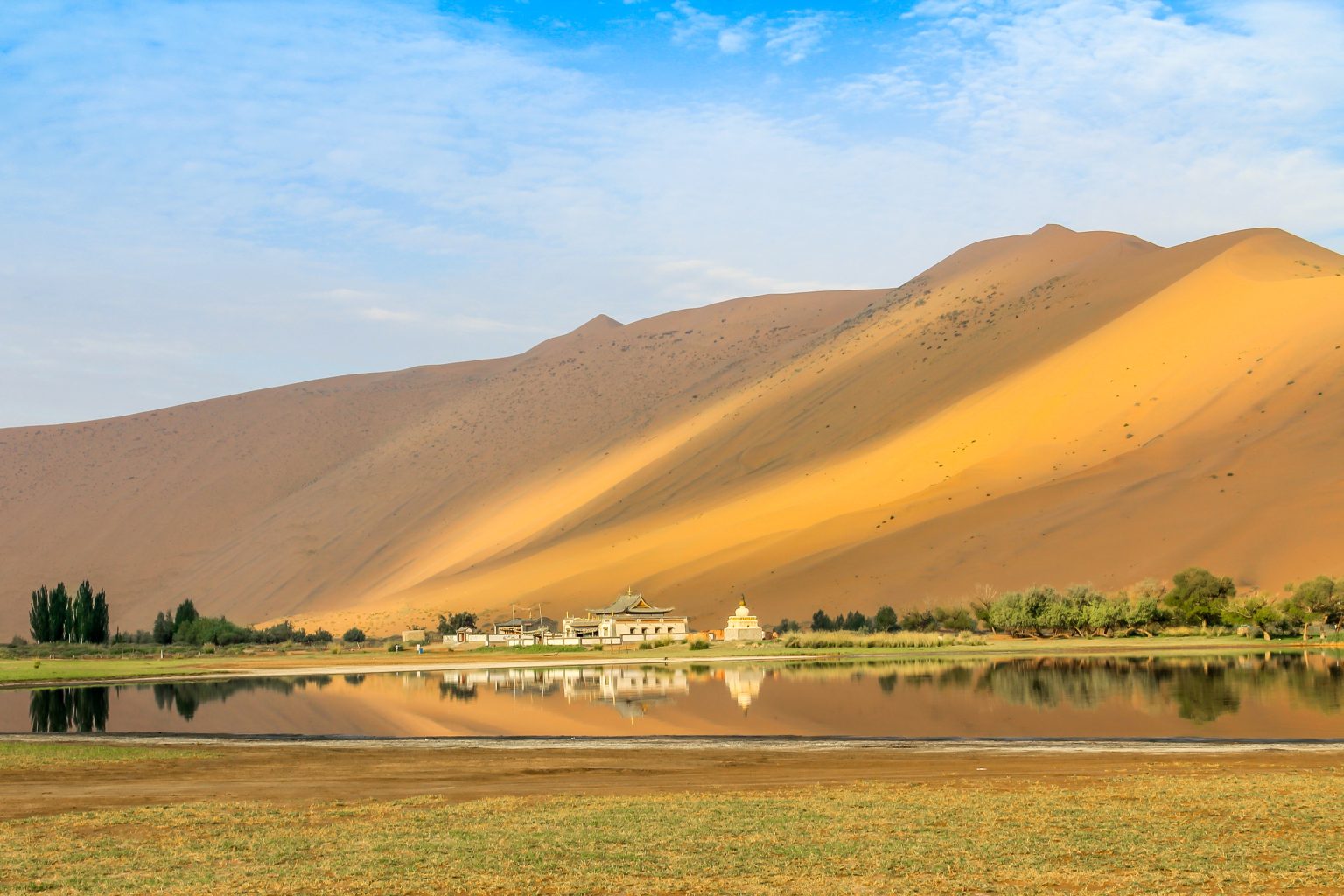
The Badain Jaran Desert is one of the most distinctive desert landscapes in China. Located deep within Inner Mongolia, it combines enormous sand dunes with more than a hundred lakes, creating an environment that differs significantly from most major sand deserts.
- Where Is the Badain Jaran Desert Located?
- The Landscape of the Badain Jaran Desert
- Climate and Best Time to Visit Badain Jaran
- Plant Life Between Sand and Water
- Wildlife of the Badain Jaran Desert
- Cultural and Spiritual Significance of Badain Jaran
- The Enduring Mystery of the Desert Lakes
- Things to Do in the Badain Jaran Desert
- Where to Stay
- Two-Day Badain Jaran Desert Itinerary
- Practical Travel Tips
- Exploring China’s Giant Dunes and Desert Lakes
Covering approximately 49,000 square kilometers (19,000 square miles), Badain Jaran is one of China’s largest deserts. Its most remarkable features are its exceptionally high, relatively stable dunes and the permanent and seasonal lakes found between them.
The desert’s Mongolian name is often translated as “the mysterious lakes,” reflecting the unusual presence of water within one of the driest regions of northern China. The origin and long-term maintenance of many of these lakes remain important subjects of scientific research.
Where Is the Badain Jaran Desert Located?
The Badain Jaran Desert lies in northern China, within the Inner Mongolia Autonomous Region, mainly in Alxa Right Banner.
Geographically, the desert is associated with several major regions:
- Gobi Altai Mountains to the north
- Hexi Corridor and Tengger Desert to the south
- Ejina Basin to the west
- Alxa Plateau to the east
Its approximate coordinates are 39°N, 102°E.
Access to the desert is generally organized from nearby towns and cities such as Bayan Hot, Zhangye, and Jinchang. Because much of the desert is remote and road infrastructure is limited, visitors normally explore it with experienced local guides and 4WD vehicles.
The Landscape of the Badain Jaran Desert
The Badain Jaran landscape is dominated by large linear dunes, dry valleys, salt flats, and lakes. The scale of the dunes is particularly unusual, with some rising hundreds of meters above the surrounding desert floor.
Some of the World’s Highest Stationary Sand Dunes
Badain Jaran contains some of the tallest stationary sand dunes on Earth, with major dunes reaching approximately 450 to 500 meters (1,480–1,640 feet).
These large dunes remain relatively stable despite strong regional winds. Their unusual size and stability have attracted considerable scientific interest.
Under certain conditions, sand moving down steep dune faces can generate low-frequency sounds commonly described as singing sands or booming sands. The phenomenon depends on factors such as grain size, moisture, and the structure of the dune surface.
Hidden Lakes Among the Dunes
More than 140 permanent and seasonal lakes are scattered among the dunes. Their water chemistry varies considerably, with some lakes being relatively fresh while others are saline or alkaline.
Depending on mineral concentration, algae, sediment, and lighting conditions, the lakes can appear blue, green, or other shades.
Their existence is one of Badain Jaran’s most important scientific questions. Current research generally points toward groundwater systems as a major source of the lakes, although the precise recharge mechanisms and long-term water balance continue to be studied.
Climate and Best Time to Visit Badain Jaran
Badain Jaran has a harsh continental desert climate, with very low precipitation and large temperature differences between seasons.
- Annual precipitation: approximately 40–60 mm
- Summer temperatures: can reach around 38–40°C
- Winter temperatures: can fall below -20°C
- Best travel period: generally May to October
The warmer months are more suitable for desert travel, although summer heat can still be intense. Visitors should check local weather and access conditions before entering the desert.
Plant Life Between Sand and Water
Vegetation is concentrated around areas where water or groundwater is available, particularly near lake margins, seasonal channels, and the desert’s outer areas.
Common vegetation includes:
- Reeds and grasses around suitable lake shores
- Tamarisk, including salt-tolerant species adapted to arid conditions
- Poplar trees in areas where groundwater is accessible
- Other drought-resistant plants around the desert margins
These plants help stabilize soil and sand while providing food and shelter for desert wildlife.
Wildlife of the Badain Jaran Desert
The combination of dunes and water sources allows Badain Jaran to support a wider range of wildlife than many extremely dry sand deserts.
Species reported in the wider region include:
- Bactrian camels
- Desert foxes
- Hares
- Various desert-adapted mammals and reptiles
- Migratory birds using the lakes as resting and feeding areas
The lakes are particularly important for birds moving through the wider Inner Asian region. Wildlife sightings are highly dependent on season, location, and recent environmental conditions.
Cultural and Spiritual Significance of Badain Jaran
The desert has longstanding connections with Mongolian communities living around its margins.
Traditional pastoralism developed around the limited water and grazing resources available in the region. Herders have historically moved livestock between suitable areas according to seasonal conditions.
Traditional gers, or yurts, remain an important part of Mongolian cultural heritage and can be encountered in communities and tourism settings around the desert.
The Badain Jaran Temple, built in the 19th century, adds a cultural and religious dimension to the desert. Located in a remote setting among dunes and lakes, the temple is one of the area’s notable human landmarks.
The Enduring Mystery of the Desert Lakes
The lakes of Badain Jaran continue to attract scientific attention because they remain present despite the desert’s extremely low rainfall.
Several explanations have been investigated, including:
- Groundwater recharge associated with distant mountain systems
- Water stored in deeper geological formations
- Ancient groundwater reserves
- Local environmental conditions that reduce evaporation in some areas
Research continues to examine how groundwater moves beneath the desert and how much water enters and leaves the lake system over time.
The combination of very large dunes and persistent lakes makes Badain Jaran an important natural environment for studying desert hydrology and dune systems.
Things to Do in the Badain Jaran Desert
Visitors can experience the desert through a range of activities:
- Climb the large dunes for views across the surrounding lakes
- Look for the singing sands phenomenon under suitable conditions
- Visit the Badain Jaran Temple
- Explore remote areas by 4WD
- Photograph the lakes, dunes, and changing desert light
- Experience desert camping
- Stargaze away from major urban centers
Most excursions require organized transport because the interior of the desert has limited roads, services, and communication coverage.
Where to Stay
Accommodation is concentrated around the desert’s access points and organized expedition routes.
Options may include:
- Guided desert camps
- Eco-lodges near the desert margins
- Traditional Mongolian ger camps
- Basic accommodation in nearby towns
Facilities become increasingly limited inside the desert, so travelers should confirm arrangements, food, water, and transport before departure.
Two-Day Badain Jaran Desert Itinerary
Day 1
Enter the desert by 4WD, travel toward the major dune and lake areas, and stop at selected viewpoints and lakes. Camp in an organized desert site or designated camping area.
Day 2
Climb one of the large dunes, visit the temple area if included in the route, and continue with photography around the lakes before watching the sunset and beginning the return journey.
A longer trip is preferable for travelers who want to explore several remote lakes and major dune systems rather than following a short route.
Practical Travel Tips
Badain Jaran is a remote desert environment, so preparation is essential.
- Travel with an experienced local guide or organized desert operator
- Use a suitable 4WD vehicle
- Carry sufficient food and drinking water
- Expect limited or unreliable mobile coverage
- Bring sun protection and appropriate clothing for large temperature changes
- Check weather and road conditions before departure
- Respect fragile lake shores and desert vegetation
- Do not disturb wildlife or collect natural materials
- Follow local access rules and environmental regulations
Exploring China’s Giant Dunes and Desert Lakes
The Badain Jaran Desert stands out because of the unusual combination of enormous sand dunes and numerous lakes within an extremely dry environment. Its landscape is shaped by the interaction of wind, groundwater, geology, and seasonal changes rather than by dunes alone.
For visitors, the experience combines 4WD exploration, large-scale dune landscapes, desert camping, wildlife observation, and encounters with Mongolian cultural heritage. The lakes also provide an opportunity to see an environment that scientists continue to study, particularly the groundwater processes that help maintain them.
Badain Jaran is therefore more than a vast area of sand. It is a complex desert ecosystem where giant dunes, isolated lakes, wildlife, geology, and human history come together in one of northern China’s most distinctive landscapes.