
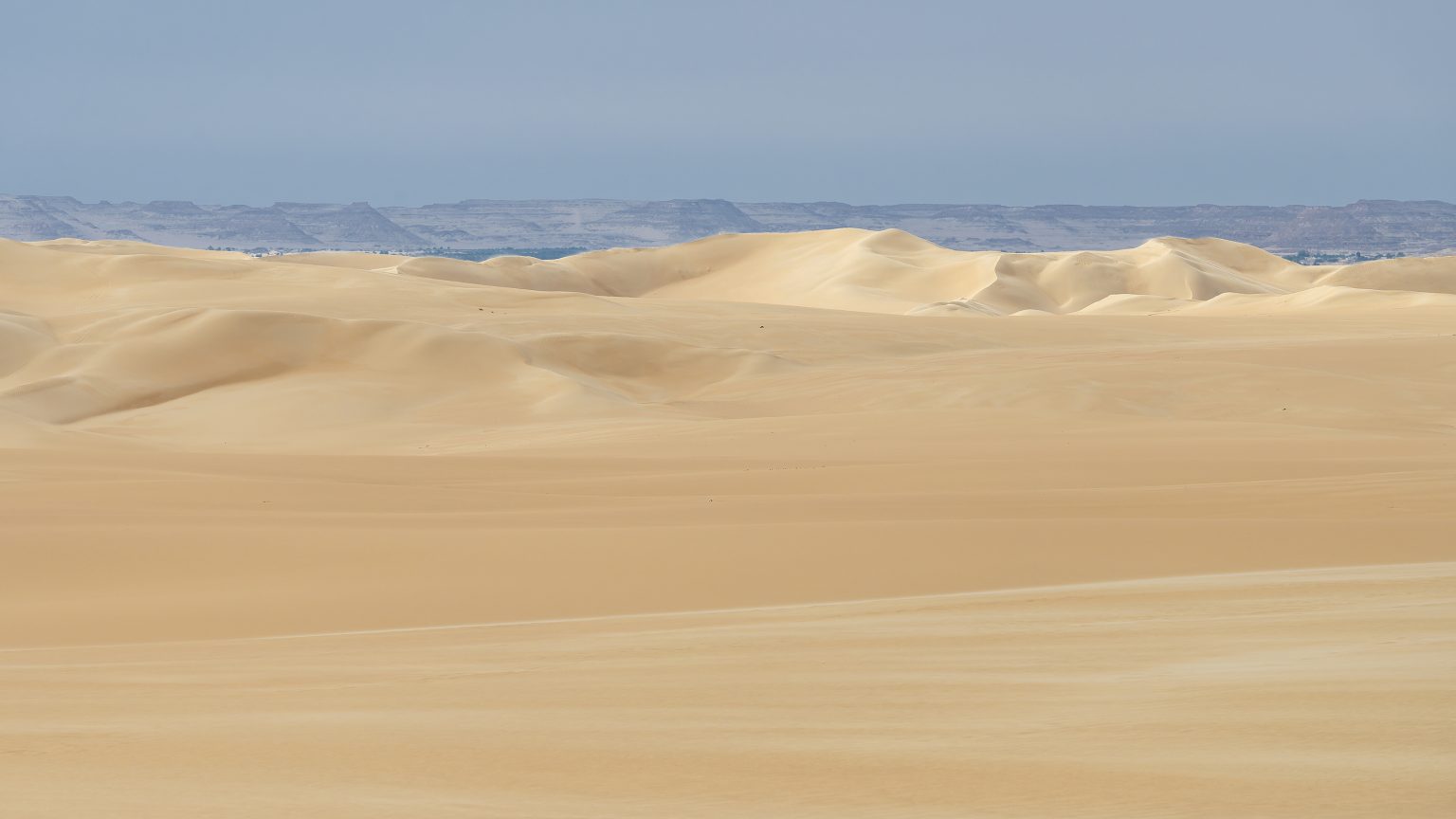
The Great Sand Sea stretches across western Egypt toward the Libyan border, forming one of the largest continuous dune landscapes in the Sahara. Its extensive fields of shifting sand create a remote environment that is very different from the desert landscapes around Egypt’s major population centers.
- Where Is the Great Sand Sea Located?
- How to Reach the Great Sand Sea
- Best Time to Visit the Great Sand Sea
- Top Things to Do in the Great Sand Sea
- 1. 4×4 Desert Safari
- 2. Sandboarding on Giant Dunes
- 3. Swim in Desert Hot Springs
- 4. Explore Fossil Fields
- 5. Camp Under the Stars
- 6. Follow the Ancient Siwa Route
- 2-Day Great Sand Sea Itinerary
- Where to Stay Near the Great Sand Sea
- Desert Culture and Local Traditions
- Practical Travel Tips
- Hidden Gems Near the Great Sand Sea
- A Vast Dune Landscape on Egypt’s Western Frontier
Covering nearly 72,000 square kilometers, the Great Sand Sea contains large dunes, some rising more than 100 meters above the surrounding terrain. From above, the dunes form long ridges and sweeping patterns shaped by prevailing winds. On the ground, the landscape changes continuously as sand moves across the dune fields.
Crossing the Great Sand Sea requires careful planning and experienced guides. For visitors, the area offers opportunities for 4×4 expeditions, sandboarding, desert camping, geological exploration, and stargazing far from artificial light.
Where Is the Great Sand Sea Located?
The Great Sand Sea, known in Arabic as Bahr al-Raml al-Kebir, lies in western Egypt, forming part of the Libyan Desert.
It stretches between the oases of Siwa, Bahariya, and Dakhla, extending across Egypt’s far western region toward Libya.
Geographic extent:
- Around 600 km north to south
- Approximately 300 km east to west
Key landmarks:
- North: Siwa Oasis, where dunes meet salt lakes and oasis landscapes
- South: The remote Gilf Kebir Plateau, one of Egypt’s most isolated desert regions
Administratively, the Great Sand Sea spans parts of:
- Matrouh Governorate
- New Valley Governorate
Over thousands of years, persistent winds have shaped the dunes into barchans (crescent dunes), seifs (long dune ridges), and star dunes, creating a landscape that varies considerably across the region.
How to Reach the Great Sand Sea
From Siwa Oasis
Siwa Oasis is the most accessible gateway to the northern part of the Great Sand Sea.
The first major dunes begin less than 10 kilometers south of Siwa, making this area suitable for day trips as well as overnight desert expeditions.
- Transport: Guided 4×4 expeditions or camel treks
- Duration: Half-day tours to multi-day desert crossings
- Routes: Desert tracks and historic routes connecting the oasis with surrounding regions
From Bahariya or Farafra
Longer expeditions can depart from Bahariya Oasis, crossing the White Desert before continuing toward the Great Sand Sea. These journeys require appropriate permits and experienced desert guides.
From Cairo
Extended desert trips may begin in Cairo, usually passing through Bahariya and Siwa before reaching the more remote areas of the western Sahara.
Best Time to Visit the Great Sand Sea
The climate is extremely dry, with very little rainfall throughout the year.
Seasonal temperatures:
- October to April: 20–30°C by day, 5–15°C at night
Ideal for camping, safaris, and photography - May to September: 35–45°C
Outdoor activities are best limited to early morning or late afternoon
Winter generally provides the most comfortable conditions for longer desert trips. Clear nights also make the area suitable for stargazing, while moonlit dunes can create strong photographic conditions.
Top Things to Do in the Great Sand Sea
1. 4×4 Desert Safari
Guided 4×4 safaris travel across the major dune fields, with stops at viewpoints and suitable locations for photography and rest. Tours from Siwa can range from several hours to overnight camping trips.
2. Sandboarding on Giant Dunes
The steep slopes of some dunes provide good conditions for sandboarding. Early morning and late afternoon are more comfortable for this activity, especially during the warmer months.
3. Swim in Desert Hot Springs
Despite the extremely dry surroundings, thermal springs can be found in the Siwa region.
Bir Wahed Hot Spring, about 15 km southwest of Siwa, is a popular stop where visitors can relax in warm mineral-rich water surrounded by desert scenery.
4. Explore Fossil Fields
The western Egyptian desert contains evidence of ancient marine environments, including fossilized shells, coral, and fish remains in some locations. Guided excursions can help visitors understand the geological history of these areas.
5. Camp Under the Stars
Overnight camping is one of the main experiences associated with the Great Sand Sea. Desert camps may include fire-cooked meals, Bedouin tea, and time for stargazing under relatively dark skies.
6. Follow the Ancient Siwa Route
Some desert expeditions follow historic routes connecting Siwa and Kufra, passing through remote desert areas and locations associated with old wells, springs, and caravan travel.
2-Day Great Sand Sea Itinerary
Day 1: Entering the Dunes
Morning departure from Siwa by 4×4
Explore dune ridges and fossil areas
Sunset visit to Bir Wahed Hot Spring
Dinner and overnight camping under the stars
Day 2: Dawn and Return
Sunrise over the dunes
Sandboarding or a short camel ride
Desert breakfast before returning to Siwa through areas of salt lakes and palm groves
Longer itineraries allow travelers to move farther into the dune fields and spend more time exploring remote areas.
Where to Stay Near the Great Sand Sea
Eco-Lodges in Siwa
- Adrère Amellal Desert Ecolodge – traditional salt-and-mud construction with a low-impact setting
- Taghaghien Island Resort – accommodation beside a salt lake
- Shali Lodge – traditional Siwan-inspired design
Desert Camps
Local operators offer equipped overnight camps with:
- Bedouin tents or open-air sleeping arrangements
- Traditional meals
- Music and storytelling around the evening campfire
Camping provides direct access to the desert landscape and allows visitors to experience the area after sunset.
Desert Culture and Local Traditions
The Siwi people have lived in and around the oasis and surrounding desert for generations. Their traditional knowledge includes navigating the desert environment and understanding local water sources, weather conditions, and seasonal changes.
Traditions include:
- Sweet tea served during journeys and gatherings
- Evening music around campfires
- Handcrafted silver jewelry and embroidered clothing
Local traditions remain an important part of the cultural experience for visitors exploring Siwa and the surrounding desert.
Practical Travel Tips
- Permits are required for some overnight desert trips
- Use experienced guides and suitable 4×4 vehicles
- Carry at least 3 liters of water per person per day, with additional supplies for remote trips
- Bring sun protection and warm layers for cold nights
- Do not disturb dunes, fossils, or archaeological sites
- Expect limited or no mobile signal in remote areas
Hidden Gems Near the Great Sand Sea
- Bir Wahed, a desert hot spring
- Fossil Valley, with evidence of ancient marine environments
- Qattara Depression, a vast below-sea-level basin
- Dakhla Dunes, further south in Egypt’s Western Desert
- Ain al-Qattara, a historic desert spring
A Vast Dune Landscape on Egypt’s Western Frontier
The Great Sand Sea is one of the most extensive dune regions in Egypt, combining large-scale desert scenery with opportunities for adventure, camping, geology, and cultural exploration.
Its proximity to Siwa Oasis makes the northern part of the region relatively accessible, while deeper expeditions require more preparation, permits, suitable vehicles, and experienced guides.
For travelers willing to venture beyond the main oasis routes, the Great Sand Sea offers a very different view of Egypt, with enormous dune fields, remote desert tracks, fossil-rich areas, clear night skies, and landscapes that extend for hundreds of kilometers.