
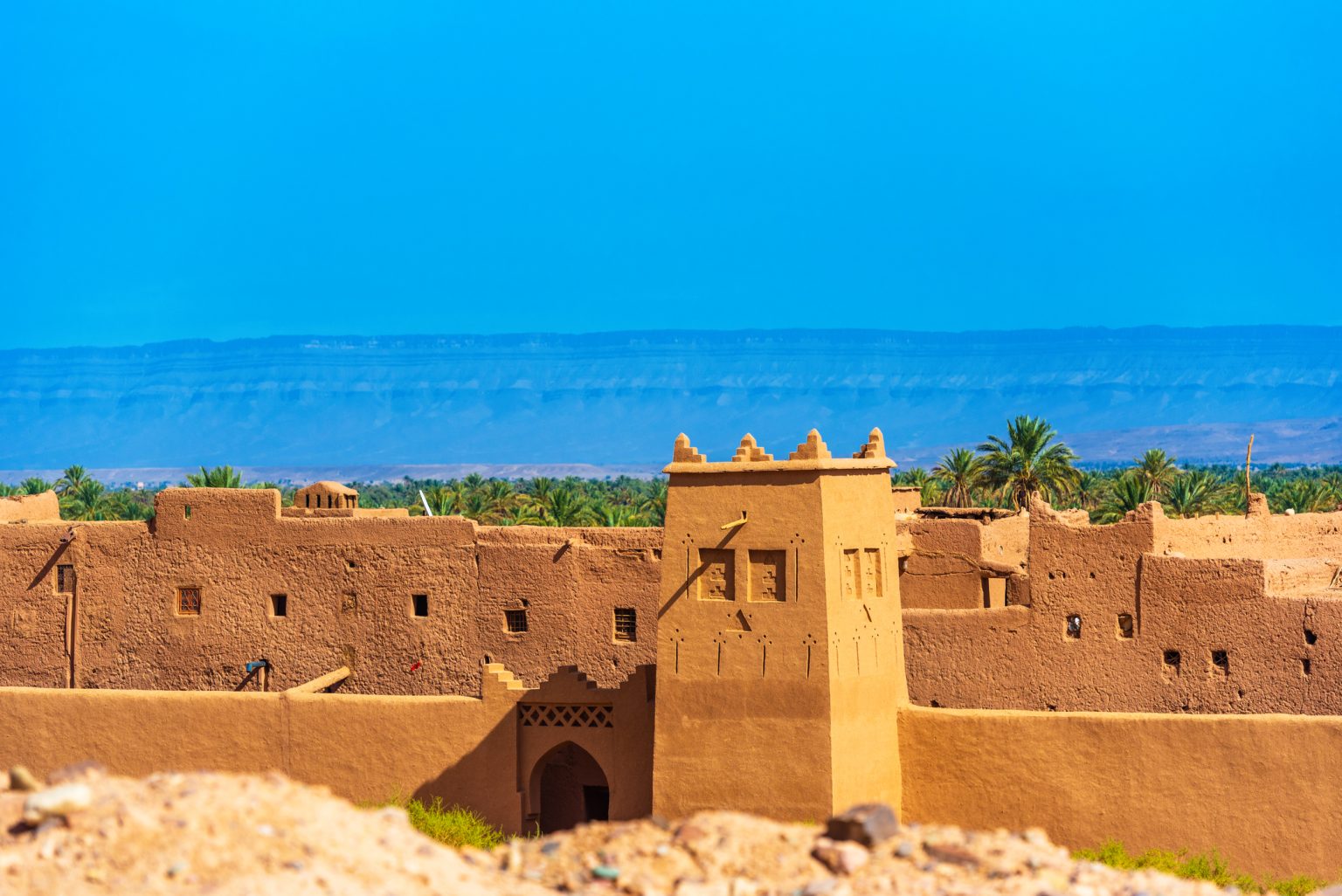
In southern Morocco, where the palm groves of the Draa Valley gradually give way to dry plateaus and sandy landscapes, lies Zagora, one of the main towns associated with Morocco’s pre-Saharan desert region. Its location between the cultivated oasis and the wider desert makes it an important base for exploring the Draa Valley, Tinfou dunes, Tamegroute, and the routes leading toward the deeper Sahara.
- Where Is Zagora Located
- Landscape of Zagora: Palms, Stone, and Sand
- Climate: A Hot and Dry Pre-Saharan Environment
- Plants and Animals of the Draa Valley
- Culture and Heritage of Zagora
- Top Things to Do in Zagora
- Camel Trek in the Tinfou Dunes
- Visit Tamegroute
- Explore the Draa Valley
- Desert Camping and Stargazing
- Kasbah Trails
- 2-Day Zagora Desert Itinerary
- Where to Stay in Zagora
- Practical Travel Tips
- Hidden Gems Around Zagora
- Zagora: Between the Oasis and the Sahara
For centuries, Zagora and the surrounding Draa Valley were connected to caravan trade routes crossing southern Morocco and continuing toward West Africa. The famous sign associated with the town, “Timbuktu – 52 days by camel,” recalls this history and the long distances once covered by camel caravans.
Today, Zagora combines oasis agriculture, caravan heritage, Amazigh and Arab culture, historic kasbahs, and access to desert landscapes, making it a useful starting point for exploring southeastern Morocco.
Where Is Zagora Located
Zagora is located in the Drâa-Tafilalet region of southern Morocco, approximately 160 kilometers southeast of Ouarzazate.
Coordinates: approximately 30.33°N, 5.83°W
Elevation: around 725 meters (2,380 feet) above sea level
The town lies within the Draa Valley, an important oasis corridor extending south toward the pre-Saharan desert.
Distances from Zagora
- Marrakech: approximately 350 km
- Ouarzazate: approximately 160 km
- M’Hamid El Ghizlane: approximately 90 km by road
Zagora is often used as a transition point between the cultivated landscapes of the Draa Valley and the more arid terrain farther south. Travelers continuing toward Erg Chigaga generally use M’Hamid El Ghizlane as the main gateway for the deeper dune areas.
Landscape of Zagora: Palms, Stone, and Sand
The landscape around Zagora is shaped by the contrast between the irrigated Draa Valley and the surrounding arid terrain.
Along the valley, extensive date palm groves grow around agricultural plots and traditional settlements. Outside the cultivated areas, the landscape becomes increasingly dry, with hamadas, gravel plains, rocky hills, and sandy stretches.
The nearby Tinfou dunes provide an accessible introduction to the sandy landscapes of southern Morocco. They are smaller and more easily reached than the major dune fields farther south.
Jbel Zagora, the rocky hill overlooking the town, provides views across the oasis and surrounding desert terrain.
The landscape changes considerably throughout the day as sunlight moves across the palm groves, kasbahs, rocky slopes, and dunes.
Climate: A Hot and Dry Pre-Saharan Environment
The Zagora region has a hot, dry climate, with very high summer temperatures and cooler winter nights.
Typical conditions include:
- Low annual rainfall, often around 50 to 100 mm.
- Summer temperatures that can exceed 40°C.
- Cool winter nights, particularly in December and January.
- Large temperature differences between day and night.
The best time to visit Zagora is generally October to April, when daytime conditions are more comfortable for walking, sightseeing, and desert excursions.
The Draa Valley’s oasis agriculture depends on irrigation and groundwater. Date palms grow alongside crops such as olives, pomegranates, alfalfa, barley, and other plants adapted to the valley’s limited water resources.
Plants and Animals of the Draa Valley
The contrast between irrigated oasis land and surrounding desert supports a variety of plant and animal life.
Plants
- Date palms, which form the characteristic canopy of the Draa oasis.
- Acacia and tamarisk, adapted to dry and saline conditions.
- Henna, traditionally cultivated in parts of the Draa Valley.
- Alfalfa and barley, important agricultural crops.
- Fig and pomegranate trees, grown in irrigated areas.
Animals
- Camels, historically important for transport and still used in tourism and pastoral activities.
- Fennec foxes and desert rodents, adapted to the surrounding arid environments.
- Migratory birds, particularly around areas with water and vegetation.
The Draa Valley provides a particularly important contrast to the surrounding desert because irrigation creates habitats that would not otherwise exist in such an arid environment.
Culture and Heritage of Zagora
Zagora and the Draa Valley reflect a mixture of Amazigh, Arab, and Saharan cultural influences developed through settlement, agriculture, trade, and movement across the desert.
The region is known for traditional music, crafts, oasis agriculture, and hospitality. Gnawa music is also part of the wider cultural landscape of southeastern Morocco, reflecting historical connections between Morocco and sub-Saharan Africa.
Nearby Tamegroute is particularly important for its religious and craft heritage. The town is known for its distinctive green pottery and the historic Nasiriyya Library, which preserves an important collection of manuscripts.
The region’s historic caravan connections are also visible in its ksour, kasbahs, old agricultural settlements, and traditional trade routes.
Top Things to Do in Zagora
Camel Trek in the Tinfou Dunes
Located a short drive from Zagora, the Tinfou dunes offer an accessible introduction to camel trekking and sandy desert scenery.
Short excursions around sunrise or sunset are suitable for travelers who want a desert experience without committing to a multi-day expedition.
Visit Tamegroute
A visit to Tamegroute can combine several cultural attractions:
- Nasiriyya Library
- Traditional green pottery workshops
- Historic religious buildings
- The town’s old settlement and craft traditions
Tamegroute is one of the most interesting cultural stops in the Draa Valley.
Explore the Draa Valley
Travel through the oasis corridor to see palm groves, agricultural plots, villages, and historic kasbahs.
Important stops can include:
- Agdz
- Tamnougalt
- Traditional villages along the Draa Valley
The route provides a clear view of how settlement and agriculture developed around the valley’s limited water resources.
Desert Camping and Stargazing
A desert camp allows visitors to spend a night outside the main settlements. Depending on the location and tour operator, experiences may include camel rides, traditional meals, Berber or Amazigh music, and stargazing.
For deeper desert landscapes, travelers generally continue south toward M’Hamid El Ghizlane and Erg Chigaga.
Kasbah Trails
Historic buildings such as Kasbah Tamnougalt and Kasbah Amezrou provide insight into the architectural and commercial history of the Draa Valley.
These sites are particularly valuable when combined with visits to the surrounding palm groves and traditional settlements.
2-Day Zagora Desert Itinerary
Day 1: Draa Valley and Tamegroute
- Morning drive from Ouarzazate through the Draa Valley.
- Afternoon visit to Tamegroute and its pottery workshops and historic library.
- Late afternoon camel ride at the Tinfou dunes.
- Overnight in Zagora or a nearby desert camp.
Day 2: Oasis and Kasbah Heritage
- Sunrise walk or camel ride.
- Explore the Zagora palm groves.
- Continue toward Kasbah Tamnougalt or another historic settlement in the Draa Valley.
- Return to Zagora in the evening.
Travelers with more time can extend the trip toward M’Hamid El Ghizlane and Erg Chigaga for a more remote desert experience.
Where to Stay in Zagora
Zagora offers hotels, guesthouses, kasbah-style accommodation, and access to desert camps.
Desert Camps
- Erg Chigaga Spirit Camp
- Caravane du Sud
Riads and Hotels
- Kasbah Azul
- Riad Lamane
- Dar Pienatcha
Budget Options
- Auberge Chez Ali
- Reda Hotel
Travelers should choose accommodation according to their route. Staying in Zagora is convenient for exploring the Draa Valley, while a desert camp is more suitable for visitors continuing toward the dune areas.
Practical Travel Tips
- Best season: October to April.
- Currency: Moroccan dirham (MAD).
- Transport: Rental cars, private drivers, buses, and organized tours are available.
- Clothing: Light layers during the day and a warm jacket for winter nights.
- Sun protection: Carry sunglasses, sunscreen, and a hat.
- Water: Carry sufficient drinking water during desert excursions.
- Photography: Ask permission before photographing local people.
- Desert excursions: Confirm the route, vehicle, accommodation, and included services before departure.
Hidden Gems Around Zagora
Travelers with additional time can explore:
- Ksar Tamnougalt, with its historic architecture and views over the Draa Valley.
- Tamegroute manuscripts, preserved in the Nasiriyya Library.
- Palm-grove walking paths, offering a closer look at oasis agriculture.
- Birdwatching areas along the Draa Valley, particularly where water and vegetation remain available.
- Amezrou, a historic settlement near Zagora known for its kasbah architecture and craft traditions.
Zagora: Between the Oasis and the Sahara
Zagora occupies an important position in southern Morocco because it connects the agricultural landscape of the Draa Valley with the increasingly arid terrain farther south.
Its importance comes from more than its proximity to the desert. The town and surrounding valley preserve the history of caravan trade, oasis agriculture, kasbah architecture, Amazigh and Arab traditions, and Saharan connections.
For travelers, Zagora works best as a starting point rather than an endpoint. From its palm groves and historic settlements, the route continues toward M’Hamid El Ghizlane and the larger dune landscapes of Erg Chigaga, making Zagora a practical base for discovering the transition from oasis Morocco to the Sahara.