
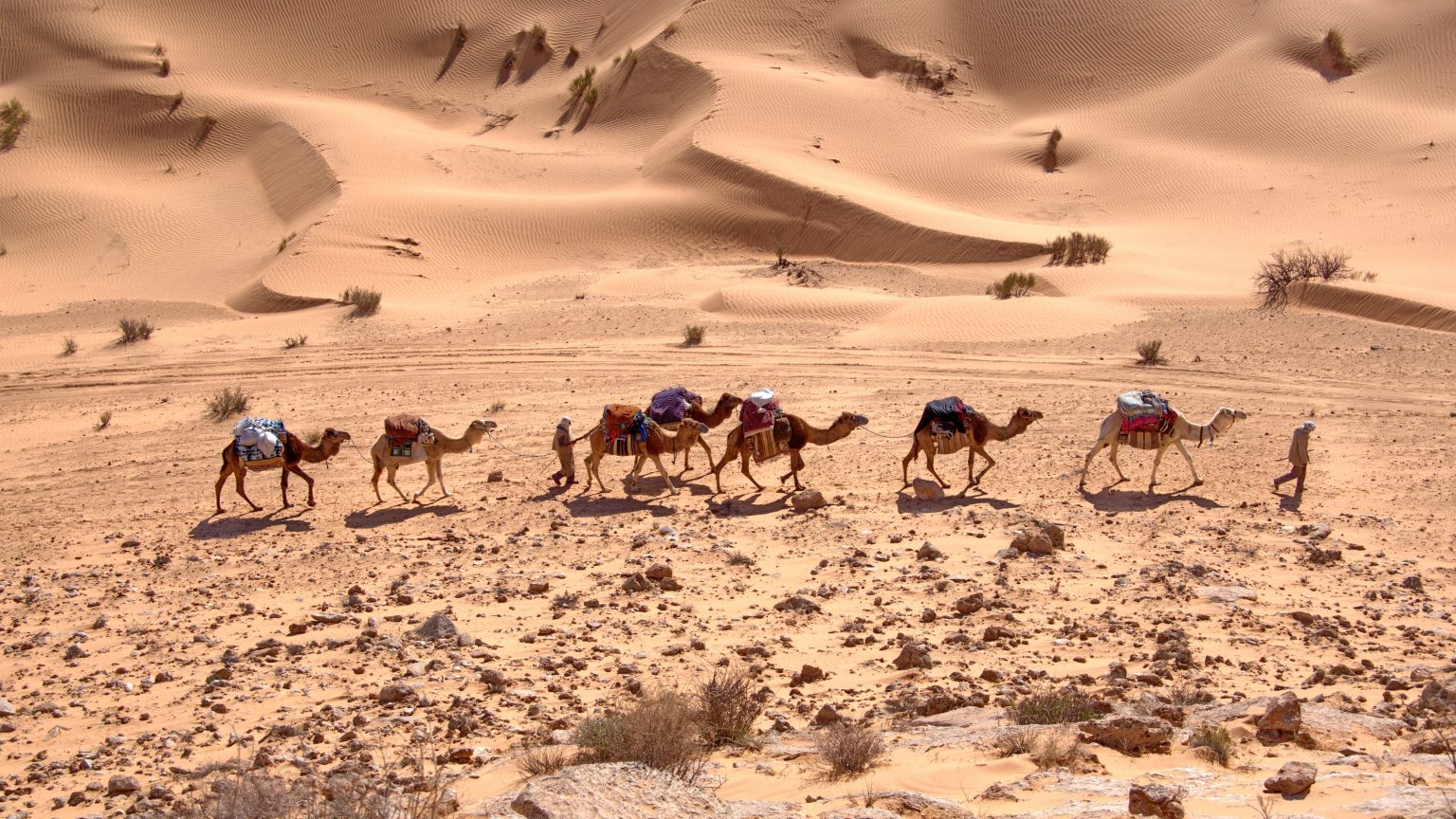
At the point where Tunisia’s paved roads give way to broad desert tracks and sand dunes, Douz stands at the northern edge of the Grand Erg Oriental. Known as the “Gateway to the Sahara,” this town in southern Tunisia combines a historic palm oasis with easy access to one of the region’s major dune landscapes.
- Where Is Douz Located in Tunisia
- How to Reach Douz
- Best Time to Visit Douz
- Top Things to Do in Douz
- Camel Trekking into the Sahara
- Visit the Douz Sahara Museum
- Attend the International Sahara Festival
- Explore the Grand Erg Oriental Dunes
- Discover the Palm Oases
- Local Markets and Daily Life
- 3-Day Douz Desert Itinerary
- Where to Stay in Douz
- Nomadic Heritage and Local Culture
- Practical Travel Tips
- Hidden Gems Near Douz
- Douz: From Oasis to the Grand Erg Oriental
For centuries, Douz has been associated with caravan routes, camel herding, and the Mrazig community. Today, the town remains one of Tunisia’s main bases for desert excursions, including camel trekking, 4×4 trips, camping, and visits to the surrounding dunes.
Douz offers travelers a practical way to experience several sides of southern Tunisia in one destination: oasis agriculture, Saharan culture, desert activities, and the vast dunes of the Grand Erg Oriental.
Where Is Douz Located in Tunisia
Douz lies in the Kebili Governorate of southern Tunisia, close to the northern edge of the Grand Erg Oriental, one of the major dune systems of the Sahara.
Key distances include:
- 475 km south of Tunis
- 125 km east of Tozeur
- 80 km south of Chott el Jerid
- Around 120 km north of the Libyan border
To the north lies the vast Chott el Jerid salt depression. South of Douz, the landscape becomes increasingly dominated by sandy desert and dune fields extending toward the Algerian border.
The transition between the salt flats, oasis landscapes, and sand dunes is one of the defining features of the region.
How to Reach Douz
From Tunis
Driving from Tunis to Douz takes approximately 7 to 8 hours, depending on traffic, stops, and road conditions. The route passes through areas including Kairouan, Gafsa, and Kebili, providing a gradual transition from northern Tunisia to the arid south.
Another option is to fly from Tunis to Tozeur, then continue to Douz by rental car, private transfer, or shared taxi (louage). The road journey from Tozeur generally takes around 2 hours.
From Tozeur
The road from Tozeur to Douz crosses the Chott el Jerid, one of southern Tunisia’s most distinctive landscapes. The causeway provides access across the salt depression, where travelers may see extensive salt surfaces, shallow water after rainfall, and atmospheric mirages.
From Djerba
From Djerba Island, the journey to Douz takes several hours by road, usually passing through Medenine and Kebili. It provides a notable change in scenery, moving from the Mediterranean island environment toward the dry landscapes of southern Tunisia.
Best Time to Visit Douz
Douz has a hot desert climate, with very hot summers and considerably cooler winters.
October to April is generally the most comfortable period for desert activities. Daytime temperatures are often suitable for camel trekking, 4×4 excursions, walking, and cultural visits.
May to September can be extremely hot, with temperatures frequently exceeding 40°C during the hottest periods. Outdoor activities are more comfortable in the early morning or late afternoon.
December and January bring cooler daytime temperatures and cold desert nights, so warm clothing is important for camping and evening activities.
The changing light is also one of the attractions of the dunes. Early morning produces softer colors, while late afternoon brings stronger contrasts across the sand ridges.
Top Things to Do in Douz
Camel Trekking into the Sahara
Camel trekking remains one of the best-known activities in Douz. Local guides lead visitors into the surrounding dunes, with excursions ranging from short rides to longer journeys involving overnight desert camps.
A sunset ride provides an easy introduction to the landscape, while multi-day treks offer more time in the dunes and a closer look at traditional desert travel.
Visit the Douz Sahara Museum
The Musée du Sahara de Douz introduces visitors to the region’s desert cultures and traditions. Exhibits include items such as:
- Bedouin tents
- Jewelry
- Saddles and riding equipment
- Traditional tools
- Photographs and cultural displays
The museum is particularly useful before a desert excursion because it provides context for the traditions and lifestyles associated with southern Tunisia.
Attend the International Sahara Festival
The International Sahara Festival of Douz is one of Tunisia’s best-known cultural events. Traditionally held in December, the festival brings together performances and activities connected with the region’s nomadic and rural heritage.
Depending on the program, visitors may see:
- Camel and horse events
- Fantasia performances
- Traditional music
- Poetry
- Cultural demonstrations
- Traditional markets and crafts
The festival provides an opportunity to see elements of Saharan culture presented in a large public celebration.
Explore the Grand Erg Oriental Dunes
The dunes begin close to Douz and provide the setting for many desert excursions. Visitors can explore them by:
- Camel
- 4×4
- Quad bike
- Sandboard
Popular longer excursions may include destinations such as Tembaine and, depending on the itinerary, Ksar Ghilane.
Discover the Palm Oases
Douz is also an oasis town. Palm groves surrounding the settlement depend on traditional irrigation and support date cultivation.
A walk through the oasis offers a different perspective on the region, showing how agriculture developed alongside the desert environment. Deglet Nour dates, one of Tunisia’s best-known varieties, are an important local product.
Local Markets and Daily Life
The Douz souk provides an opportunity to see everyday commerce and purchase regional products such as:
- Silver jewelry
- Woven mats
- Leather goods
- Dates
- Spices
The market is also a useful place to observe local life away from the main tourist excursions.
3-Day Douz Desert Itinerary
Day 1: Oasis and Heritage
Arrive in Douz and settle into your hotel or guesthouse. Visit the palm oasis and the Sahara Museum, then spend the evening exploring the town or enjoying traditional Tunisian food and mint tea.
Day 2: Into the Dunes
Take a camel or 4×4 excursion into the Grand Erg Oriental. Depending on the itinerary, spend part of the day exploring the dunes before reaching a desert camp for the night.
After sunset, enjoy dinner and traditional music around the camp. Desert nights can become cold, particularly during winter, so warm clothing is essential.
Day 3: Salt Flats and Southern Tunisia
Wake early for sunrise before returning to Douz. From there, continue toward Chott el Jerid and, if your route allows, onward to Tozeur or Nefta.
The salt depression provides a strong contrast with the sandy terrain around Douz and makes a useful final stop on a southern Tunisia itinerary.
Where to Stay in Douz
Douz offers several types of accommodation, from conventional hotels to desert camps.
Hotels
- Sahara Douz Hotel offers gardens, a swimming pool, and traditional elements.
- El Mouradi Douz provides resort-style accommodation and access to organized desert excursions.
- Hotel Sun Palm Douz is another option for travelers looking for a hotel close to the desert attractions.
Desert Camps
- Camp Mars Douz offers traditional-style tents and camel excursions.
- Douz Nomad Camp focuses on family-run hospitality and desert experiences.
- Camp Zmela provides a more remote desert setting.
Guesthouses
Maison Proche du Desert and Dar Jerid are alternatives for travelers who prefer smaller-scale accommodation and a more local atmosphere.
Nomadic Heritage and Local Culture
Douz has strong cultural connections with the Mrazig, a community historically associated with nomadic life, camel herding, and caravan travel in southern Tunisia.
Although many Mrazig families now live in settled communities, elements of their heritage remain visible in:
- Music and poetry
- Traditional clothing
- Jewelry
- Camel culture
- Hospitality
- Festival traditions
Tea is an important part of social hospitality, while traditional music and drums feature prominently during celebrations and cultural events.
For visitors, Douz provides an opportunity to learn about a desert culture that developed around movement, livestock, trade, oasis agriculture, and the seasonal use of the surrounding landscape.
Practical Travel Tips
- Best season: October to April is generally the most comfortable period for desert activities.
- Road access: Douz is accessible by paved roads; a 4×4 is mainly needed for dune excursions.
- Cash: Carry some cash for markets and smaller local businesses.
- Clothing: Wear light clothing during the day and bring warm layers for winter nights.
- Sun protection: Use sunscreen, sunglasses, and a hat, particularly during desert excursions.
- Water: Drink regularly, especially during camel rides and 4×4 trips.
- Photography: Ask permission before photographing local people.
- Desert camps: Internet and mobile coverage can be limited or unavailable in remote areas.
Hidden Gems Near Douz
For travelers staying longer, several less-visited places can be added to a southern Tunisia itinerary:
- Tembaine Mountain, a distinctive rocky landmark surrounded by dunes.
- Ksar Ghilane Oasis, known for its palm oasis and thermal spring.
- Zemlet el Borma, a remote desert area for travelers seeking more isolated landscapes.
- Chott el Jerid, particularly interesting when seasonal water creates reflective surfaces.
- Douiret and Chenini, historic Berber villages in the Tataouine region, suitable as part of a wider southern Tunisia trip.
Douz: From Oasis to the Grand Erg Oriental
Douz brings together two landscapes that define southern Tunisia: the cultivated palm oasis around the town and the sandy expanse of the Grand Erg Oriental beyond it.
Its history as a center of caravan and camel culture remains visible through the Mrazig heritage, the Sahara Museum, local markets, festivals, and desert excursions. At the same time, modern travelers use Douz as a base for exploring dunes, camping, wildlife, salt flats, and the wider landscapes of southern Tunisia.
For anyone exploring the Tunisian Sahara, Douz is valuable not simply because it provides access to the dunes, but because it connects oasis life, Saharan culture, and desert travel in one destination.