
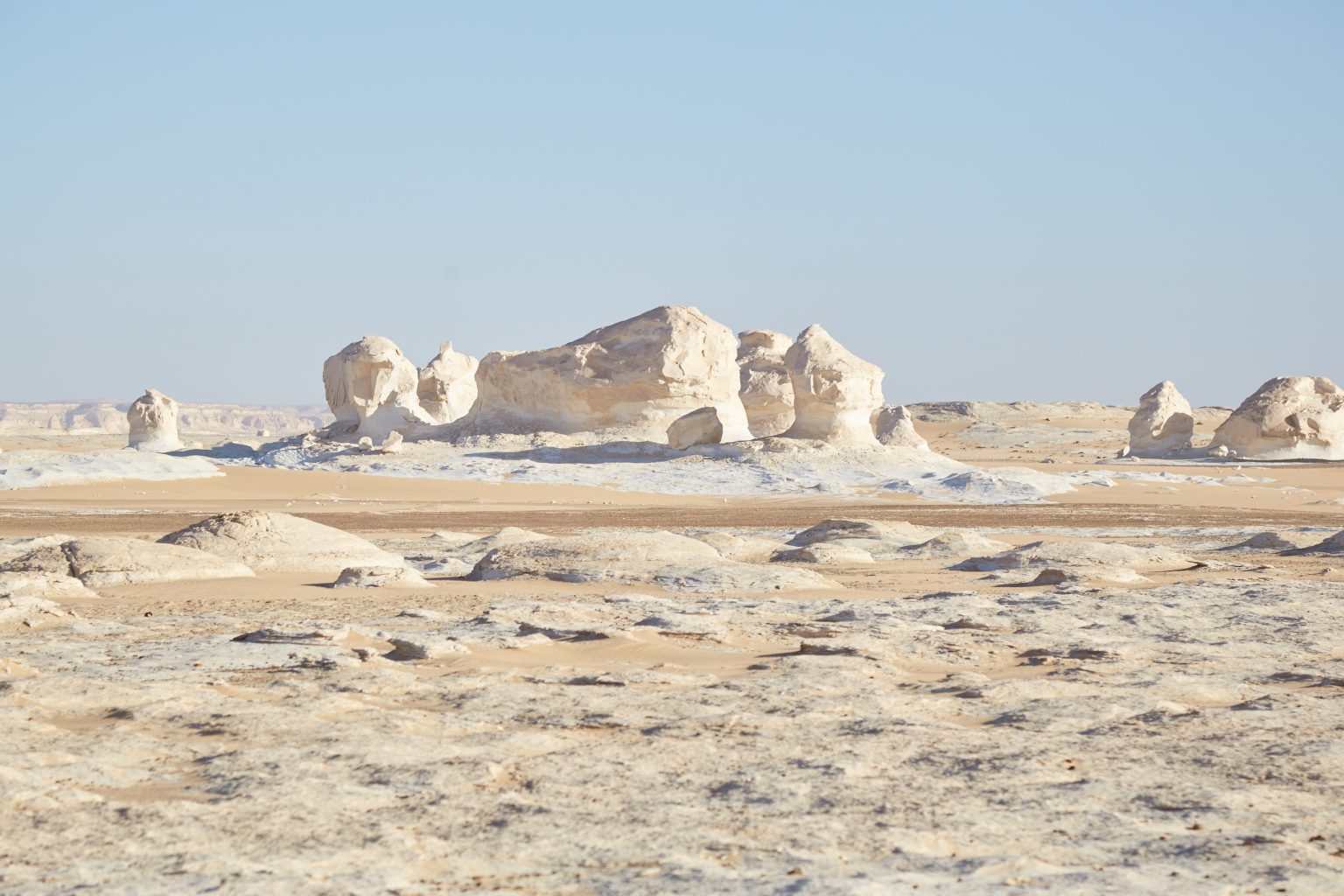
The White Desert National Park, also known as Sahara el Beyda, is one of the most distinctive landscapes in Egypt’s Western Desert. Located between Bahariya Oasis and Farafra, the park is known for its bright white chalk and limestone formations, shaped over long periods by wind erosion.
- Where Is the White Desert National Park Located?
- How to Reach the White Desert from Cairo
- Best Time to Visit the White Desert
- Things to Do in the White Desert National Park
- Explore the Chalk Formations
- Camp Under the Desert Stars
- Visit the Black Desert
- Stop at Crystal Mountain
- Discover Farafra Oasis
- Watch Sunrise and Sunset
- 2-Day White Desert Itinerary
- Where to Stay Near the White Desert
- Bedouin Culture and Desert Life
- Practical Travel Tips
- Hidden Gems of the White Desert
- Exploring Egypt’s White Desert
Instead of traditional sand dunes, the landscape is covered with unusual rock formations that resemble mushrooms, animals, towers, and other shapes. Their appearance changes with the position of the sun, making the White Desert especially attractive for photography and desert camping.
The area also forms part of a wider desert route that includes Bahariya Oasis, the Black Desert, Crystal Mountain, and Farafra Oasis, allowing visitors to experience several different landscapes within the same journey.
Where Is the White Desert National Park Located?
The White Desert National Park lies within Egypt’s Farafra Depression, around 500 kilometers southwest of Cairo and approximately 45 kilometers north of Farafra Oasis, in the New Valley Governorate.
To the north stretches the Black Desert, while Dakhla Oasis lies farther south. Covering more than 3,000 square kilometers, the area was once associated with an ancient marine environment. Over millions of years, erosion gradually shaped the softer chalk layers into the formations visible today.
Key distances include five to six hours by car from Cairo via Bahariya, about two hours from Bahariya Oasis, and roughly one hour north of Farafra Oasis. Beyond Bahariya, paved roads become limited, and 4×4 vehicles are needed for routes inside the desert.
How to Reach the White Desert from Cairo
Most travelers reach the White Desert through organized 4×4 desert safaris departing from Cairo. The route passes through Bahariya Oasis, where permits, fuel, food, and other supplies can be arranged before continuing into the desert.
The journey covers around 500 kilometers and takes approximately five to six hours. Travel beyond Bahariya requires a 4×4 vehicle accompanied by experienced local guides.
Both Bahariya and Farafra can be used as access points, although many tours depart from Bahariya. Inside the reserve, there are no conventional roads, and local Bedouin guides use established desert tracks and landmarks to navigate the area.
Best Time to Visit the White Desert
The best time to visit the White Desert National Park is generally from October to April, when temperatures are more suitable for outdoor activities.
During this period, daytime temperatures can range between 20 and 28°C, while nights may fall to 5–10°C. These months are particularly suitable for camping, photography, and desert exploration.
From May to September, temperatures can exceed 40°C, making long desert excursions more demanding. Clear winter nights can provide excellent conditions for stargazing, while full-moon nights offer a different view of the pale rock formations.
Things to Do in the White Desert National Park
Explore the Chalk Formations
Walking through the White Desert provides close views of the unusual formations created by wind erosion. Local Bedouin guides have given many of them descriptive names, including the Mushroom, the Chicken, the Camel, and the Rabbit.
The formations are particularly impressive around sunrise and sunset, when lower sunlight emphasizes their shapes and textures.
Camp Under the Desert Stars
Desert camping is one of the main experiences in the White Desert. Evening camps usually include traditional meals, tea, and time to explore the surrounding formations before nightfall.
Away from urban areas, the region has very little artificial light, creating good conditions for observing the Milky Way and other stars.
Visit the Black Desert
Just north of the White Desert lies the Black Desert, a volcanic landscape marked by dark basalt hills rising from orange and brown desert terrain.
The contrast between the dark volcanic hills and the pale chalk formations of the White Desert makes the two areas a natural combination on the same desert trip.
Stop at Crystal Mountain
Crystal Mountain lies between Bahariya and Farafra and contains calcite and quartz crystals. Sunlight can highlight the crystals across the rocky hill, making it a popular stop along the desert route.
Discover Farafra Oasis
After exploring the desert, Farafra Oasis offers palm groves, gardens, and access to local springs. Bir Sitta hot spring is a popular place to relax, while local artists and workshops showcase handmade objects influenced by the surrounding desert landscape.
Watch Sunrise and Sunset
The changing light is one of the most attractive features of the White Desert. Early morning brings softer colors and long shadows, while sunset can turn the chalk formations into shades of pink, orange, and violet.
For photographers, these periods provide the strongest contrast and texture across the landscape.
2-Day White Desert Itinerary
Day 1
Depart early from Bahariya Oasis. Stop at Crystal Mountain and explore the volcanic hills of the Black Desert. Reach the White Desert in the afternoon, walk among the formations, and set up camp. Dinner is prepared at the desert camp before spending the night under the stars.
Day 2
Wake before sunrise to photograph the changing colors of the formations. After breakfast, return toward Bahariya along sandy tracks. Before heading back to Cairo, relax at one of Bahariya’s natural hot springs.
Where to Stay Near the White Desert
In Bahariya Oasis, Desert Rose Eco Lodge offers accommodation and access to guided desert tours, while the International Hot Spring Hotel provides simple accommodation with access to thermal pools.
In Farafra Oasis, Badawiya Hotel Farafra offers rustic accommodation close to the park, while Desert Safari Home provides a family-run option for visitors exploring the area.
Many visitors choose to camp inside the White Desert, with licensed local guides arranging permits, transportation, camping equipment, and meals.
Bedouin Culture and Desert Life
The White Desert is located within a region traditionally travelled and inhabited by Bedouin communities of Egypt’s Western Desert. Local knowledge remains important for navigating the remote terrain, locating water, and understanding the desert environment.
Visitors may be welcomed with mint tea, traditional food, music, and stories about desert life. Guided visits also provide an opportunity to learn about local customs and the practical knowledge needed to travel through the Western Desert.
Practical Travel Tips
A camping permit is required and should be arranged through licensed guides. 4×4 vehicles are necessary for reaching the remote parts of the park.
Bring plenty of water, sun protection, warm layers for the night, and basic medical supplies. Stay with your guide, avoid climbing on fragile formations, and remove all waste from the desert.
Hidden Gems of the White Desert
Ain el-Serr is a remote spring that can be visited with experienced local guides. El Heiz Oasis offers palm groves and traditional crafts. El Agabat Valley features dramatic chalk formations and canyon walls, while areas around Crystal Mountain contain additional geological features.
Exploring Egypt’s White Desert
The White Desert National Park offers a different side of Egypt’s Western Desert, where wind-shaped chalk and limestone formations replace the large dune fields found in other parts of the Sahara.
Its location also makes it particularly suitable for a multi-stop desert journey combining Bahariya Oasis, the Black Desert, Crystal Mountain, Farafra, and the White Desert.
For travelers interested in geology, photography, desert camping, and Bedouin culture, the White Desert provides an opportunity to experience how wind erosion and ancient geological processes have shaped one of Egypt’s most distinctive desert landscapes.