
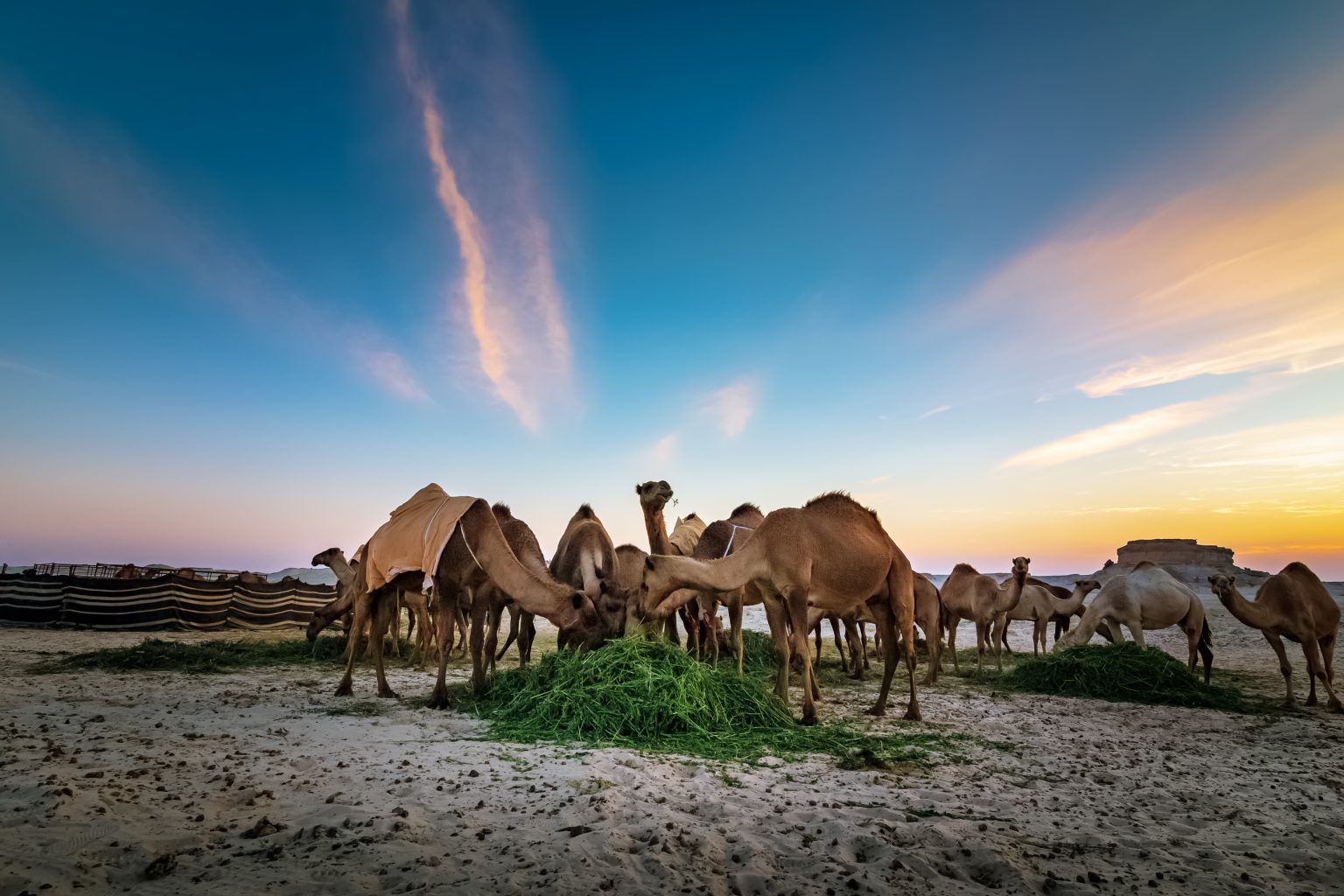
Saudi Arabia is home to some of the Arabian Peninsula’s most extensive desert environments. The Saudi Arabia desert includes the vast Empty Quarter (Rub al Khali), the red dunes of Al-Nafud, and the long sandy corridor of Ad-Dahna. These landscapes also contain historic routes, isolated oases, volcanic fields, and wildlife adapted to extreme heat and limited water.
- The Desert Landscapes of Saudi Arabia
- Wildlife of the Saudi Arabian Desert
- Desert mammals adapted to extreme heat
- Birds of the Saudi Arabian Desert
- Reptiles and insects of the Arabian Desert
- Desert Plants, Oases, and Water Habitats
- Best Places to Experience Saudi Arabia’s Desert Nature
- The Empty Quarter (Rub al Khali)
- Al-Nafud Desert
- Harrat Khaybar
- Al-Ahsa Oasis
- Turaif and the Northern Desert Landscapes
- Desert Activities and Wildlife Experiences
- Camel Experiences Across the Dunes
- Desert Camping and Stargazing
- Tracking Animals in the Sand
- 4×4 Trips Through Deserts and Wadis
- Weather and the Best Time to Visit
- Safety Tips for Exploring the Saudi Arabian Desert
- Exploring Saudi Arabia’s Desert Landscapes
The deserts of Saudi Arabia are more varied than their vast sandy areas might suggest. Desert foxes, gazelles, falcons, reptiles, and other species survive across dunes, rocky plains, mountains, and wadis. Travelers can also discover unusual rock formations and landscapes shaped by wind, erosion, and volcanic activity over long periods.
The Desert Landscapes of Saudi Arabia
The deserts of Saudi Arabia vary considerably from one region to another. The southern part of the country is dominated by the Rub al Khali, the world’s largest continuous sand desert. Its enormous dunes can change shape as strong winds move the sand, creating landscapes that range from pale gold to orange and deep red.
Farther north, the Al-Nafud Desert is known for its striking red sands and large dunes. The region is also associated with important archaeological sites and ancient rock art, including the UNESCO-listed rock art landscapes around Jubbah and Shuwaymis in the wider Ha’il region.
Running across central Saudi Arabia, the Ad-Dahna Desert forms a long sandy corridor connecting the Al-Nafud Desert in the north with the Rub al Khali farther south. Its reddish dunes create one of the most distinctive desert landscapes in the Arabian Peninsula.
Western Saudi Arabia has a different character. Around the volcanic fields known as the harrats, travelers can encounter rocky deserts, lava plains, volcanic cones, and unusual geological formations. Harrat Khaybar is particularly notable for its extensive black lava fields and volcanic features.
Desert oases provide another important contrast. Places such as Al-Ahsa and Najran contain palms, springs, agricultural areas, and habitats for birds and other wildlife. These pockets of water and vegetation have supported human settlement in otherwise dry environments for centuries.
Wildlife of the Saudi Arabian Desert
Desert mammals adapted to extreme heat
Many desert animals are most active during the cooler hours of the day or at night. Among Saudi Arabia’s best-known desert mammals is the Arabian oryx, a species that was once close to extinction before successful conservation programs helped restore populations in parts of the Arabian Peninsula.
The sand gazelle, also known as the reem gazelle, is another important desert species. It is well adapted to dry environments and can survive with limited access to free-standing water.
The Arabian wolf is much less common and is generally associated with remote areas, including mountainous and rocky terrain.
Other smaller mammals found in suitable desert habitats include:
- Arabian hare, adapted to dry open landscapes.
- Jerboas, small nocturnal rodents that move across sandy terrain.
- Rüppell’s fox, a small desert fox with adaptations for hot and arid conditions.
- Camels, which remain important for transportation, tourism, and cultural traditions.
Camels have played an important role in Arabian desert life for centuries and remain closely connected with Saudi heritage.
Birds of the Saudi Arabian Desert
Saudi Arabia’s deserts support a wide variety of resident and migratory birds. Falcons have a particularly important place in Saudi and wider Arabian culture, where falconry has a long history and remains an important tradition.
Other birds found across desert and semi-desert habitats include:
- Shrikes
- Hoopoes
- Sandgrouse
- Larks
- Bustards
- Eagles
- Buzzards
- Kites
Oases and wetlands such as Al-Ahsa and Al-Qatif can provide important resting and feeding areas for migratory birds, particularly during seasonal movements.
Birds of prey also use open desert landscapes to search for smaller mammals and reptiles. The Arabian bustard and other ground-dwelling birds can be found in suitable habitats where vegetation provides food and cover.
Reptiles and insects of the Arabian Desert
The warm, dry conditions of Saudi Arabia provide suitable habitats for numerous reptiles. Depending on the region, visitors may encounter skinks, geckos, and monitor lizards, often sheltering among rocks or vegetation during the hottest parts of the day.
Several snake species are also adapted to desert environments, including horned vipers and sand boas. They are generally difficult to spot and tend to avoid people.
Insects and other invertebrates are equally important to the desert ecosystem. Beetles, ants, spiders, and other small species form an important part of the food chain and become particularly active when moisture and vegetation increase after rainfall.
Desert Plants, Oases, and Water Habitats
Plants in the Saudi desert have developed different ways to survive heat, drought, salty soils, and limited rainfall.
In valleys and wadis, trees such as ghaf, acacia, and sidr can provide shade, food, and shelter for wildlife. Their roots and fallen plant material also contribute to soil stability and nutrient cycling.
Other plants adapted to sandy or rocky environments include:
- Halfa grass
- Saltbush
- Calligonum species
- Wormwood and other drought-tolerant shrubs
After seasonal rainfall, parts of the northern desert can temporarily become greener, with grasses and flowering plants appearing in areas that remain dry for much of the year.
Al-Ahsa Oasis is one of Saudi Arabia’s most important examples of a productive oasis landscape. Its springs, agricultural areas, and extensive palm groves create habitats that are very different from the surrounding desert. These water-rich environments support insects, birds, and small mammals while also providing the foundation for human settlement and agriculture.
Best Places to Experience Saudi Arabia’s Desert Nature
The Empty Quarter (Rub al Khali)
The Rub al Khali offers some of Saudi Arabia’s most dramatic dune landscapes. Remote areas provide opportunities for desert photography, wildlife observation, dune exploration, and guided 4×4 trips.
Al-Nafud Desert
The Al-Nafud Desert is known for its red dunes, archaeological heritage, and relatively accessible desert landscapes. It is a strong choice for travelers interested in combining scenery, wildlife, and Saudi cultural history.
Harrat Khaybar
Harrat Khaybar is one of the country’s most distinctive volcanic landscapes. Its lava fields, volcanic cones, craters, and rocky terrain create a very different environment from the major sand deserts.
Al-Ahsa Oasis
This UNESCO World Heritage Site combines palm groves, springs, agricultural land, and historic settlements. Its water and vegetation also make it an important habitat for birds and other species.
Turaif and the Northern Desert Landscapes
The desert landscapes around northern Saudi Arabia can support gazelles, foxes, migratory birds, and seasonal vegetation. The wider region also contains important cultural and archaeological sites.
Together, these destinations show that the Saudi Arabian desert is not a single type of landscape. Sand dunes, volcanic fields, oases, rocky plains, and seasonal vegetation all form part of the country’s dry environments.
Desert Activities and Wildlife Experiences
Camel Experiences Across the Dunes
Camel travel has been part of Arabian desert life for generations. Today, guided camel experiences allow visitors to travel across dunes at cooler times of the day while learning about traditional desert transportation and culture.
Desert Camping and Stargazing
Away from major cities, the Saudi Arabian desert can offer excellent conditions for stargazing. On clear nights, the Milky Way can be visible, while nocturnal animals become more active after sunset.
Tracking Animals in the Sand
Reading animal tracks in the sand is a traditional skill used by experienced desert guides. Footprints can sometimes reveal the presence of foxes, gazelles, birds, rodents, and reptiles.
4×4 Trips Through Deserts and Wadis
Guided 4×4 excursions provide access to remote dunes, rocky valleys, wadis, volcanic landscapes, and unusual geological formations. In unfamiliar terrain, traveling with an experienced local guide is strongly recommended.
Weather and the Best Time to Visit
The climate of Saudi Arabia’s desert can be extremely hot, particularly during summer. For most travelers, the cooler months from October to April are generally the most comfortable period for outdoor activities.
Winter is especially suitable for camping and longer excursions because daytime temperatures are more manageable, although nights can become surprisingly cold in some desert areas.
During the hottest months, outdoor activities are best planned for early morning or late afternoon and evening. Conditions vary considerably between the northern, central, western, and southern parts of the country.
Rainfall is generally limited, but seasonal showers can temporarily transform parts of the northern desert. After sufficient rain, grasses and flowering plants may appear for a short period.
Safety Tips for Exploring the Saudi Arabian Desert
Remote desert travel requires careful preparation. A qualified local guide is strongly recommended for unfamiliar or isolated areas, particularly when traveling deep into dune fields or volcanic terrain.
Before heading into the desert, travelers should carry:
- Sufficient drinking water
- Sun protection and sunscreen
- Suitable closed footwear
- Navigation equipment and offline maps
- A charged phone and emergency communication option
- Basic first-aid supplies
Wild animals generally avoid people, but visitors should not approach or feed them. Extra caution is advisable after dark, when many desert species become active.
Navigation also requires attention. GPS devices can be useful, but travelers should not rely on a single electronic device in remote areas. Sandstorms and sudden changes in visibility can create additional risks, particularly during periods of unsettled weather.
Exploring Saudi Arabia’s Desert Landscapes
Saudi Arabia’s deserts extend far beyond the image of endless sand dunes. The Al-Nafud and Rub al Khali contain enormous sandy landscapes, while Harrat Khaybar reveals the country’s volcanic geology and Al-Ahsa shows how water can transform an arid environment.
These regions also support a variety of wildlife, from oryx and gazelles to foxes, birds, reptiles, and countless smaller species. Ancient routes, oasis settlements, falconry, camel culture, and archaeological sites add an important human dimension to the landscape.
For travelers willing to explore beyond the major cities, Saudi Arabia’s desert offers a combination of wildlife, geology, cultural heritage, and wide-open landscapes that makes the country’s dry regions especially diverse.