
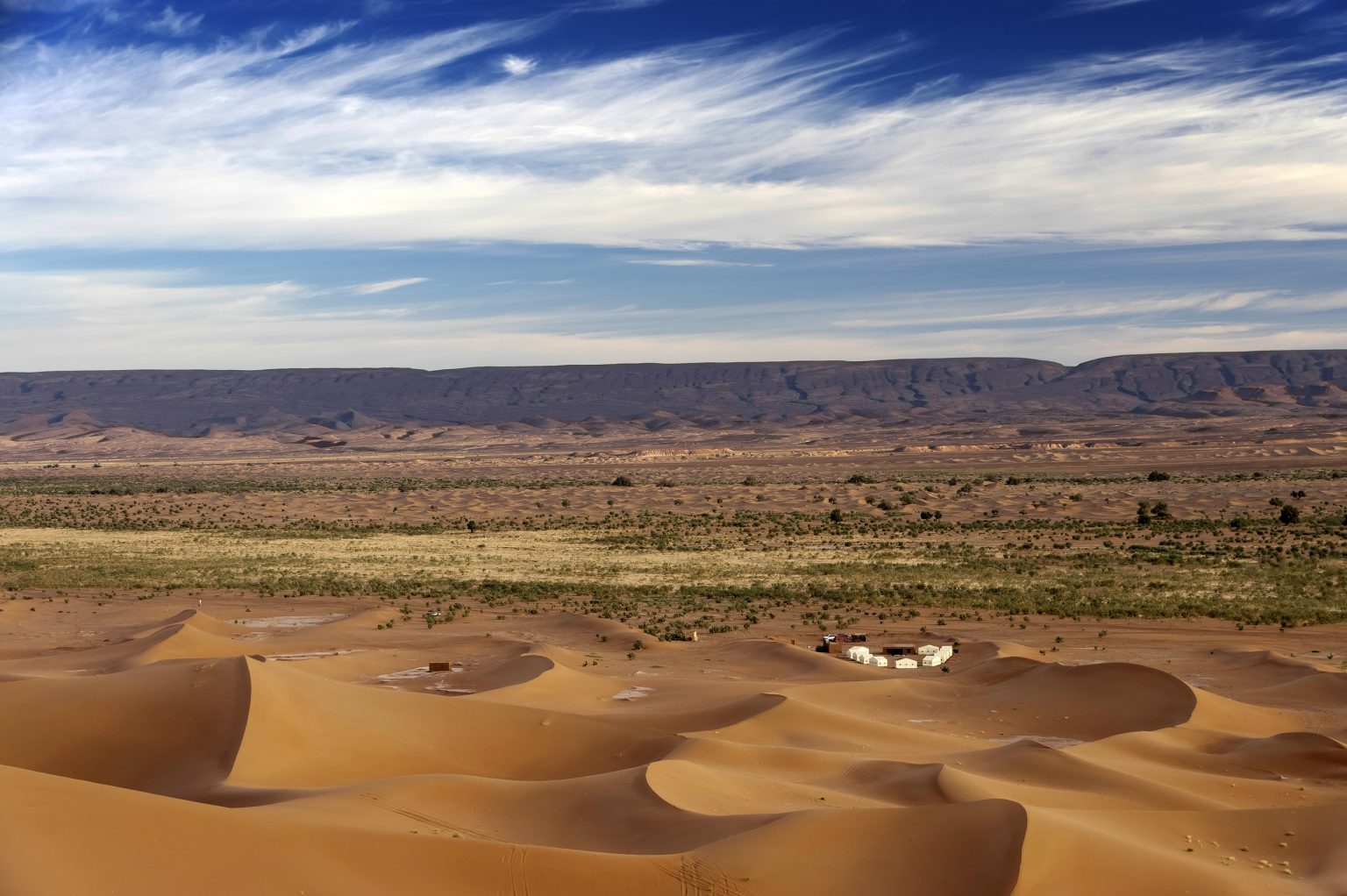
Erg Chigaga lies deep in southern Morocco, beyond M’Hamid El Ghizlane and the paved roads that connect the Draa Valley with the wider Sahara. Reaching the dunes requires an off-road journey across the Hamada du Drâa, making the area more remote than the better-known desert destination of Erg Chebbi near Merzouga.
- Where Is Erg Chigaga Located?
- The Landscape: Sand Dunes and Open Desert
- Climate and Best Time to Visit Erg Chigaga
- Wildlife and Desert Vegetation
- Nomadic Culture and Desert Traditions
- Top Things to Do in Erg Chigaga
- Camel Trekking from M’Hamid
- Overnight Desert Camping
- 4×4 Off-Road Desert Tours
- Sandboarding
- Sunrise and Sunset Viewing
- Suggested 2-Day Erg Chigaga Itinerary
- Where to Stay in Erg Chigaga
- Practical Travel Tips
- Hidden Places Near Erg Chigaga
- The Remote Dunes of Erg Chigaga
The dune field extends for more than 40 kilometers and is known for its large sand formations, open desert surroundings, and limited development. Travelers come here for camel trekking, 4×4 excursions, overnight camps, photography, and clear night skies.
What makes Erg Chigaga distinctive is its combination of scale and remoteness. The journey across the rocky desert is part of the experience, leading from the oasis landscape around M’Hamid into one of southern Morocco’s largest concentrations of sand dunes.
Where Is Erg Chigaga Located?
Erg Chigaga is located in southern Morocco, near M’Hamid El Ghizlane in Zagora Province. The dunes lie west of M’Hamid and can only be reached by crossing desert tracks.
- Coordinates: approximately 29.9°N, 6.2°W
- Elevation: around 450 meters above sea level in the wider M’Hamid-Erg Chigaga area
- Distance from M’Hamid: approximately 65 km west, depending on the route and destination within the dune field
- Distance from Marrakech: approximately 520 km by road to M’Hamid, followed by an off-road journey
- Distance from Ouarzazate: approximately 260 km by road to the M’Hamid area
Erg Chigaga is considerably less developed than Erg Chebbi, with fewer camps and less road traffic. This makes it particularly attractive to travelers who want a more remote desert setting.
The Landscape: Sand Dunes and Open Desert
The route to Erg Chigaga crosses several different desert environments before reaching the main dune field. The landscape is not made up of sand alone. Rocky plains, dry channels, scattered vegetation, and isolated oases form part of the wider environment.
Key landscape features include:
- Dune field: Large golden and reddish sand dunes extending across a broad area.
- Hamada du Drâa: A rocky desert plateau crossed on the way from M’Hamid toward Erg Chigaga.
- Small oases: Isolated areas of vegetation and water can be found in parts of the wider desert.
- Ancient drainage landscapes: The region contains geological traces associated with former water systems and the wider Draa River basin.
The appearance of the dunes changes throughout the day as the angle of the sun alters the colors, shadows, and definition of the ridges.
Climate and Best Time to Visit Erg Chigaga
Erg Chigaga has a hot and extremely dry Saharan climate. Summer conditions can be difficult for extended outdoor activities, while winter brings much more comfortable daytime temperatures but cold nights.
Typical conditions include:
- Annual rainfall: generally less than 100 mm, although rainfall varies considerably from year to year
- Summer temperatures: often above 40°C and potentially approaching 50°C during extreme heat
- Winter nights: can fall close to or below 5°C, particularly in clear conditions
Best Time to Visit
October to April is generally the most comfortable period for visiting Erg Chigaga.
November to March is particularly suitable for:
- Camel trekking
- 4×4 desert tours
- Camping
- Hiking around the dunes
- Photography
- Stargazing
Occasional rainfall can also produce short-lived vegetation and wildflowers in parts of the surrounding desert, although these events are highly seasonal and unpredictable.
Wildlife and Desert Vegetation
The environment around Erg Chigaga supports plants and animals adapted to limited water, high temperatures, and large daily temperature changes. Wildlife is easier to notice in the cooler hours of the day.
Plants
Common desert vegetation in the wider region includes:
- Tamarisk, particularly around areas with access to groundwater or seasonal water
- Halfa grass and other desert grasses, which can become more visible after rainfall
- Acacia trees, especially around dry channels and areas with deeper soils
- Small shrubs and seasonal herbs adapted to arid conditions
Animals
Wildlife that may be encountered in the wider M’Hamid and Erg Chigaga region includes:
- Camels used by local communities and tourism operators
- Fennec foxes and other small desert mammals
- Jerboas and other nocturnal rodents
- Lizards and geckos
- Desert-adapted snakes
- Migratory and resident birds, including wheatears and birds of prey
Most wildlife is difficult to spot during the hottest part of the day, when many species remain sheltered from the heat.
Nomadic Culture and Desert Traditions
The wider Erg Chigaga region has long been associated with Amazigh and Arab desert communities, including nomadic and semi-nomadic groups whose livelihoods have traditionally depended on livestock, seasonal movement, trade, and knowledge of desert water sources.
Important elements of local desert culture include:
- Camel and goat herding
- Traditional tents and mobile camps
- Mint tea and desert hospitality
- Nabati and other forms of oral poetry
- Traditional music and percussion
Evening gatherings at desert camps may include Gnawa music, drums, singing, and storytelling. These cultural experiences are best approached as living traditions rather than as entertainment separated from the region’s history.
Top Things to Do in Erg Chigaga
Camel Trekking from M’Hamid
M’Hamid El Ghizlane is the main starting point for camel journeys toward Erg Chigaga. Depending on the itinerary, guided treks can last from a few hours to several days.
Multi-day journeys allow travelers to cross sections of the desert at a slower pace, camp overnight, and experience the changing landscape between M’Hamid and the main dunes.
Overnight Desert Camping
Travelers can choose between traditional bivouac-style camps and more comfortable desert camps.
A typical overnight stay may include:
- Dinner prepared at the camp
- Tea and refreshments
- Campfire gatherings
- Traditional music
- Stargazing
- Sunrise and sunset views from nearby dunes
Temperatures can drop significantly after sunset during the cooler months, so warm clothing is important even after a hot afternoon.
4×4 Off-Road Desert Tours
A 4×4 journey from M’Hamid crosses the Hamada du Drâa before reaching the Erg Chigaga dune field. Depending on the route, excursions may include stops at geological sites, desert vegetation, old caravan areas, or small oases.
Because there are no conventional paved roads through this section of the desert, traveling with an experienced local driver is strongly recommended.
Sandboarding
The larger dunes provide suitable slopes for sandboarding. Equipment can often be arranged through desert camps or local tour operators.
The activity is simple to combine with a 4×4 excursion or overnight camping trip.
Sunrise and Sunset Viewing
The high dunes provide broad views across the surrounding desert. Sunrise and sunset are particularly good times for photography because the low-angle light creates stronger shadows and emphasizes the shape of the dune ridges.
Suggested 2-Day Erg Chigaga Itinerary
Day 1: Journey into the Dunes
- Morning departure from M’Hamid by 4×4
- Cross the Hamada du Drâa
- Stop at selected desert landscapes or an oasis along the route
- Afternoon arrival at the Erg Chigaga dune field
- Explore the dunes and watch the sunset
- Dinner and overnight stay at a desert camp
Day 2: Desert Exploration and Return
- Early morning sunrise from the dunes
- Breakfast with Moroccan tea
- Short camel ride or sandboarding session
- Optional visit to nearby nomadic areas, depending on the route and local arrangements
- Return to M’Hamid by 4×4
Travelers who want more time for camel trekking, photography, or remote desert exploration should consider staying for a third night rather than compressing the experience into two days.
Where to Stay in Erg Chigaga
Comfortable Desert Camps
Several camps operate in the Erg Chigaga area, ranging from simple bivouacs to more comfortable tented accommodation. Options may include:
- Erg Chigaga Sahara Services Camp
- Luxury desert camps operated by local tourism companies
Traditional and Smaller Bivouacs
Travelers looking for a simpler setting can choose smaller camps such as:
- Camp Al Koutban
- Le Petit Prince Bivouac
Eco and Nomadic-Style Camps
Other camps focus on smaller-scale accommodation and traditional desert settings, including:
- Camp Azalaï
- Erg Chigaga Nomad Camp
Camp names, facilities, and operating arrangements can change, so travelers should confirm current availability and services before booking.
Practical Travel Tips
Erg Chigaga is remote, and preparation becomes more important once you leave M’Hamid.
- Best season: October to April
- Access: Approximately 2–3 hours off-road from M’Hamid, depending on the route and conditions
- Clothing: Bring lightweight clothing for the day and warm layers for the night.
- Sun protection: Carry sunscreen, sunglasses, and a scarf or head covering.
- Water: Carry adequate drinking water even when traveling with a tour operator.
- Power: A power bank is useful because charging options are limited in remote camps.
- Navigation: Use an experienced local guide or driver for off-road travel.
- Connectivity: Mobile coverage can be limited or unavailable in parts of the desert.
- Vehicle: Remote desert travel should be undertaken in a properly equipped 4×4.
Hidden Places Near Erg Chigaga
Several locations around the route from M’Hamid to Erg Chigaga can add geological and cultural interest to a desert journey:
- Erg Smar Oasis: A small oasis area within the wider desert landscape.
- Hamada du Drâa: Rocky desert terrain with fossils and geological features.
- Aït Ounir: A local desert area associated with nomadic routes and landmarks.
- M’Hamid ksars and palm groves: Historic settlements and cultivated areas that mark the transition from the Draa Valley oasis to the surrounding desert.
These places are best visited with a local guide who knows the routes and current access conditions.
The Remote Dunes of Erg Chigaga
Erg Chigaga stands out because reaching the dunes is part of the destination itself. The journey from M’Hamid El Ghizlane crosses the rocky Hamada du Drâa before the landscape gradually changes into large stretches of sand.
For travelers, this combination of remoteness, large dunes, desert camping, camel routes, and local cultural traditions creates a different experience from the more accessible desert areas of Morocco. The limited road access also means that planning, local guidance, water, and suitable transport are important.
Erg Chigaga is ultimately defined by its geography: a remote dune system beyond the Draa Valley oasis, reached by crossing open desert and experienced through the landscape, activities, and communities that surround it.