
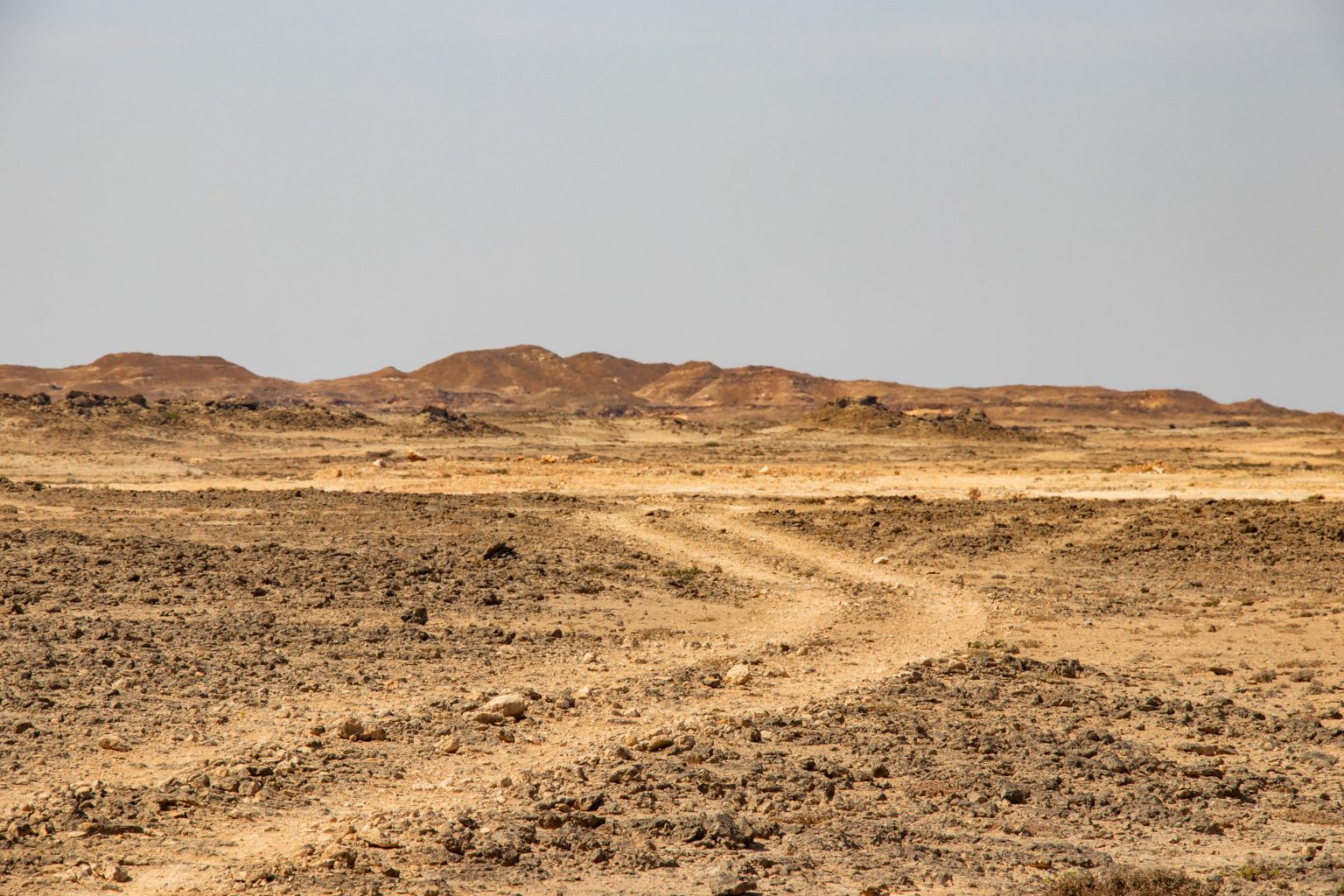
Beyond the dunes of Ramlat al Wahbah, southern Oman opens into a very different desert environment: Jiddat al Harasis, a vast stony plateau covering a large part of Al Wusta Governorate.
- Where Is Jiddat al Harasis?
- Climate and Best Time to Visit
- Getting to Jiddat al Harasis
- The Arabian Oryx Sanctuary
- The Harasis People
- Fossil Plains and Ancient Landscapes
- Camping Under Oman’s Desert Sky
- Suggested 2-Day Itinerary
- Practical Travel Tips
- Nearby Hidden Places
- A Vast Desert Plateau Shaped by Wildlife and Geology
Unlike Oman’s better-known sand deserts, Jiddat al Harasis is dominated by broad gravel plains, rocky surfaces, scattered vegetation, and low relief. Its open terrain provides habitat for wildlife including Arabian oryx and gazelles, while fossil deposits reveal that the region has a much older geological history than its dry appearance suggests.
The plateau is also closely connected with the Harasis people, whose traditional knowledge of the region developed through generations of movement across this difficult environment. For visitors, Jiddat al Harasis offers a remote desert experience focused on wildlife, geology, astronomy, and wide-open landscapes rather than large dunes.
Where Is Jiddat al Harasis?
Jiddat al Harasis lies in Al Wusta Governorate in central-southern Oman. The plateau covers an extensive area, with estimates commonly placing its size at around 30,000 square kilometers.
It extends south of Haima, with Duqm to the east and the desert regions toward the Rub al Khali farther west.
The wider plateau includes several different environments, from gravel plains and rocky surfaces to seasonal drainage areas and isolated vegetation.
The Arabian Oryx Sanctuary was established within this wider desert region as part of efforts to protect the Arabian oryx and restore its population in the wild.
Climate and Best Time to Visit
Jiddat al Harasis has a hot, dry desert climate with significant differences between summer and winter conditions.
Typical seasonal patterns include:
- November to March: Cooler daytime temperatures, generally making this the most comfortable period for camping and wildlife observation.
- April and May: Increasing temperatures, with conditions becoming hotter during the afternoon.
- June to September: Very hot conditions, with daytime temperatures potentially exceeding 40°C.
- October: Often a useful transition period before the cooler season begins.
The cooler months are generally the best choice for combining wildlife observation, camping, photography, and long-distance desert travel.
Getting to Jiddat al Harasis
From Muscat
Travelers coming from Muscat generally travel south through the interior of Oman, passing areas such as Nizwa, Adam, and Haima before reaching the wider Jiddat al Harasis region.
The road journey to Haima is roughly 550 kilometers, although the final distance and travel time depend on the specific destination within the plateau.
A properly equipped 4×4 becomes important when leaving paved roads and entering remote desert tracks.
From Duqm
Duqm provides another access point from the east. Some parts of Jiddat al Harasis can be reached from Duqm in approximately 250 kilometers, depending on the destination and route.
The journey crosses open desert terrain containing gravel plains, salt-affected areas, shrubs, and occasional low-lying depressions.
Because services are scarce away from the main roads, travelers should plan fuel, water, navigation, and communications before entering remote sections.
The Arabian Oryx Sanctuary
The Arabian Oryx Sanctuary became one of the most important conservation projects in the region after the Arabian oryx had disappeared from the wild in Oman.
The sanctuary supported efforts to reintroduce the species and protect its habitat. It became an important part of the history of Arabian oryx conservation and was designated a UNESCO World Heritage Site in 1994. Its World Heritage status was later removed in 2007 following concerns related to changes to the protected area and oil exploration.
Wildlife associated with the wider Jiddat al Harasis environment includes:
- Arabian oryx
- Arabian gazelles
- Desert foxes
- Hares
- Various reptiles
- Migratory and resident desert birds
Wildlife observation is generally best during the cooler hours of the day. Early morning and late afternoon provide better conditions for spotting animals and photographing them without exposing them to excessive heat.
Visitors should maintain a safe distance from wildlife and follow all regulations in protected areas.
The Harasis People
The Harasis are an Omani tribal community traditionally associated with Jiddat al Harasis. Their knowledge of the plateau developed through generations of living and traveling in an environment where water, grazing, and navigation are limited.
Traditional activities and cultural practices include:
- Camel herding
- Livestock management
- Falconry
- Poetry and oral traditions
- Desert navigation
- Hospitality and communal gatherings
The Harasis’ knowledge of local terrain and resources is particularly relevant to anyone exploring the remote plateau. Visitors should approach local communities respectfully and arrange cultural encounters through appropriate local guides or operators.
Fossil Plains and Ancient Landscapes
Jiddat al Harasis is also important for its geological and fossil resources. Marine fossils found in parts of the region provide evidence that areas of what is now Oman were once covered by ancient seas.
Fossil material can include:
- Shell fragments
- Marine fossils
- Coral-related remains
- Other traces of ancient marine environments
The plateau’s geology adds another dimension to a landscape that may initially appear uniform. Gravel plains, exposed rock, sedimentary formations, and fossil-bearing areas reveal different stages of the region’s geological history.
Visitors should avoid collecting fossils or geological specimens unless collection is specifically permitted. Many sites have scientific, environmental, or cultural value.
Camping Under Oman’s Desert Sky
Camping in Jiddat al Harasis offers a very different experience from staying at a developed desert resort. Remote areas have few permanent facilities, so most organized trips rely on temporary camps or mobile setups.
Depending on the operator, a desert camp may provide:
- Sleeping tents
- Meals and drinking water
- Campfire areas
- Basic lighting
- Stargazing
- Local guides
- Wildlife observation
The region’s distance from major urban centers can provide excellent conditions for night-sky observation, particularly on clear nights with little artificial light.
Because temperatures can fall considerably after sunset during winter, warm clothing and suitable sleeping equipment are essential.
Suggested 2-Day Itinerary
Day 1: Entering the Plateau
- Morning departure from Haima or Duqm
- Travel toward the selected Jiddat al Harasis area
- Wildlife observation during the cooler afternoon
- Visit a suitable cultural or geological site with a local guide
- Set up camp before sunset
- Dinner and stargazing
Day 2: Wildlife and Fossils
- Early morning wildlife observation
- Visit selected fossil-bearing areas where access is permitted
- Sunrise and landscape photography
- Continue exploring the plateau
- Return toward Haima or Duqm, or continue toward another desert destination
A longer trip is preferable for travelers interested in wildlife, geology, or remote off-road exploration because distances across the plateau are substantial.
Practical Travel Tips
Jiddat al Harasis is a remote environment where preparation is essential.
- Use a properly equipped 4×4 vehicle for remote desert tracks.
- Stock up on fuel, drinking water, food, and essential supplies before leaving major settlements such as Haima or Duqm.
- Check whether permits or access arrangements are required for the specific area you plan to visit.
- Carry reliable offline navigation and, for remote travel, consider a satellite communication device.
- Traveling in a two-vehicle convoy is advisable for isolated off-road routes.
- Carry recovery equipment suitable for sand and gravel terrain.
- Protect yourself from the sun during the day and bring warm clothing for winter nights.
- Keep a safe distance from wildlife.
- Do not disturb archaeological, fossil, or geological sites.
- Take all waste with you and avoid damaging vegetation.
- Arrange remote excursions with an experienced local guide whenever possible.
Nearby Hidden Places
Travelers with more time can explore several lesser-known areas around Al Wusta and the wider Jiddat al Harasis region.
- Haima fossil areas: Locations around Haima contain geological and fossil features of interest.
- Wusta wildlife areas: Other parts of Al Wusta provide opportunities to observe desert species and migratory birds.
- Mahout salt flats: Coastal salt landscapes provide a strong contrast with the inland plateau.
- Remote oryx observation areas: Suitable locations can be visited through authorized operators and conservation programs.
- Desert meteorite areas: The arid plains of Oman are known for meteorite finds, although collection and access may be restricted.
A Vast Desert Plateau Shaped by Wildlife and Geology
Jiddat al Harasis offers a different view of the Omani desert. There are no towering dune fields defining the landscape. Instead, broad gravel plains, exposed rock, scattered vegetation, fossil deposits, and open horizons dominate the plateau.
Its importance also extends beyond scenery. The region is associated with the Arabian oryx, one of the most recognizable animals of the Arabian Peninsula, and with the Harasis people, whose traditional knowledge is closely connected to the desert environment. Its fossil-bearing landscapes add evidence of an ancient geological past.
For travelers prepared for remote conditions, Jiddat al Harasis provides an opportunity to experience one of Oman’s largest and least developed desert environments through wildlife observation, geology, cultural heritage, camping, and off-road exploration.