
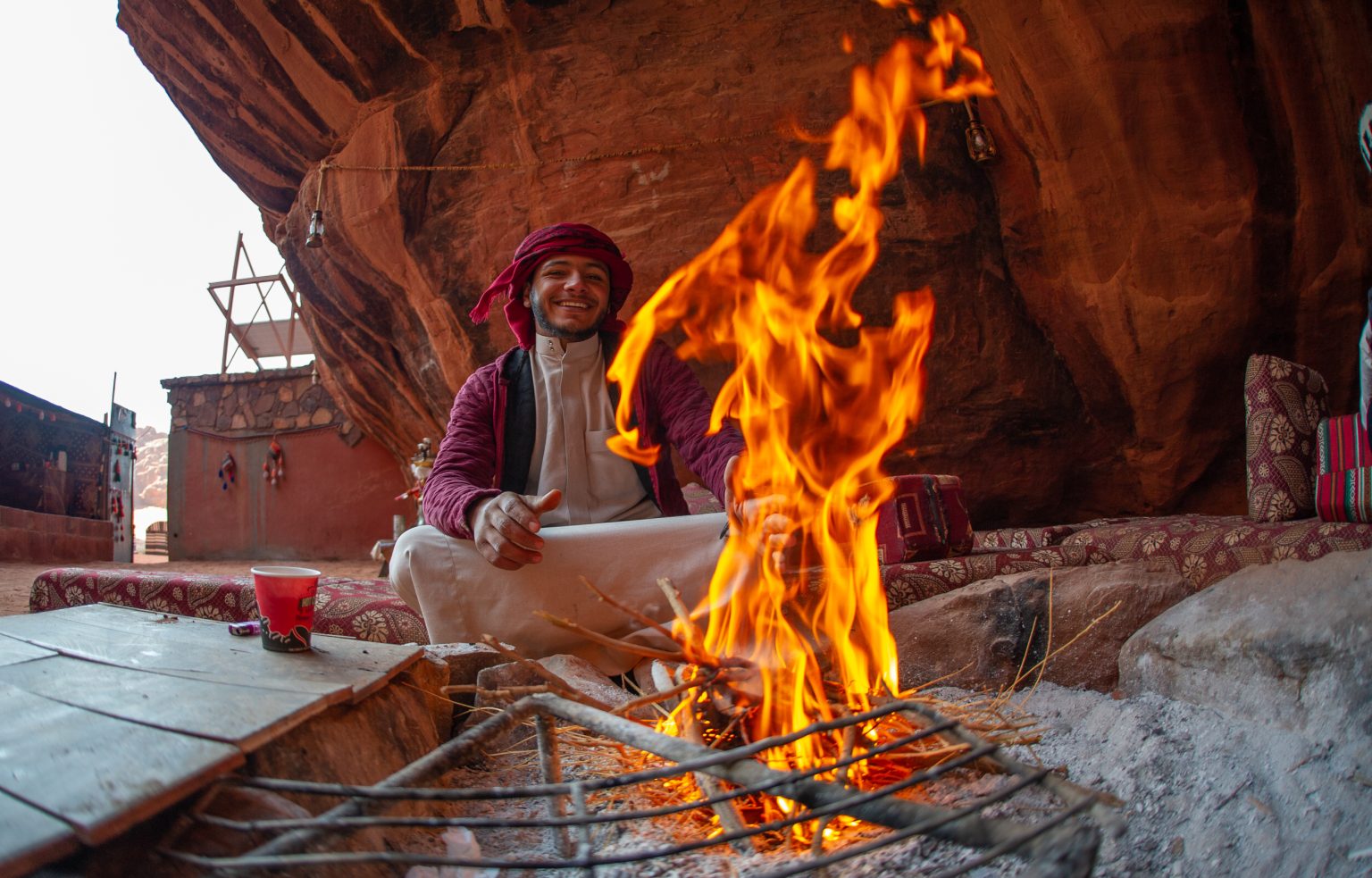
Bedouin hospitality in Jordan is often experienced over Arabic coffee and conversation in a desert camp. In Wadi Rum, visitors may spend an evening around a fire, share a traditional meal, and learn about the customs that have shaped life in southern Jordan. The experience offers more than a night in the desert: it provides an introduction to a living culture whose traditions continue to evolve.
- Who Are the Bedouins of Jordan?
- The Meaning of Bedouin Hospitality
- Daily Life in Wadi Rum
- Bedouin Food and Desert Cuisine
- Bedouin Music and Oral Storytelling
- Bedouin Values and Community Traditions
- Experiencing Bedouin Culture as a Traveler
- The Role of Bedouin Women
- Bedouins in Modern Jordan
- How to Travel Respectfully Among Bedouin Communities
- Planning a One-Night Cultural Experience in Wadi Rum
- Discover the Living Heritage of Bedouin Hospitality
From Bedouin culture in Jordan to the heritage of Wadi Rum, this guide explores local communities, hospitality customs, food, music, and everyday life. It also explains how travelers can experience these traditions respectfully while supporting local people and community-based tourism.
Who Are the Bedouins of Jordan?
The Bedouins, often called Bedu, are Arab communities historically associated with pastoralism, seasonal movement, and life in arid and semi-arid environments. In Jordan, Bedouin communities have long-standing connections with the southern regions around Petra and Wadi Rum, as well as other parts of the country.
Their knowledge of the landscape developed through generations of travel, animal husbandry, water management, and familiarity with local plants and wildlife. Oral traditions, poetry, craftsmanship, and social customs have also helped preserve cultural knowledge.
There is no single Bedouin way of life. Some families maintain pastoral practices, while others live in towns and villages or work in tourism, education, business, and other professions. Traditions vary between communities and families.
Bedouin heritage in Jordan includes several tribal groups. In southern Jordan, communities with historical connections to Petra and Wadi Rum include the Bdul, Ammarin, and Sa’idiyyin. Other tribal groups have historical ties to different regions of the country.
UNESCO inscribed the cultural space of the Bedu in Petra and Wadi Rum on its Representative List of the Intangible Cultural Heritage of Humanity in 2008. The recognition highlights cultural knowledge and practices associated with the region, including oral traditions and relationships with the surrounding environment.
The Meaning of Bedouin Hospitality
Hospitality has an important place in Bedouin social traditions. Welcoming guests, offering refreshments, and making visitors comfortable express generosity and respect. Historically, hospitality also had practical importance in regions where travelers could face long distances between settlements and limited access to resources.
Visitors may encounter these customs when staying with local hosts or joining a community-led desert experience. A welcome can include greetings, Arabic coffee, tea, and conversation, although the details depend on the household and occasion.
Arabic Coffee and the Art of Welcome
Arabic coffee, often called gahwa or qahwa, is a well-known symbol of hospitality in Jordan. Its preparation and serving may involve roasting and grinding the beans, brewing the coffee with spices, and offering small portions in traditional cups.
During a visit, travelers may notice several customs associated with serving coffee:
- Serving the guest: Coffee may be offered as part of the initial welcome.
- Respect for elders and guests: In some settings, the order of serving reflects social customs and respect.
- Small portions: Coffee is traditionally served in small cups, allowing guests to accept additional servings.
- Shaking the cup: In some communities, gently shaking an empty cup indicates that the guest does not want another serving.
Stories about the symbolic meanings of three coffee cups are sometimes associated with Bedouin traditions. However, the meanings and expectations attached to individual cups vary, so the custom should not be presented as a universal ritual followed identically by every community.
Accepting coffee can be a courteous gesture, but guests who do not drink it can politely decline. Observing how a host serves it is a simple way to learn about local customs without assuming that every household follows the same practices.
Daily Life in Wadi Rum
Bedouin life in Wadi Rum combines cultural continuity with modern changes. Some residents maintain knowledge of camel care, traditional crafts, and the surrounding environment, while many work in tourism and other sectors. Desert camps, guesthouses, and guided excursions have created new ways for local people to share their knowledge with visitors.
Traditional goat-hair tents remain part of Bedouin heritage, although contemporary homes and tourism facilities are also common. Solar power, vehicles, and digital communication may be part of daily life alongside older customs and skills.
A locally guided experience may introduce visitors to:
- Traditional desert navigation: Knowledge of the terrain and the practical skills historically used to travel through the region.
- Animal husbandry: The care of camels and other animals in communities where these practices remain relevant.
- Environmental knowledge: Familiarity with local geography, plants, and natural resources.
- Craftsmanship: Skills associated with weaving, textiles, and other traditional products.
- Oral history: Stories and knowledge passed between generations.
The activities available depend on the guide and the experience booked. Wadi Rum is also a lived-in landscape, not simply a backdrop for tourism. Respecting residents, private spaces, and local guidance helps ensure that cultural experiences benefit the communities that make them possible.
Bedouin Food and Desert Cuisine
Food is an important part of hospitality in Jordan, and shared meals offer travelers a practical introduction to local traditions. Ingredients and preparation methods vary between households, regions, and occasions, but several dishes and drinks are commonly associated with Jordanian and Bedouin food culture.
Zarb: Cooking Beneath the Sand
Zarb is a traditional method of cooking meat and vegetables in a covered underground oven heated with hot coals. The food is placed on trays inside the oven, which is then covered while the ingredients cook slowly.
A zarb meal at a desert camp may include:
- Lamb or chicken.
- Rice and vegetables.
- Bread and salads.
- Other accompaniments selected by the cook.
In Wadi Rum, zarb is often served as part of an evening meal. Some camps demonstrate the preparation process, while others serve the finished dish. Ask in advance if watching the cooking is important to you.
Bread, Tea, and Other Local Dishes
Bread is a staple in Jordanian food culture. In some Bedouin traditions, arbood is prepared as a simple bread cooked in or near hot embers. Preparation methods differ, and not every camp offers it.
Other refreshments and foods travelers may encounter include:
- Arabic coffee: Often served during greetings and social visits.
- Tea: Commonly offered during desert excursions and at camps.
- Dates: Sometimes served alongside coffee or as a light refreshment.
- Traditional meals: Depending on the host, meals may include rice, meat, bread, yogurt, and salads.
When sampling local food, ask about ingredients if you have allergies or dietary restrictions. Menus depend on the camp, its facilities, and the arrangements made for the visit.
Bedouin Music and Oral Storytelling
Oral traditions have played an important role in preserving Bedouin history and cultural knowledge. Poetry, songs, folktales, and personal stories can communicate family histories, experiences of travel, relationships with the land, and reflections on community life.
Several forms of music and storytelling are associated with the wider region:
- Rababa music: The rababa is a traditional bowed string instrument found in several regional musical traditions.
- Poetry: Spoken and recited poetry can express experiences, emotions, history, and social values.
- Folk songs: Songs may accompany gatherings and celebrations, with styles varying between communities.
- Storytelling: Oral accounts can preserve memories, family histories, and knowledge of the local landscape.
- Group dances: Some cultural gatherings and tourist camps feature traditional group performances.
In Wadi Rum, some desert camps organize evening performances featuring local songs or dances. These activities can introduce visitors to regional music, but a staged performance for tourists should not be mistaken for a complete representation of everyday cultural life.
If a host shares a story or explains a song, ask about its meaning. Listening to local explanations offers a more grounded understanding than assuming that every performance has the same significance throughout Jordan.
Bedouin Values and Community Traditions
Hospitality, generosity, respect for guests, family relationships, and community responsibility are important themes in many accounts of Bedouin social life. Their expression, however, varies between individuals, families, and tribal communities.
Two terms often discussed in relation to these traditions are:
- Karam: Generosity, including the practice of welcoming and assisting guests.
- Sharaf: Honor, a concept associated with reputation and social responsibilities in various Arab communities.
Community ties have historically helped people share resources, preserve knowledge, and maintain relationships across difficult environments. Oral traditions have been especially important in passing on stories, practical skills, and local history.
For visitors, the most respectful approach is to learn from the people they meet rather than expecting every host to represent an entire culture. A conversation about daily life, family traditions, or changes in the local economy can be just as meaningful as a formal cultural activity.
Experiencing Bedouin Culture as a Traveler
Travelers can learn about Bedouin heritage through local guides, community-run accommodation, food experiences, and activities that introduce them to the landscape and its history.
Consider these experiences when planning a visit:
- Stay at a locally managed desert camp: Ask who operates the camp and how the experience connects with the surrounding community.
- Join a guided walk: Local guides may explain the area’s geography, traditional travel practices, and knowledge of plants and wildlife.
- Arrange a camel excursion: Learn about the historical role of camels in desert travel and transport.
- Share Arabic coffee or tea: Use the occasion to learn about serving customs and local hospitality.
- Try traditional food: Ask about dishes such as zarb and whether the camp offers demonstrations of their preparation.
- Learn about local crafts: Weaving, tent-making, and other traditional skills form part of the cultural heritage associated with southern Jordan.
- Listen to local stories and music: Ask performers or hosts about the traditions behind what they share.
- Support local businesses: Where possible, buy crafts directly from their makers or book activities through community-based providers.
Choose experiences that are transparent about what they offer and respectful of local people. Buying crafts directly from their makers, where possible, can help support artisans and small businesses.
The Role of Bedouin Women
Women contribute to Bedouin family and community life in diverse ways. Depending on the community and household, their work may include family responsibilities, food preparation, craft production, education, business, or participation in tourism initiatives.
Traditional craftsmanship, including weaving and the making of textiles used in tents and household life, forms part of the cultural heritage associated with Bedouin communities in southern Jordan. Such knowledge can be passed between generations, although practices vary and change over time.
Some women participate in cooperatives, craft businesses, and tourism projects that create opportunities to earn income and share local knowledge. Travelers can support these initiatives through activities such as:
- Purchasing locally made textiles or handicrafts.
- Visiting community craft projects that welcome visitors.
- Booking activities offered directly by women-led businesses.
- Learning about the materials and techniques used in traditional crafts.
It is important not to assume that every woman has the same role or wishes to participate in tourism. Ask permission before taking photographs, respect privacy, and follow the guidance of your host.
Bedouins in Modern Jordan
Bedouin communities in Jordan are not limited to a single traditional occupation or lifestyle. Many people live in permanent settlements and work in a wide range of professions, while others maintain connections with pastoral activities, cultural heritage, and desert tourism.
In Wadi Rum, tourism has created opportunities for local guides, drivers, camp operators, cooks, and craft sellers. These businesses can help visitors access the landscape while providing income for residents. At the same time, tourism can put pressure on cultural traditions when experiences are simplified or presented only to match visitor expectations.
Visitors may notice modern facilities alongside traditional cultural elements, including:
- Desert camps with electricity and digital communication.
- Guided excursions using 4×4 vehicles.
- Local businesses offering accommodation and meals.
- Cultural activities that introduce visitors to food, music, and storytelling.
- Craft businesses that maintain or adapt traditional techniques.
UNESCO’s recognition of the cultural space of the Bedu in Petra and Wadi Rum highlights the importance of safeguarding local knowledge and oral heritage as social conditions change.
A visit can contribute positively when it supports local livelihoods, respects community choices, and treats cultural heritage as something living rather than a performance frozen in the past.
How to Travel Respectfully Among Bedouin Communities
Respectful travel begins with recognizing that Wadi Rum and other parts of Jordan are home to people whose daily lives continue beyond the visitor experience.
Keep these guidelines in mind:
- Choose local providers when possible: Look for camps, guides, and businesses that identify their operators clearly.
- Ask before taking photographs: This is especially important when photographing people, homes, or private gatherings.
- Dress appropriately: Modest clothing is a considerate choice when visiting communities and shared cultural spaces.
- Follow your host’s guidance: Customs differ, so observe local practices rather than assuming that one rule applies everywhere.
- Respect private areas: Do not enter homes, tents, or restricted spaces without an invitation.
- Reduce your environmental impact: Take rubbish with you and follow instructions about water use, fires, and movement through the protected landscape.
- Support local crafts and services: Where practical, buy directly from makers or book through community-based businesses.
- Avoid intrusive questions: Let conversations develop naturally and respect subjects that hosts prefer not to discuss.
- Be considerate during cultural activities: Ask whether participation or photography is appropriate before joining in.
Avoid judging authenticity solely by whether an experience appears traditional. Contemporary life, modern equipment, and cultural continuity can coexist.
Planning a One-Night Cultural Experience in Wadi Rum
An overnight stay can provide time to experience the landscape and learn about local customs without trying to fit too many activities into one day. The exact itinerary depends on the camp, season, weather, and activities available.
Suggested Itinerary
Afternoon
- Arrive at the agreed meeting point.
- Travel to your camp or designated desert area.
- Join a guided 4×4 excursion or walk if arranged in advance.
- Learn about the surrounding landscape from your local guide.
Sunset
- Stop at an appropriate viewpoint to observe the changing light.
- Take photographs while following your guide’s instructions.
- Remain within permitted areas and avoid disturbing other visitors or residents.
Evening
- Share a meal, which may include zarb.
- Enjoy Arabic coffee or tea if offered.
- Join local music, storytelling, or other cultural activities if included in the booking.
Night
- Stay in the accommodation you have booked.
- Enjoy stargazing if the skies are clear.
- Bring an extra layer, as desert temperatures can fall after sunset.
Morning
- Enjoy breakfast at the camp.
- Speak with your host or guide about the area if time permits.
- Return to the agreed meeting point or continue with your planned journey.
What to Confirm Before Booking
To avoid surprises, check the following details with your camp or tour provider:
- Accommodation: Confirm the type of tent or room and the facilities available.
- Transport: Check pickup arrangements, meeting points, and return transfers.
- Meals: Ask which meals and drinks are included.
- Cultural activities: Confirm whether storytelling, music, craft demonstrations, or food preparation are offered.
- Tour duration: Check how much time is spent on excursions and how much is free time.
- Additional charges: Ask whether optional activities cost extra.
- Accessibility and dietary needs: Discuss any requirements before arrival.
If you want to learn about a particular tradition, ask whether a local host can explain it rather than assuming that every camp offers the same program.
Discover the Living Heritage of Bedouin Hospitality
Bedouin hospitality in Jordan brings together traditions of welcoming guests, sharing food and coffee, preserving oral stories, and maintaining connections with the desert landscape. In Wadi Rum and the surrounding region, these customs form part of a living heritage that continues to change as communities respond to modern life and tourism.
For travelers, meaningful encounters often come through respectful conversations, locally guided experiences, and the chance to learn directly from the people who call the desert home. By supporting community-based tourism and approaching traditions with curiosity rather than assumptions, visitors can gain a richer understanding of Bedouin culture in Jordan while helping protect the heritage that makes the region distinctive.