
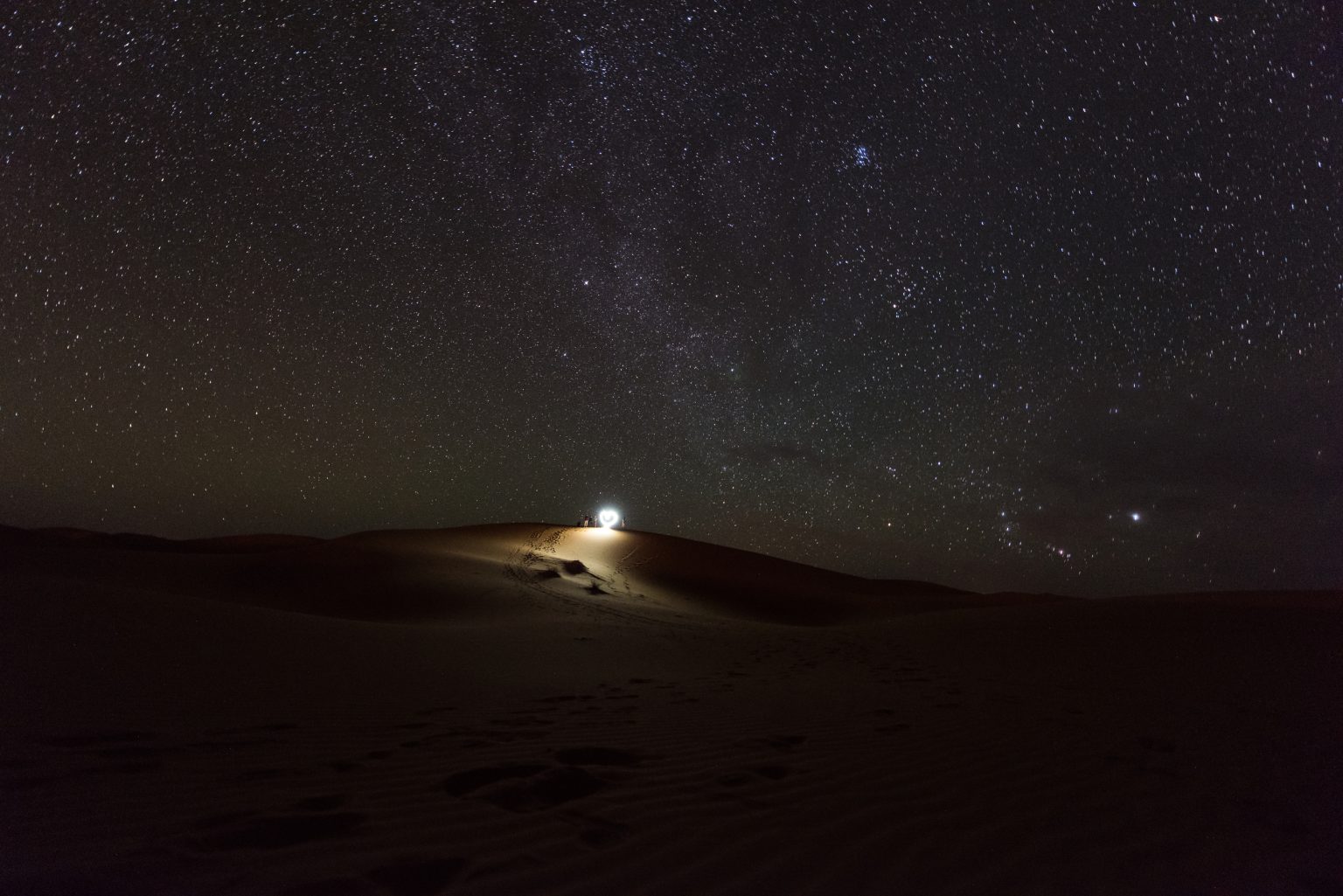
Far from city lights, Morocco’s desert landscapes offer excellent opportunities to observe the night sky. On clear nights, stars, planets, and familiar constellations become easier to see, while the Milky Way can appear as a luminous band across the darkness when the season and moonlight conditions are favorable.
- Why Morocco’s Desert Is Good for Stargazing
- Best Places for Stargazing in Morocco’s Desert
- Erg Chebbi, Merzouga
- Erg Chigaga near M’Hamid El Ghizlane
- Agafay Desert near Marrakech
- Dades Valley and the Ouarzazate Region
- Best Time of Year for Stargazing in Morocco
- What to Bring for Stargazing in the Desert
- Amazigh Heritage and the Night Sky
- Desert Camps to Consider for Stargazing
- Combining Stargazing with Desert Experiences
- Protecting Morocco’s Desert Night Sky
- A Two-Day Stargazing Itinerary for Erg Chebbi
- Costs to Expect for a Stargazing Trip
- Experience Morocco’s Desert Sky
Stargazing in Morocco’s desert combines astronomy with an overnight outdoor experience. Visitors can spend an evening near the dunes of Erg Chebbi, travel deeper into the Sahara around Erg Chigaga, or choose the more accessible rocky landscapes of Agafay Desert near Marrakech.
This guide explains when to go, where to look, what to bring, and how to enjoy the Saharan night sky while respecting the environment and local communities.
Why Morocco’s Desert Is Good for Stargazing
Remote desert areas can offer excellent viewing conditions because they have fewer artificial lights and broad, unobstructed horizons. However, sky quality varies with the location, weather, moon phase, and nearby settlements.
Several features make Morocco appealing for night-sky observation:
- Limited light pollution: Remote camps outside towns can offer darker skies than urban destinations.
- Open horizons: Dunes, rocky plains, and open desert camps provide broad views of the sky.
- A range of destinations: Travelers can choose between accessible locations near Marrakech and more remote Saharan dunes.
- Seasonal viewing opportunities: Different constellations and sections of the Milky Way become visible at different times of the year.
- An outdoor cultural experience: An evening may combine astronomy with local food, tea, music, and an overnight stay at a desert camp.
Dry weather can help visibility, but it does not guarantee a clear sky. Dust, haze, wind, and cloud cover can affect observations, so check the forecast and remain flexible.
Best Places for Stargazing in Morocco’s Desert
Erg Chebbi, Merzouga
Erg Chebbi, near Merzouga in southeastern Morocco, is one of the country’s best-known dune landscapes. Its large sand dunes and established network of desert camps make it a popular destination for travelers who want to combine a Sahara excursion with an evening beneath the stars. The Moroccan National Tourist Office identifies Merzouga as a gateway to the Sahara and the Erg Chebbi dune region.
Stargazing opportunities include:
- Observing the stars from a camp away from nearby artificial lighting.
- Photographing dune silhouettes beneath the night sky.
- Identifying visible planets and constellations with a stargazing app.
- Watching the Milky Way when it is visible and conditions are favorable.
- Joining a guided astronomy session if the chosen camp or operator offers one.
Desert camps differ in their facilities and activities. Some may provide telescopes or organized astronomy sessions, while others offer only an open area for observing the sky. Confirm these details before booking rather than assuming a telescope is included.
The Andromeda Galaxy can sometimes be seen without optical equipment under sufficiently dark skies, but it appears as a faint smudge rather than a bright, detailed object. Binoculars can make it easier to observe.
Best for: First-time Sahara visitors, photographers, couples, and travelers looking for an established desert-camp experience.
Erg Chigaga near M’Hamid El Ghizlane
Erg Chigaga lies in a remote part of southern Morocco, west of M’Hamid El Ghizlane. Reaching the main dune area generally involves a 4×4 journey arranged with an experienced local operator.
Its distance from major urban lighting can make it attractive for stargazing, particularly when the Moon is below the horizon and the sky is clear.
Reasons to consider Erg Chigaga include:
- Broad dune landscapes with open views of the sky.
- Overnight desert camps away from major towns.
- Opportunities to combine stargazing with guided desert excursions.
- Photography of dunes, stars, and the changing light around sunrise and sunset.
Travel advice:
- Arrange transport and confirm the route with your camp or guide.
- Ask whether the camp provides a telescope, an astronomy guide, or simply an outdoor viewing area.
- Bring warm clothing because temperatures can drop considerably after sunset.
- Check weather and moon conditions before traveling.
Erg Chigaga can provide a quieter experience than more accessible destinations, but actual darkness depends on the camp’s lighting, surrounding conditions, and the night you visit.
Best for: Travelers seeking a more remote desert stay, night-sky photography, and guided Sahara excursions.
Agafay Desert near Marrakech
Agafay is a rocky desert landscape southwest of Marrakech. Unlike Erg Chebbi and Erg Chigaga, it is not a vast sea of sand dunes, but its open terrain and proximity to the city make it convenient for a short desert escape.
The area has established camps and accommodation options, including Scarabeo Camp, which describes its setting as a rocky landscape with views toward the Atlas Mountains.
Stargazing activities may include:
- Observing the night sky from an outdoor camp area.
- Photographing the stars above the rocky landscape.
- Enjoying dinner or tea outdoors after sunset.
- Combining a short stay with other activities offered by the camp.
Agafay is generally easier to include in a short trip from Marrakech than the more distant Sahara dunes. However, light pollution from nearby settlements and camps can affect the view, so choose a location with limited direct lighting.
Best for: Short stays, first-time desert visitors, and travelers who do not have time to reach the Sahara.
Dades Valley and the Ouarzazate Region
The Dades Valley and Ouarzazate region offer a combination of mountain scenery, rocky valleys, kasbahs, and access routes toward the Sahara. Stargazing conditions vary according to the precise location, local lighting, and weather.
Possible activities include:
- Observing the stars from rural accommodation away from bright streetlights.
- Photographing mountain silhouettes and the night sky.
- Combining an overnight stay with visits to Dades Gorges or nearby cultural sites.
- Exploring the wider region on a multi-day road trip toward southeastern Morocco.
These locations should not automatically be described as having professional astronomy tours. Ask local accommodation providers or guides about any available stargazing activities before booking.
Best for: Travelers combining desert scenery with mountain landscapes, cultural visits, and a longer road trip.
Best Time of Year for Stargazing in Morocco
The best time depends on what you want to see. Clear winter nights can be excellent for general stargazing, while the Milky Way’s bright central region is more prominent during particular months.
Autumn: September to November
Autumn can offer comfortable conditions for desert travel, although temperatures vary by location and elevation.
- Look for clear nights with low moonlight.
- Pack layers for the drop in temperature after sunset.
- Check for dust or cloud cover before planning photography.
Winter: December to February
Winter is a popular period for visiting Morocco’s desert regions because daytime temperatures are often more comfortable than during the hottest months. Nights, however, can be very cold.
- Bring an insulated jacket, warm trousers, and suitable footwear.
- Use a sleeping setup appropriate for the expected overnight temperature.
- Check the forecast before scheduling a long evening outdoors.
Spring: March to May
Spring offers opportunities for desert travel and night-sky photography. The best viewing conditions still depend on moonlight, visibility, and the time of night.
- Check which constellations and planets will be visible on your dates.
- Plan around the Moon if your priority is observing faint objects.
- Carry water and sun protection for daytime excursions.
Summer: June to August
Summer can offer favorable opportunities to observe the Milky Way’s bright central region during suitable parts of the night, depending on the date and viewing conditions. Daytime heat can be intense, especially in lower-elevation desert areas.
- Avoid strenuous outdoor activity during extreme daytime heat.
- Plan stargazing sessions around the local temperature and camp arrangements.
- Check for dust, haze, and moonlight before traveling specifically for astrophotography.
A practical tip: For the darkest sky, choose dates close to the New Moon and check the Moon’s rise and set times. The New Moon does not guarantee clear weather, and the best season for the Milky Way is not necessarily the best season for every other astronomical target.
Apps such as Stellarium, Sky Guide, and similar planetarium tools can help you identify planets, stars, and constellations. Download maps and sky information before entering areas with limited mobile coverage.
What to Bring for Stargazing in the Desert
A comfortable setup makes it easier to spend time outdoors while waiting for your eyes to adjust to the darkness.
Essential Equipment
- Warm layers, including a jacket for cold desert nights.
- A blanket, reclining mat, or comfortable camping chair.
- A red-light flashlight or headlamp with a red-light mode.
- Drinking water and light snacks.
- A charged phone with an offline stargazing app.
- A power bank and suitable charging cables.
- Sunglasses, a hat, and sunscreen for daytime activities.
Temperatures can fall sharply after sunset, even following a hot day. Pack according to the forecast rather than relying on daytime conditions.
Equipment for Night-Sky Photography
For travelers interested in desert astrophotography, consider bringing:
- A DSLR or mirrorless camera with manual exposure controls.
- A wide-angle lens with a relatively fast aperture, such as f/2.8 or wider.
- A stable tripod.
- A remote shutter release or a camera timer.
- Extra batteries and memory cards.
- A lens cloth and protective bag to keep dust away from equipment.
Cold temperatures can reduce battery performance, so keep spare batteries protected when possible.
Basic Camera Settings
These settings provide a starting point rather than a universal formula:
- Aperture: Use a wide aperture, such as f/2.8, if your lens supports it.
- ISO: Begin around ISO 1600 to 3200 and adjust according to the camera, sky brightness, and desired image quality.
- Exposure: Try a few seconds to around 15 seconds with a wide-angle lens, then inspect the stars for movement and adjust.
- Focus: Use manual focus and check a bright star or distant light using the camera’s magnified live view.
- File format: Shoot RAW if you plan to edit the image afterward.
Longer exposures can record more light, but stars may begin to appear as short trails if the exposure is too long. Star-trail photography usually requires a different technique, often involving many exposures or a longer continuous exposure where the camera and conditions permit.
Amazigh Heritage and the Night Sky
The night sky has practical and cultural significance in many societies, including communities across North Africa. Stars can help people identify directions, recognize seasonal patterns, and organize activities around the year.
In Morocco, Amazigh cultural traditions vary between communities and regions. It is important not to assume that every community uses the same names for constellations or follows one shared system of celestial knowledge.
Visitors interested in this subject can:
- Ask local guides whether they know regional stories or traditional ways of reading the sky.
- Learn how travel, pastoral livelihoods, and seasonal changes have shaped life in the desert.
- Listen respectfully to stories shared by local hosts without assuming they represent every Amazigh community.
- Support guides and cultural experiences that explain their traditions accurately and with community participation.
Modern astronomy can add another layer to the experience. A guide or stargazing app may help identify the stars, while local hosts can share knowledge of the surrounding landscape and its cultural history.
Desert Camps to Consider for Stargazing
The best camp depends on the destination, desired level of comfort, and the facilities available on your travel dates. The options below illustrate different locations rather than guaranteeing dedicated astronomy programs.
- Desert camps around Erg Chebbi: Merzouga and the surrounding dunes have a range of camps. Ask whether the camp has an area with limited lighting and whether telescopes or guided astronomy sessions are available.
- Camps around Erg Chigaga: These can suit travelers seeking a more remote Sahara experience. Confirm transport, overnight arrangements, lighting, and stargazing facilities before booking.
- Scarabeo Camp in Agafay: This established camp offers accommodation in the rocky Agafay landscape near Marrakech. Confirm its current activities directly if astronomy equipment or a guided sky session is essential to your visit.
- Rural accommodation in the Dades and Ouarzazate region: Look for properties outside brightly lit town centers and ask about the visibility from their outdoor areas.
Booking Advice
- Choose dates with limited moonlight if dark-sky observation is your main priority.
- Ask whether the camp’s lights can be dimmed in the observation area.
- Confirm whether a telescope, binoculars, or astronomy guide is included in the price.
- Check whether transport to remote camps is included.
- Read the cancellation policy in case weather or access conditions change.
Do not choose a camp solely because its name includes words such as “stars” or “sky.” Confirm the actual facilities and services before paying.
Combining Stargazing with Desert Experiences
An evening under the stars can be part of a broader desert itinerary. Depending on the destination and operator, daytime and evening activities may include:
- Camel trekking near sunset.
- Guided 4×4 excursions on authorized routes.
- Walking on dunes or exploring rocky desert landscapes.
- Sampling Moroccan meals and mint tea at a desert camp.
- Listening to local music and learning about regional traditions.
- Photographing sunrise, dunes, and desert wildlife where present.
Activities vary between camps, and not every experience is offered at every destination. Ask about schedules, transport, safety arrangements, and any additional charges when booking.
Protecting Morocco’s Desert Night Sky
Dark skies are a natural resource, and artificial lighting can affect both astronomical visibility and nocturnal wildlife. Visitors can help preserve the experience by following a few simple practices.
- Use red light when practical and avoid shining bright lights into other camps or across the landscape.
- Choose camps that use lighting thoughtfully, especially around outdoor observation areas.
- Follow local guidance on wildlife and avoid disturbing animals after dark.
- Take all rubbish away and avoid leaving food waste in the desert.
- Stay on authorized routes and use designated camping areas.
- Respect local residents, private land, and community rules.
- Keep music and other noise at a level that does not disturb nearby people or wildlife.
Responsible stargazing is not just about seeing more stars. It is also about allowing the landscape and its nighttime environment to remain undisturbed.
A Two-Day Stargazing Itinerary for Erg Chebbi
This sample itinerary works best for travelers who are already near Merzouga or have planned enough time to reach the area. Driving from Marrakech or Fez can take much of a day, so do not assume you can make the journey, enjoy a full desert evening, and return the next morning without a demanding schedule.
Day 1: Arrive in Merzouga
Arrive in the Merzouga area with enough daylight to check in and prepare for the evening. Depending on your booking, you may join a camel excursion or travel by an arranged vehicle to your desert camp.
After dinner, move away from unnecessary artificial lighting and allow your eyes to adjust to the dark. Identify a few bright stars or planets first, then look for fainter objects if the sky is clear.
If a guided astronomy session is available, use it to learn about the visible constellations and the seasonal position of the Milky Way.
Day 2: Sunrise and Desert Exploration
Wake before sunrise if you want to photograph the dunes in soft morning light. After breakfast, choose an activity suited to your interests, such as a guided excursion, a visit to a nearby settlement arranged respectfully through a local operator, or a short walk in the surrounding landscape.
If you plan to return to Marrakech or Fez, allow sufficient time for the long drive and consider an overnight stop along the way. The journey is more enjoyable when it is not rushed.
Costs to Expect for a Stargazing Trip
Costs depend on the season, camp category, transport, room type, and activities included. A basic overnight camp and a private astronomy experience are different products, so compare what each package actually covers.
Budget for:
- Accommodation: Basic camps, standard desert camps, and luxury camps have different rates.
- Transport: Transfers from Merzouga, M’Hamid, or Marrakech may be priced separately.
- Food: Check whether dinner, breakfast, and drinks are included.
- Astronomy activities: Telescope use or a guided session may be included, offered as an extra, or unavailable.
- Photography services: A private astrophotography guide or workshop may cost more than a standard camp stay.
- Additional excursions: Camel rides and 4×4 trips may be separate from accommodation.
Ask for a written breakdown of the price before booking. Verify current rates directly with the camp or operator rather than relying on fixed online estimates that may no longer apply.
Experience Morocco’s Desert Sky
Morocco offers several ways to explore the night sky, from the accessible rocky landscapes of Agafay to the sand dunes of Erg Chebbi and the more remote setting of Erg Chigaga. The best destination depends on your travel time, preferred level of comfort, and interest in astronomy.
Choose a night with limited moonlight, check the weather, and confirm the facilities offered by your camp. Bring warm clothing, protect your equipment from dust, and allow enough time for your eyes to adjust.
With thoughtful planning, stargazing in Morocco’s desert can become a rewarding part of a Sahara journey, combining the science of the night sky with the landscapes and cultural experiences of southern Morocco.