
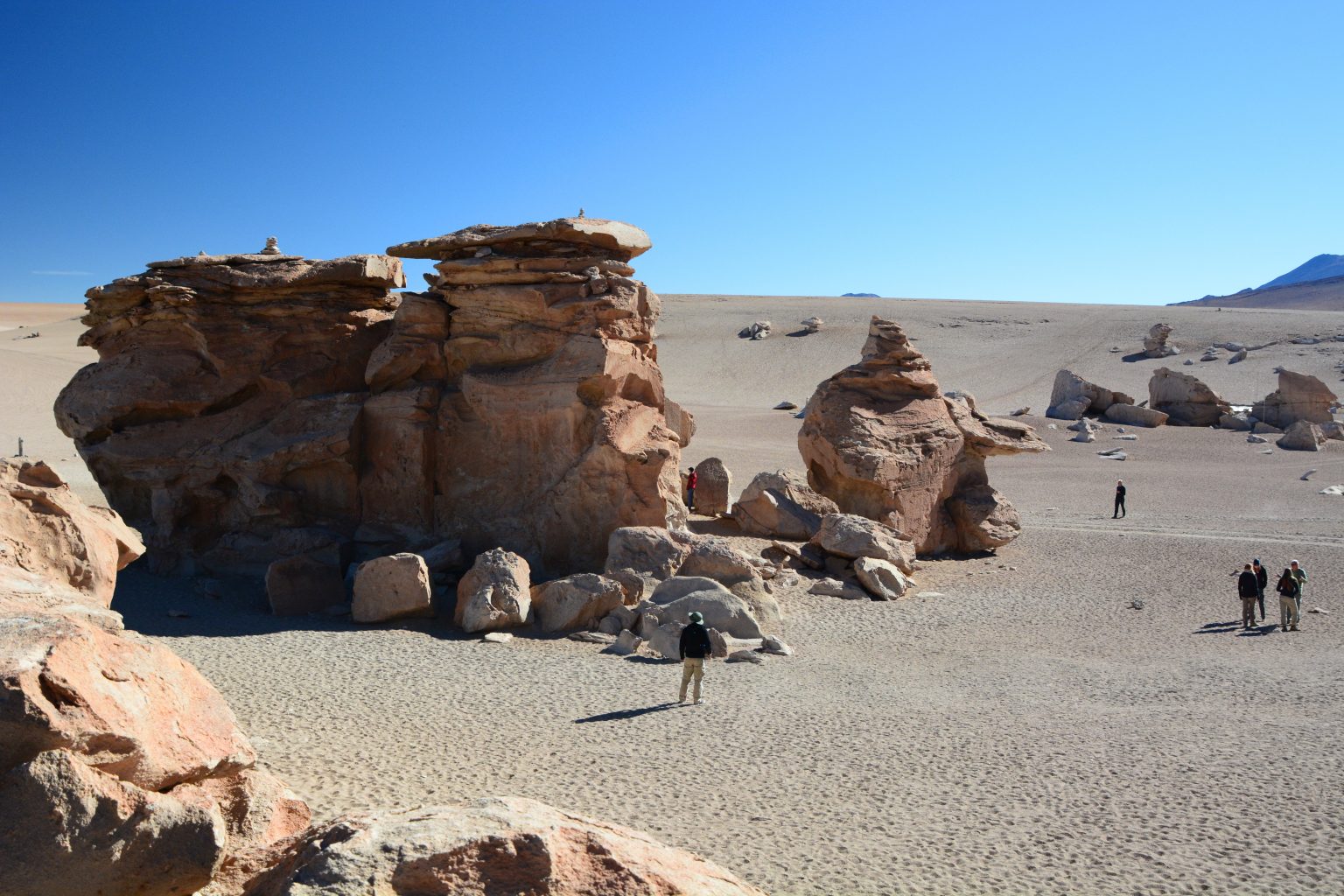
On the remote edge of the Eduardo Avaroa Andean Fauna Reserve, the Siloli Desert is known for its high-altitude volcanic landscapes, unusual rock formations, and striking colors.
- Where Is the Siloli Desert Located?
- A Landscape Shaped by Fire, Wind, and Time
- Best Time to Visit the Siloli Desert
- How to Reach the Siloli Desert
- Top Things to Do in the Siloli Desert
- Árbol de Piedra (The Stone Tree)
- Explore the Painted Mountains
- Observe High-Desert Wildlife
- Stargazing at Extreme Altitude
- Photography in a Natural Studio
- Suggested 2-Day Siloli Desert Itinerary
- Where to Stay in the Siloli Desert
- Cultural and Spiritual Meaning of Siloli
- Practical Travel Tips
- Hidden Gems Near the Siloli Desert
- A High-Altitude Desert of Color and Rock
The terrain includes ochre, crimson, violet, and gold tones created by different minerals and volcanic rocks. At elevations of around 4,600 meters, the desert combines vast gravel plains, volcanic formations, mountains, and open views across the Bolivian Altiplano.
One of the highest and driest desert regions on Earth, Siloli has very little vegetation and extreme temperature changes between day and night. Its unusual landscape makes it one of the most distinctive stops on the route between Uyuni and the Chilean border.
Where Is the Siloli Desert Located?
The Siloli Desert lies in southwestern Bolivia, within the Potosí Department, near the Chilean border and inside the Eduardo Avaroa Andean Fauna Reserve.
- Coordinates: 22.1°S, 67.1°W
- Elevation: around 4,600 meters (15,000 ft)
It forms part of the vast Andean Altiplano, visually extending toward Chile’s Atacama Desert.
Rather than being dominated by dunes, Siloli is characterized by volcanic rock, mineral-rich soil, gravel plains, and eroded hills, all shaped by high-altitude conditions and strong winds.
A Landscape Shaped by Fire, Wind, and Time
The Siloli Desert developed through volcanic activity and long periods of erosion.
- Volcanic ash and minerals create rust red, sulfur yellow, copper green, and soft violet tones
- Gravel plains and ash fields replace the sand dunes found in many other deserts
- Eroded rock formations give parts of the landscape a distinctive lunar appearance
The colors can change noticeably throughout the day as sunlight moves across the mountains and rock formations. The combination of volcanic geology and erosion is one of the main reasons Siloli looks so different from other desert environments.
Best Time to Visit the Siloli Desert
Seasonal Experience
- April to October (dry season): Clear skies, cold temperatures, and generally good conditions for photography and exploration
- November to April (wet season): Fewer visitors, greener areas around some lagoons, and occasional rain or snowfall
Mornings can be extremely cold, while daytime temperatures rise quickly under direct sunlight. At night, temperatures can fall well below freezing.
How to Reach the Siloli Desert
The Siloli Desert is generally visited as part of a multi-day 4×4 expedition.
- From Uyuni, Bolivia: approximately 370 km, usually covered over several days with multiple stops
- From San Pedro de Atacama, Chile: approximately 180 km, depending on the route and border procedures
There are no conventional paved roads through much of the area. Routes cross salt tracks, volcanic plains, gravel surfaces, and rocky terrain.
An experienced driver and organized tour are strongly recommended, particularly because of the altitude, remoteness, and limited services.
Top Things to Do in the Siloli Desert
Árbol de Piedra (The Stone Tree)
The Stone Tree is Siloli’s most recognizable landmark.
This wind-eroded rock formation rises about seven meters and has a narrow base supporting a much wider upper section. Its unusual shape was created through long-term erosion rather than human construction.
It is one of the most photographed formations in the Eduardo Avaroa reserve.
Explore the Painted Mountains
The surrounding mountains display combinations of white borax, iron-red rock, and sulfur-yellow deposits.
Nearby volcanoes such as Ollagüe, Uturuncu, and Tapaquillcha add to the dramatic high-altitude landscape, with some peaks carrying snow during colder periods.
Observe High-Desert Wildlife
Despite the extreme conditions, the reserve supports several species adapted to high-altitude environments:
- Vicuñas grazing on sparse ichu grass
- Vizcachas sheltering among rocks
- Andean foxes occasionally seen around the desert
- Flamingos feeding in nearby high-altitude lagoons
These species are adapted to low temperatures, strong sunlight, limited vegetation, and scarce water.
Stargazing at Extreme Altitude
At around 4,600 meters, the high elevation and remote location can provide excellent night-sky conditions when the weather is clear.
The Milky Way can appear particularly prominent, with little artificial light in the surrounding landscape.
Photography in a Natural Studio
Siloli offers exceptional conditions for landscape photography. The combination of colorful volcanic terrain, unusual rock formations, long shadows, distant volcanoes, and open skies creates strong natural contrasts.
The changing light throughout the day also produces noticeably different colors across the same landscape.
Suggested 2-Day Siloli Desert Itinerary
Day 1: Stone and Color
Morning: Arrive from Uyuni or the Eduardo Avaroa Reserve
Visit the Stone Tree and surrounding plains
Afternoon: Drive through colored hills and volcanic landscapes
Evening: Sunset and overnight stay at a desert lodge
Day 2: Wildlife and High-Altitude Landscapes
Morning: Short walks to panoramic viewpoints
Afternoon: Visit nearby lagoons and wildlife areas
Evening: Stargazing if weather conditions are suitable
Where to Stay in the Siloli Desert
- Tayka del Desierto Lodge: Solar-powered accommodation in a remote location
- Los Flamencos Eco-Hotel: Convenient for routes near Laguna Colorada
- Community lodges: Simple accommodation operated by local Aymara families
Facilities are limited in this remote region. Electricity may be restricted, and nights can be extremely cold, with temperatures dropping to around −15°C or lower depending on conditions.
Cultural and Spiritual Meaning of Siloli
For Aymara and Quechua communities, the landscapes of the Bolivian Altiplano have long been connected with local traditions, beliefs, and stories.
Some local legends describe unusual rock formations as the result of actions by supernatural beings or ancient figures. These stories form part of the cultural traditions associated with the region.
The connection between local communities and the surrounding mountains, lagoons, and desert landscapes remains an important part of the cultural context of the Altiplano.
Practical Travel Tips
- Best months: May to October
- Vehicle: 4×4 with an experienced driver
- Acclimatize in Uyuni or La Paz before visiting
- Dress in layers to handle large temperature changes
- Bring sunscreen, sunglasses, lip balm, and power banks
- Respect rock formations and wildlife
- Carry extra water and fuel
Hidden Gems Near the Siloli Desert
- Desierto de Dalí, a neighboring landscape known for unusual rock formations
- Laguna Colorada, a red-colored high-altitude lagoon frequented by flamingos
- Valle de las Rocas, a valley filled with large volcanic rock formations
- Polques Hot Springs, natural thermal pools
- Licancabur Volcano, a prominent Andean landmark near the Chilean border
A High-Altitude Desert of Color and Rock
The Siloli Desert stands out for its combination of extreme altitude, volcanic geology, unusual rock formations, and colorful terrain. Unlike traditional sand deserts, its landscape is dominated by gravel, ash, eroded rock, and high-altitude plains.
A visit to Siloli is usually part of a longer journey through the Eduardo Avaroa Andean Fauna Reserve, often combined with Laguna Colorada, the Stone Tree, high-altitude lagoons, hot springs, and other landscapes of the Bolivian Altiplano.
For travelers exploring the Uyuni region, Siloli offers a very different side of Bolivia’s desert environment, where altitude and volcanic geology shape almost every part of the landscape.