
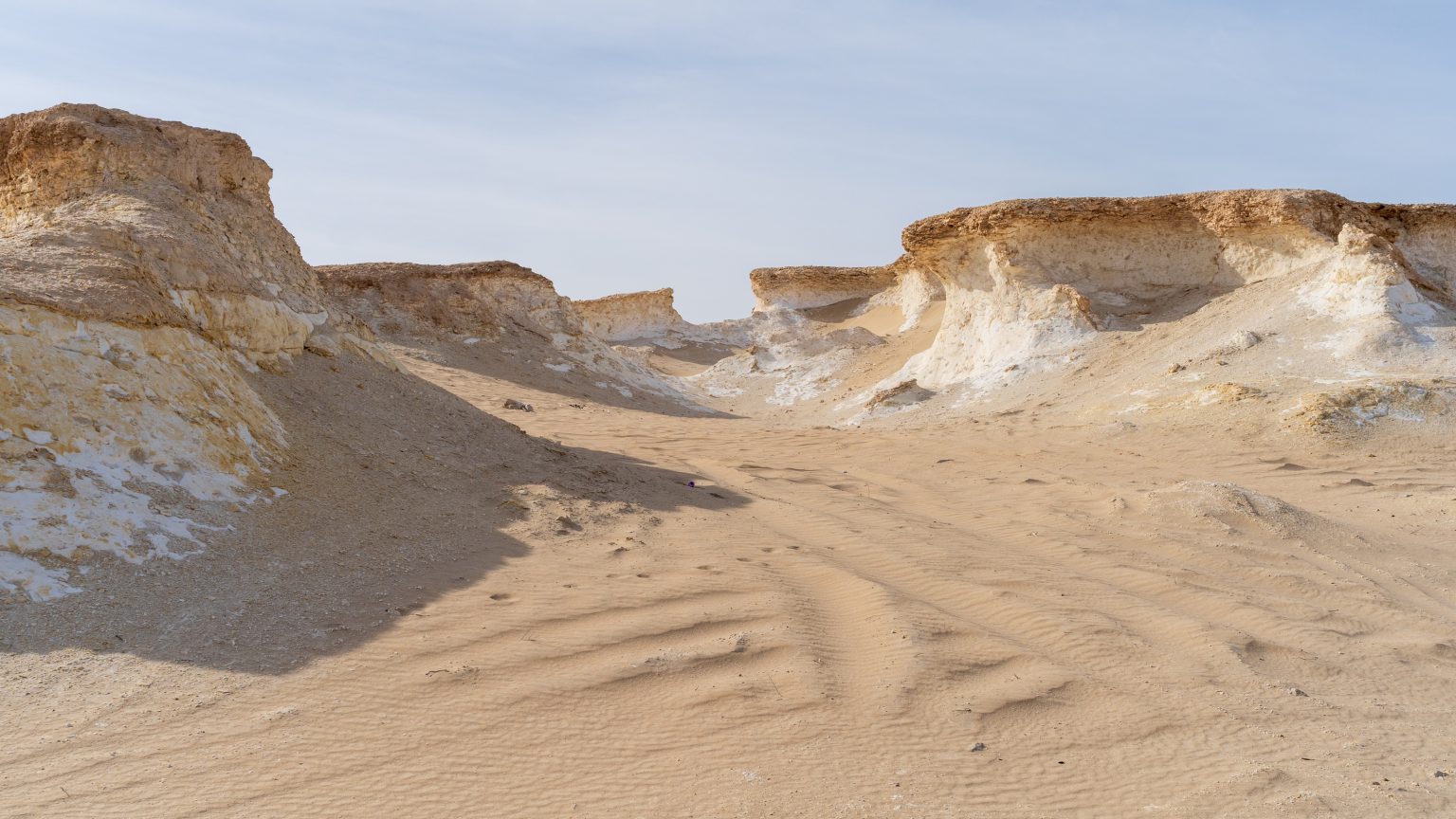
The Dukhan Desert and the Zekreet Peninsula form one of western Qatar’s most distinctive desert landscapes, combining pale sand, limestone formations, open plains, and coastal scenery along the country’s western side.
- Where Are the Dukhan Desert and Zekreet Peninsula Located?
- Best Time to Visit Dukhan and Zekreet
- How to Reach Zekreet and Dukhan from Doha
- Things to Do in the Dukhan Desert and Zekreet Peninsula
- Explore Zekreet’s Limestone Formations
- Discover the Zekreet Peninsula
- Experience Richard Serra’s East–West/West–East
- Visit Film City (Mystery Village)
- Relax at Dukhan Beach
- Watch Sunset from Zekreet’s Cliffs
- 2-Day Dukhan and Zekreet Itinerary
- Where to Stay and Camp
- Culture and Heritage of Western Qatar
- Practical Travel Tips
- Hidden Gems Around Zekreet
- Exploring Western Qatar’s Desert Coast
Unlike Qatar’s larger sandy desert areas, this region is known for its rocky terrain and limestone formations, as well as its proximity to the Arabian Gulf. Visitors can explore natural rock structures, beaches, archaeological remains, art installations, and desert tracks within the same trip.
The area is also home to several of Qatar’s most unusual attractions, including Richard Serra’s East–West/West–East, Film City, and the coastal landscapes around Zekreet and Ras Abrouq.
Where Are the Dukhan Desert and Zekreet Peninsula Located?
The Dukhan Desert and Zekreet Peninsula lie about 90 kilometers west of Doha, along Qatar’s western coastline on the Arabian Gulf.
Dukhan City, an oil town, serves as the main gateway to the region. Nearby is Zekreet Village, a small settlement at the desert’s edge. The area also includes Film City, built for television productions, and Richard Serra’s East–West/West–East sculpture installation.
Administratively, the region belongs to Al Rayyan Municipality and forms part of Qatar’s western limestone plateau, where desert terrain meets the Gulf coastline.
Best Time to Visit Dukhan and Zekreet
The best time to explore the Dukhan Desert and Zekreet Peninsula is between November and March.
During winter, temperatures range between 18 and 28°C, making conditions suitable for walking, photography, and outdoor exploration. April and May are warmer but can still be comfortable during the early morning and late afternoon. From June to September, temperatures often exceed 40°C, making midday activities difficult. October generally brings more comfortable conditions as temperatures begin to fall.
Winter evenings can be cool, particularly in exposed areas along the coast and around the limestone formations.
How to Reach Zekreet and Dukhan from Doha
The drive from Doha takes around 1.5 hours, covering approximately 90 kilometers. Travelers follow the Doha–Dukhan Highway (Route 50) and take the Zekreet turn-off.
Roads remain paved for most of the journey, while some routes into the desert become gravel or rough tracks. A 4×4 vehicle is recommended for reaching remote limestone formations, Film City, and less accessible coastal areas.
Things to Do in the Dukhan Desert and Zekreet Peninsula
Explore Zekreet’s Limestone Formations
The Zekreet limestone formations are among the most distinctive geological features in western Qatar. Wind erosion has shaped the rock into arches, mushroom-like formations, and curved towers across the desert.
The formations are particularly attractive during the early morning and late afternoon, when lower sunlight brings out their shapes and textures.
Discover the Zekreet Peninsula
The Zekreet Peninsula combines desert and coastal landscapes within a relatively small area. Rocky cliffs overlook bays and beaches, while fossilized coral can be found in parts of the surrounding terrain.
The peninsula is well suited to photography, coastal walks, and 4×4 exploration.
Experience Richard Serra’s East–West/West–East
In the desert stand four massive steel plates, each more than 14 meters high, positioned across roughly a kilometer of open terrain. Created by Richard Serra, the installation creates a striking contrast with the surrounding limestone landscape.
Walking between the sculptures also gives visitors a clear sense of the scale of both the artwork and the surrounding desert.
Visit Film City (Mystery Village)
Film City is a replica of a traditional Arabian village built for television productions. Located among cliffs and open desert, the site includes buildings, towers, and narrow passageways designed to resemble a traditional settlement.
Its isolated location has made it one of the more unusual stops in the Zekreet area.
Relax at Dukhan Beach
After exploring the rocky desert, Dukhan Beach provides access to the coast. The shoreline is suitable for swimming, picnics, fishing, and sunset views when conditions are favorable.
The beach is also a popular gathering place for local families, particularly during the cooler months.
Watch Sunset from Zekreet’s Cliffs
The limestone cliffs around Zekreet provide elevated views over the desert and coastline. At sunset, the changing light brings out warmer tones in the rock and creates good conditions for landscape photography.
2-Day Dukhan and Zekreet Itinerary
Day 1
Morning drive from Doha to the Serra sculptures and nearby limestone formations. Afternoon visit to Film City and picnic in a suitable desert area. Evening photography or camping under the open sky.
Day 2
Morning walk along the Zekreet shoreline or visit to Dukhan Beach. Afternoon exploration of nearby desert and coastal areas, followed by a return to Doha before evening.
Where to Stay and Camp
Camping is a popular way to spend more time in the Zekreet area. Choose an appropriate location away from sensitive natural and archaeological sites, and bring water, shade, wind protection, and waste bags. Warm layers are useful during cooler winter nights.
For hotel stays, Dukhan Beach Hotel is one of the closest options. Many travelers also stay in western Doha and visit Zekreet and Dukhan as a day trip.
Culture and Heritage of Western Qatar
Before the oil era, western Qatar supported nomadic communities, fishermen, and pearl divers. Old wells, archaeological remains, and coastal traditions provide evidence of this earlier way of life.
Today, the region remains popular with local families during the cooler months. Desert camps, falconry, fishing, and gatherings along the coast continue to form part of Qatar’s outdoor culture.
The area also illustrates the contrast between Qatar’s modern development and its older desert and coastal landscapes.
Practical Travel Tips
A 4×4 vehicle is recommended for rough terrain and remote tracks. Bring food, water, fuel, and other supplies, as services become limited outside the main towns.
Visit in the early morning or late afternoon for more comfortable temperatures and better photography conditions. Carry offline maps because mobile coverage can be limited in some remote areas.
Respect art installations, archaeological sites, wildlife, and natural formations, and take all waste with you.
Hidden Gems Around Zekreet
The Ras Abrouq Peninsula features remote beaches and unusual coastal landscapes. Remains of older structures and archaeological sites can be found in parts of the region.
Wind-shaped rock formations appear along several stretches of the peninsula, while fossilized coral and other marine remains provide evidence of the area’s geological history.
Exploring Western Qatar’s Desert Coast
The Dukhan Desert and Zekreet Peninsula offer a combination that is difficult to find elsewhere in Qatar: limestone formations, desert tracks, Gulf beaches, archaeological remains, and large-scale contemporary art.
A visit can easily combine the Zekreet rock formations, Richard Serra’s East–West/West–East, Film City, Dukhan Beach, and the coastal landscapes of Ras Abrouq in a single western Qatar itinerary.
For travelers looking beyond Qatar’s better-known desert attractions, this region provides a different perspective on the country’s landscape, where the desert is shaped as much by limestone and the nearby Gulf coast as by sand.