
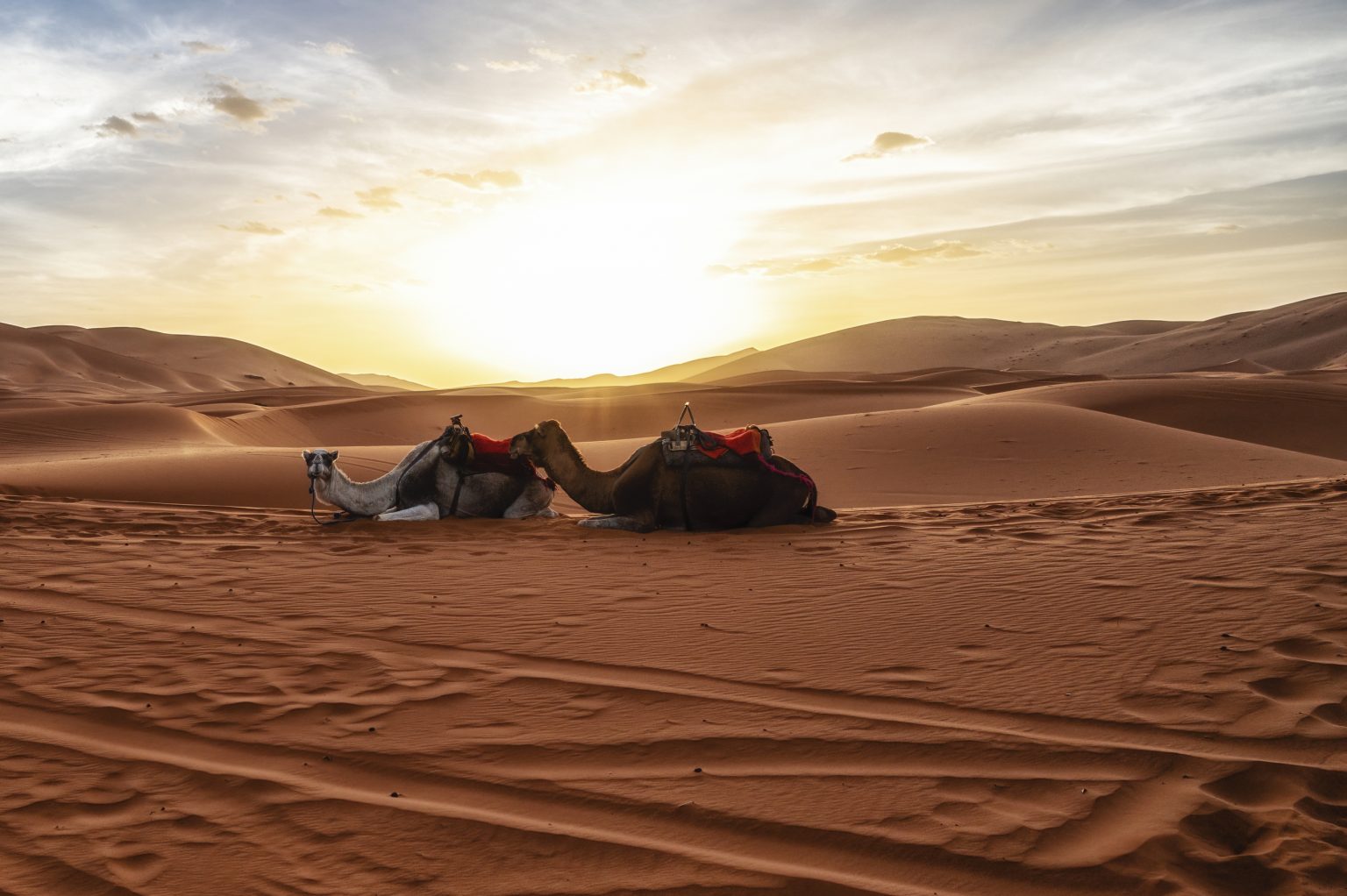
In the far southeast of Morocco, near the Algerian border, Merzouga is one of the country’s best-known destinations for experiencing the Sahara. The village sits beside the Erg Chebbi dune field, where large sand dunes, desert camps, seasonal wetlands, and oasis landscapes come together.
- Where Is Merzouga Located
- The Landscape: Erg Chebbi and the Surrounding Desert
- Merzouga Desert Climate: Hot Summers and Cold Nights
- Life in the Sands: Plants and Wildlife
- Culture and People: The Heart of Merzouga
- Top Things to Do in Merzouga
- Camel Trekking into Erg Chebbi
- Overnight Desert Camping
- Quad Biking and Sandboarding
- Visit Dayet Srji Lake
- Explore Rissani
- Meet the Gnawa Musicians of Khamlia
- 2-Day Merzouga Itinerary
- Where to Stay in Merzouga
- Practical Travel Tips
- Hidden Gems Near Merzouga
- Merzouga: Erg Chebbi and the Desert Around It
Merzouga has long been connected with desert travel and caravan routes. Today, visitors come for camel trekking, desert camping, sandboarding, wildlife observation, and Amazigh cultural experiences.
The area’s appeal comes from the contrast between the high dunes of Erg Chebbi and the surrounding rocky desert, seasonal lake, palm groves, and traditional settlements.
Where Is Merzouga Located
Merzouga is situated in Errachidia Province, in southeastern Morocco, close to the historic towns of Erfoud and Rissani. It lies beside the Erg Chebbi dune field, one of Morocco’s most prominent sand landscapes.
The village is located at approximately 31.1°N, 4.0°W, at an elevation of around 700 meters (2,300 feet) above sea level.
The Erg Chebbi dunes extend for roughly 28 km (17 miles) from north to south and up to several kilometers across. Some dunes rise more than 150 meters, although heights vary throughout the dune field.
Distances from Merzouga
- Marrakech: approximately 560 km
- Fez: approximately 470 km
- Erfoud: approximately 50 km
Merzouga is normally reached by road from Erfoud or Rissani, with longer journeys from Marrakech or Fez crossing the Atlas Mountains and the arid landscapes of southeastern Morocco.
The Landscape: Erg Chebbi and the Surrounding Desert
The Erg Chebbi dunes dominate the landscape around Merzouga. Wind continually moves sand across the dune field, producing ridges, slopes, and changing patterns.
The dunes are particularly striking around sunrise and sunset, when low-angle sunlight emphasizes their contours and changes the appearance of the sand from pale gold to orange and deeper red tones.
Beyond Erg Chebbi, the wider region contains several different environments:
- Hamadas, or rocky desert plateaus.
- Dayet Srji, a seasonal lake and important bird habitat.
- Palm groves supported by groundwater and irrigation.
- Traditional villages built with earthen architecture.
- Dry plains and rocky areas surrounding the dune field.
This variety means that the Merzouga area is not simply a landscape of sand dunes. It is part of a broader pre-Saharan environment.
Merzouga Desert Climate: Hot Summers and Cold Nights
Merzouga has an arid desert climate with very low rainfall and large differences between summer and winter temperatures.
Typical conditions include:
- Annual rainfall: generally less than 100 mm.
- Summer temperatures: often above 40°C and sometimes approaching 45°C or more.
- Winter nights: can fall close to freezing, particularly during cold periods.
- Large day-night temperature differences, especially in the dry season.
The best time to visit Merzouga is generally October to April, when daytime temperatures are more comfortable for camel trekking, hiking, and desert excursions.
Summer visits are possible, but outdoor activities should be planned around the cooler hours of the morning and evening.
Life in the Sands: Plants and Wildlife
The Merzouga region supports life despite its extremely dry conditions.
Plant Life
- Tamarisk trees, particularly around areas with access to groundwater.
- Hardy desert shrubs adapted to limited rainfall.
- Date palms around villages and irrigated areas.
- Other grasses and small plants that appear following seasonal rainfall.
Vegetation can help stabilize sandy surfaces and provides food and shelter for insects, reptiles, and other desert species.
Animal Life
- Dromedary camels, important for tourism and historically essential to desert transport.
- Fennec foxes and other small desert mammals.
- Geckos and desert lizards adapted to high temperatures.
- Flamingos and migratory birds at Dayet Srji when seasonal water conditions are favorable.
The presence of water at Dayet Srji can significantly change local bird activity, making the lake particularly interesting during wetter periods.
Culture and People: The Heart of Merzouga
Merzouga and the surrounding villages have strong Amazigh cultural traditions, shaped by oasis agriculture, pastoralism, desert travel, and historical trade routes.
Hospitality is an important part of local life. Visitors may be offered mint tea and traditional meals, while music remains an important part of cultural gatherings.
The nearby village of Khamlia is particularly well known for Gnawa music, a musical tradition with deep African, Saharan, and Moroccan connections.
The region’s cultural heritage can also be seen in traditional architecture, handicrafts, food, music, and the continued use of camels in tourism and local activities.
Top Things to Do in Merzouga
Camel Trekking into Erg Chebbi
Camel trekking is one of the most popular ways to explore the dunes. Local guides lead visitors across the sand to desert camps or viewpoints.
Short rides around sunset are suitable for first-time visitors, while longer excursions can include overnight stays deeper in the dune field.
Overnight Desert Camping
A night in an Erg Chebbi desert camp combines accommodation with a range of activities.
Depending on the camp, visitors may experience:
- Traditional Moroccan dinner
- Amazigh or Berber drumming
- Tea and local hospitality
- Stargazing
- Sunrise and sunset over the dunes
Camp standards range from simple traditional tents to high-end private accommodations.
Quad Biking and Sandboarding
The Erg Chebbi dunes are suitable for several adventure activities, including quad biking and sandboarding.
Visitors should use established operators and follow local safety instructions, particularly when riding on steep dune slopes.
Visit Dayet Srji Lake
Dayet Srji is a seasonal wetland near Merzouga. When sufficient water is present, it attracts flamingos and other migratory birds.
Birdwatching is often most rewarding during the cooler hours of the morning or late afternoon.
Explore Rissani
Rissani is an important historic town in southeastern Morocco and a former center of caravan trade.
Its traditional market is known for local produce, crafts, livestock, and regional food. Rissani is also historically associated with the Alaouite dynasty, Morocco’s ruling dynasty.
Meet the Gnawa Musicians of Khamlia
A visit to Khamlia offers an opportunity to hear Gnawa musicians perform traditional songs and rhythms.
The village is particularly associated with the history of communities whose ancestors came from sub-Saharan Africa and became part of the cultural landscape of southeastern Morocco.
2-Day Merzouga Itinerary
Day 1: Erg Chebbi and Desert Camping
- Morning arrival from Erfoud or Rissani.
- Explore Merzouga and the surrounding desert landscape.
- Afternoon camel trek into the Erg Chebbi dunes.
- Watch the sunset from the dunes.
- Dinner, traditional music, and overnight stay at a desert camp.
Day 2: Wetlands and Local Culture
- Early morning sunrise over Erg Chebbi.
- Return to Merzouga for breakfast.
- Visit Dayet Srji if seasonal water conditions are suitable.
- Continue to Khamlia to experience Gnawa music.
- Visit Rissani if time allows.
- Return to Merzouga for the evening or continue to your next destination.
Where to Stay in Merzouga
Merzouga offers accommodation ranging from luxury desert camps to simple guesthouses.
Luxury Desert Camps
- Merzouga Luxury Desert Camp
- Sahara Stars Camp
Mid-Range
- Kasbah Hotel Tombouctou
- Riad Madu
Budget
- Nomad Palace
- Les Roches Auberge
Travelers should compare the location, transport arrangements, meal plans, and activities included with each accommodation, particularly when booking desert camps.
Practical Travel Tips
- Best season: October to April.
- Access: Merzouga is reached mainly by road from Erfoud and Rissani, with longer routes from Marrakech and Fez.
- Clothing: Wear light, breathable clothing during the day and bring warm layers for desert nights.
- Essentials: Carry sunglasses, sunscreen, a hat, and sufficient water.
- Footwear: Comfortable closed shoes are useful for walking on rocky terrain and dunes.
- Local etiquette: A simple greeting such as “Salam Alaikum” is appreciated.
- Camel rides: Follow the guide’s instructions and bring water, especially during warmer months.
- Wildlife: Do not approach or feed birds and other animals around Dayet Srji.
Hidden Gems Near Merzouga
Travelers with extra time can explore several lesser-known locations around the region:
- Tisserdmine Oasis, an area associated with fossil discoveries and desert geology.
- Taouz, a small settlement near the Algerian border with access to ancient rock-art sites.
- Rissani Market, one of the region’s most interesting traditional markets.
- Seasonal desert lakes, which may form after periods of significant rainfall and attract wildlife.
Merzouga: Erg Chebbi and the Desert Around It
The appeal of Merzouga comes from the concentration of experiences available around Erg Chebbi. Large dunes provide the setting for camel treks, camping, sandboarding, and sunrise excursions, while the surrounding landscape adds rocky desert, palm groves, seasonal wetlands, and traditional settlements.
The area’s cultural identity is equally important. Amazigh traditions, Gnawa music, caravan history, oasis life, and desert hospitality remain visible throughout the region.
For travelers exploring southeastern Morocco, Merzouga provides a practical base for experiencing the Erg Chebbi dunes and the wider desert environment of the Tafilalet region, with enough cultural and natural variety to make it more than a simple dune destination.