
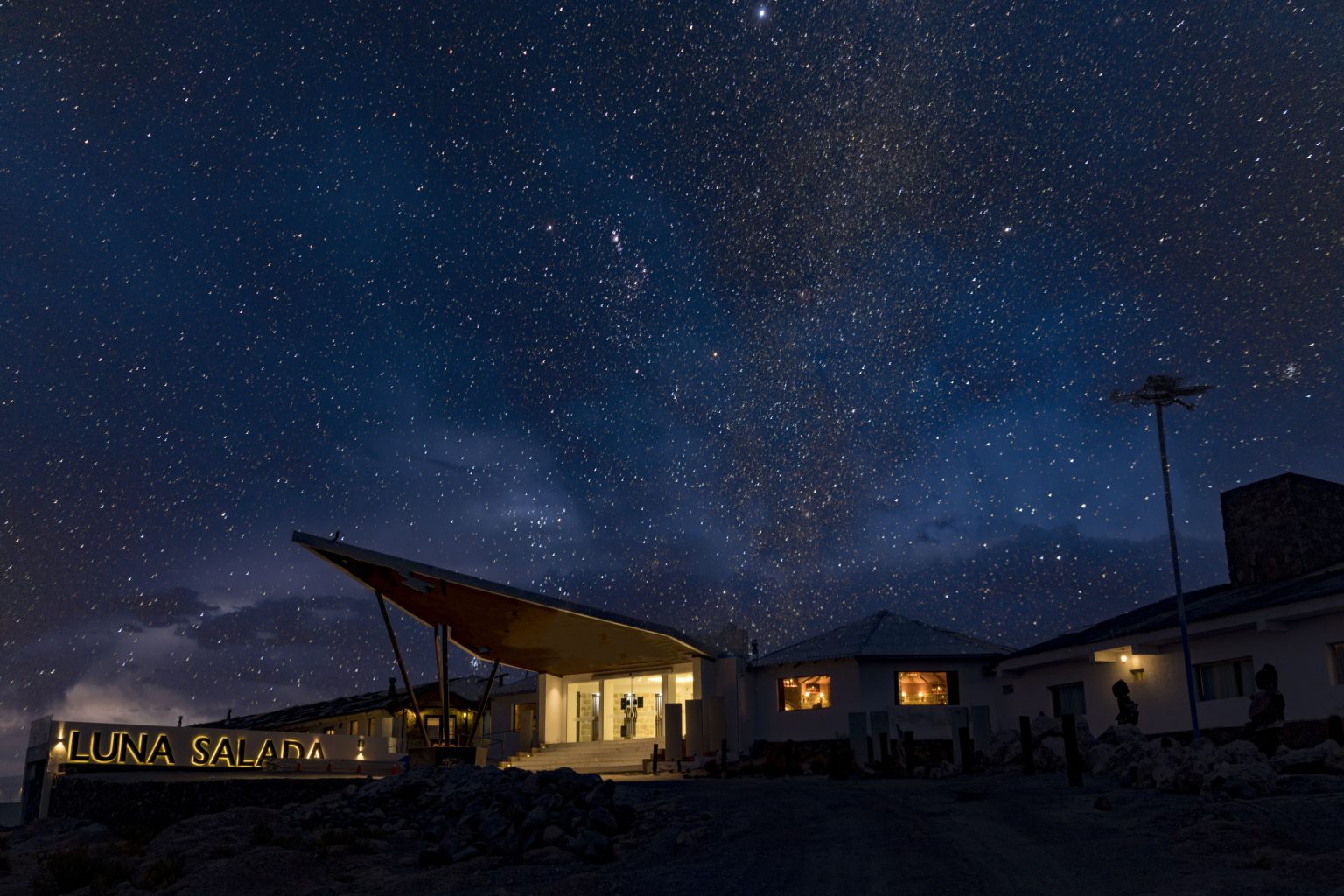
The Salar de Uyuni in Bolivia offers a remarkable setting for stargazing, with an immense white salt crust, a high-altitude landscape and wide horizons far from major urban lights. On clear nights, visitors may see the Milky Way, prominent constellations and bright planets above the Altiplano.
- Why Salar de Uyuni Is a Special Place for Stargazing
- Where to Go Stargazing Around Salar de Uyuni
- The Main Salt Flat
- Coquesa and the Slopes of Tunupa Volcano
- The Siloli Desert
- Laguna Colorada
- Laguna Verde
- Best Time of Year for Stargazing at Salar de Uyuni
- What You Can See in the Uyuni Night Sky
- What to Bring for a Stargazing Trip
- A Two-Day Salar de Uyuni Stargazing Itinerary
- Day 1: Explore the Salt Flat and Observe the Night Sky
- Day 2: Visit Coquesa and Explore the Northern Salt Flat
- Safety and Responsible Stargazing
- Why Stargazing at Salar de Uyuni Is Memorable
During the rainy season, a shallow layer of water can transform parts of the salt flat into a mirror, reflecting the night sky when the surface is calm. This effect is weather-dependent, but when conditions align, stargazing in the Uyuni Salt Flats can combine astronomy with unusual reflections of stars and distant mountains.
Whether you visit for astrophotography or simply want to experience the night sky in a remote landscape, this guide covers the best places to look, seasonal conditions, essential equipment and practical ways to plan a safe Bolivia stargazing experience.
Why Salar de Uyuni Is a Special Place for Stargazing
At approximately 3,650 meters above sea level, the Salar de Uyuni lies on Bolivia’s high Andean plateau. Its vast, relatively flat surface provides open views across the horizon, while the limited artificial lighting in remote areas can create excellent conditions for observing the night sky.
The quality of any stargazing session still depends on cloud cover, wind, moonlight and atmospheric conditions. High elevation does not guarantee clear skies, and the dry season generally offers more reliable access and many opportunities for astronomy.
What makes the salt flat distinctive includes:
- Wide horizons: The open landscape offers unobstructed views across much of the sky.
- Dark surroundings: Away from settlements and vehicle lights, many stars become easier to see.
- High-altitude scenery: The salt flat sits within the Andes, giving visitors a different perspective from coastal or lowland destinations.
- Seasonal reflections: When a thin layer of water covers the salt and the surface remains calm, stars may appear reflected below the horizon.
- Photography opportunities: The white crust, distant mountains and night sky can create striking compositions.
The reflection effect is not permanent, and the salt flat is not a natural telescope. Its appeal comes from the combination of altitude, open space, relatively dark surroundings and, at certain times of year, a reflective surface.
Where to Go Stargazing Around Salar de Uyuni
The Main Salt Flat
The Salar de Uyuni salt flat is the main attraction for night-sky photography. During the dry season, its white crust creates a stark foreground beneath the stars. During suitable wet-season conditions, shallow water can produce the famous mirror effect.
The best location depends on the season, current road access and the tour operator’s assessment of conditions.
Highlights include:
- Observing the Milky Way when it is visible and the sky is sufficiently dark.
- Photographing constellations above the white salt crust.
- Watching the stars reflect on shallow water during calm, clear conditions.
- Capturing wide-angle images of the sky and distant horizon.
The mirror effect at night requires several conditions to align: enough standing water, a smooth surface, limited wind and a sky clear enough to see stars. Rain alone does not guarantee a reflection.
During the wettest months, some areas can become inaccessible to vehicles. Always follow your guide’s instructions and never walk alone across flooded salt flats in darkness.
Coquesa and the Slopes of Tunupa Volcano
The village of Coquesa, on the northern side of Salar de Uyuni, offers a different perspective on the salt flat. The surrounding landscape includes the slopes of Tunupa Volcano, with elevated viewpoints and striking views across the white expanse.
A visit can combine local cultural heritage, daytime scenery and night-sky observation, provided weather and access conditions allow.
Consider the following:
- Arrange transport and any guided activities in advance.
- Ask locally about suitable viewpoints and current road conditions.
- Visit archaeological sites, including the Coquesa mummies, only through authorized access arrangements.
- Bring warm clothing for exposed areas after sunset.
- Confirm whether your accommodation or tour actually includes a nighttime astronomy stop.
Coquesa is a useful option for travelers who want to explore the northern edge of the salt flat rather than spend the entire visit on its central surface.
The Siloli Desert
The Siloli Desert lies farther south, within the wider southwestern Bolivia highland circuit. Its dry terrain, rock formations and high-altitude surroundings create a different setting for night-sky photography.
This is not a nearby stop on a short Salar de Uyuni excursion. Visiting Siloli usually forms part of a longer route that may include lagoons, volcanic landscapes and other remote attractions.
The area can be rewarding for photographers interested in combining stars with rugged foregrounds. However, access, overnight arrangements and road conditions should be confirmed before departure.
For a trip that includes Siloli:
- Allow enough time for the long distances between stops.
- Confirm accommodation and transport arrangements.
- Prepare for cold nights and high-altitude conditions.
- Follow your guide’s advice about safe viewing locations.
- Avoid wandering away from the vehicle or accommodation in darkness.
Laguna Colorada
Laguna Colorada is a high-altitude lake in Bolivia’s Eduardo Avaroa Andean Fauna National Reserve. Known for its reddish water and flamingos, it is a separate destination on the southwestern highland circuit rather than part of the Salar de Uyuni itself.
The surrounding plateau can provide dramatic night-sky views when conditions are clear. However, the lake’s water should not be assumed to produce a mirror-like reflection of the stars. Wind, surface conditions and the lake’s mineral-rich water all affect what can be seen.
Visitors should also remember that this is a protected wildlife area. Follow designated routes and keep a respectful distance from flamingos and other animals, especially near sensitive nesting or feeding areas.
Laguna Verde
Laguna Verde, near Licancabur Volcano in southwestern Bolivia, is another high-altitude destination generally visited as part of a longer Andean circuit. Its distinctive green color is influenced by the minerals in the water and can change with lighting and wind conditions.
Although the surrounding landscape can be impressive after dark, Laguna Verde is not an extension of the Salar de Uyuni salt flat. Reaching it requires a separate itinerary and careful planning for altitude, weather and road conditions.
If you include this area in your trip, arrange transport with an experienced operator and confirm the route before departure.
Best Time of Year for Stargazing at Salar de Uyuni
The best time to visit depends on whether you prioritize clear night skies or the famous reflection effect. These experiences are linked to different seasonal conditions, so there is no single period that guarantees both.
April to October: Dry-Season Stargazing
The dry season generally offers more reliable access across the salt flat and many opportunities for clear-sky observation. The salt crust is usually dry, revealing its familiar white surface and polygon patterns.
Advantages include:
- Better access to many established routes and viewpoints.
- Good opportunities for night-sky photography when skies are clear.
- Easier access to Incahuasi Island during suitable conditions.
- Strong contrast between the white salt surface and the dark sky.
Nights can be extremely cold, particularly during the winter months. Prepare for freezing temperatures and check the forecast before setting out.
November to April: Rainy Season and the Mirror Effect
The rainy season can bring shallow water to the salt flat, creating reflections of clouds, mountains and stars. The effect is often most likely during the wetter months, particularly January and February, but conditions vary from year to year.
Advantages may include:
- Opportunities for reflected star photographs.
- Dramatic sunset and sunrise reflections.
- A distinctive landscape that looks very different from the dry-season salt crust.
There are important trade-offs. Cloud cover may obscure the stars, wind can disrupt reflections, and water can restrict access to parts of the salt flat. Some routes and attractions may be closed or unavailable.
Before booking, ask local operators about recent rainfall, water levels, wind and the areas that can safely be reached.
What You Can See in the Uyuni Night Sky
The stars visible from Salar de Uyuni change with the season, the time of night and the position of the observer. A dark, clear sky can reveal much more than the brightest constellations, but no single set of celestial objects is visible throughout the year.
Possible highlights include:
- The Milky Way: Its visibility and position change throughout the year. The brighter central region is best seen when it is above the horizon on a dark night.
- The Southern Cross: A recognizable feature of the southern sky, visible during suitable parts of the year.
- The Magellanic Clouds: These two nearby galaxies can be seen from dark southern skies when they are above the horizon.
- Orion: A familiar constellation that is particularly prominent during parts of the southern summer.
- Bright planets: Venus, Jupiter, Mars and Saturn may be visible depending on their positions and observing dates.
- Meteor showers: Events such as the Geminids in December can offer additional viewing opportunities, although visibility depends on moonlight, weather and the shower’s activity.
Use a reliable astronomy app or star chart to check what will be visible on your travel dates. For the best experience, choose a night with limited moonlight, a favorable forecast and as little artificial lighting as possible.
What to Bring for a Stargazing Trip
The high-altitude environment can become cold quickly after sunset. Good preparation makes it easier to remain outdoors comfortably while protecting your equipment.
Essential items include:
- Warm layered clothing: Bring thermal base layers, an insulating mid-layer, a windproof outer jacket, gloves, a warm hat and thick socks.
- Sturdy footwear: Useful for walking on uneven or wet ground.
- Headlamp with a red-light mode: Helps preserve night vision while allowing you to move carefully.
- Drinking water: Stay hydrated, especially at high altitude.
- Camera and tripod: Useful for long-exposure night-sky photography.
- Spare batteries or a power bank: Cold conditions can reduce battery performance.
- Offline star map: Download a suitable astronomy app or chart before leaving areas with reliable connectivity.
Optional equipment includes binoculars, a telescope and a notebook for recording observations. A telescope is not essential for enjoying the Milky Way or photographing the stars.
Give your eyes time to adapt to darkness, and keep phone screens dim. Avoid shining bright lights toward other observers or wildlife.
A Two-Day Salar de Uyuni Stargazing Itinerary
A two-day visit can introduce you to the salt flat, its changing light and its night sky. The precise route should be adjusted to the season, local conditions and the tour you book.
Day 1: Explore the Salt Flat and Observe the Night Sky
Begin in Uyuni town with a pre-arranged guided excursion to the Salar de Uyuni. During the day, explore the salt crust and designated viewpoints. If conditions allow, your guide may take you to areas suitable for sunset photography.
After dark, join an organized stargazing excursion if the weather, road access and local rules permit. During the dry season, you may photograph stars above the white crust. In the rainy season, a reflective surface may be available, but the effect cannot be guaranteed.
Stay at accommodation arranged in advance. Salt hotels and other lodgings in the wider Uyuni area offer different facilities, so confirm the location, heating and transport arrangements before booking.
Day 2: Visit Coquesa and Explore the Northern Salt Flat
If conditions and your schedule allow, arrange a guided visit to Coquesa on the northern side of the salt flat. Explore the surrounding landscape and learn about local heritage through authorized visits.
A viewpoint near Tunupa Volcano may offer broad views across the Salar, but access and hiking conditions should be confirmed locally. Do not attempt a high-altitude walk without checking the route, weather and your readiness for the elevation.
Return to Uyuni town according to your transport schedule.
Important: If your main goal is to photograph stars reflected in water, tell your operator before booking and ask about recent conditions. If your priority is the full salt-flat circuit, Incahuasi Island and the surrounding highland lagoons, the dry season may be more suitable.
Safety and Responsible Stargazing
Salar de Uyuni is an immense, remote and high-altitude environment. Darkness, cold, changing weather and limited navigation landmarks make independent nighttime exploration risky.
Follow these precautions:
- Travel with a qualified local guide or organized operator for nighttime excursions.
- Never walk alone across the salt flat after dark.
- Do not enter flooded sections or assume shallow water is safe to cross.
- Stay away from vehicle routes and follow the guide’s instructions.
- Dress for freezing temperatures and sudden wind changes.
- Drink water regularly and take time to acclimatize to the altitude.
- Stop and seek help if you experience severe headache, confusion, unusual breathlessness or other concerning symptoms at altitude.
- Avoid disturbing wildlife around lakes and wetlands.
- Carry out all rubbish and leave natural and archaeological features untouched.
For astrophotography, set up your tripod away from vehicles and other visitors. Do not use bright lights unnecessarily, and never sacrifice safe footing for a photograph.
Why Stargazing at Salar de Uyuni Is Memorable
Stargazing at Salar de Uyuni brings together a vast landscape, a high-altitude night sky and the possibility of seeing stars reflected across shallow water. The experience can be striking even without the mirror effect: the white salt crust, distant mountains and open horizon create a distinctive setting for observing the southern sky.
The most successful trip begins with realistic expectations. Choose your season according to your priorities, check local conditions, prepare for the cold and arrange nighttime travel with a knowledgeable guide.
Whether you visit beneath a clear dry-season sky or find a calm, reflective surface during the rainy months, the Salar offers a remarkable opportunity to experience Bolivia’s high-altitude landscapes after dark.