
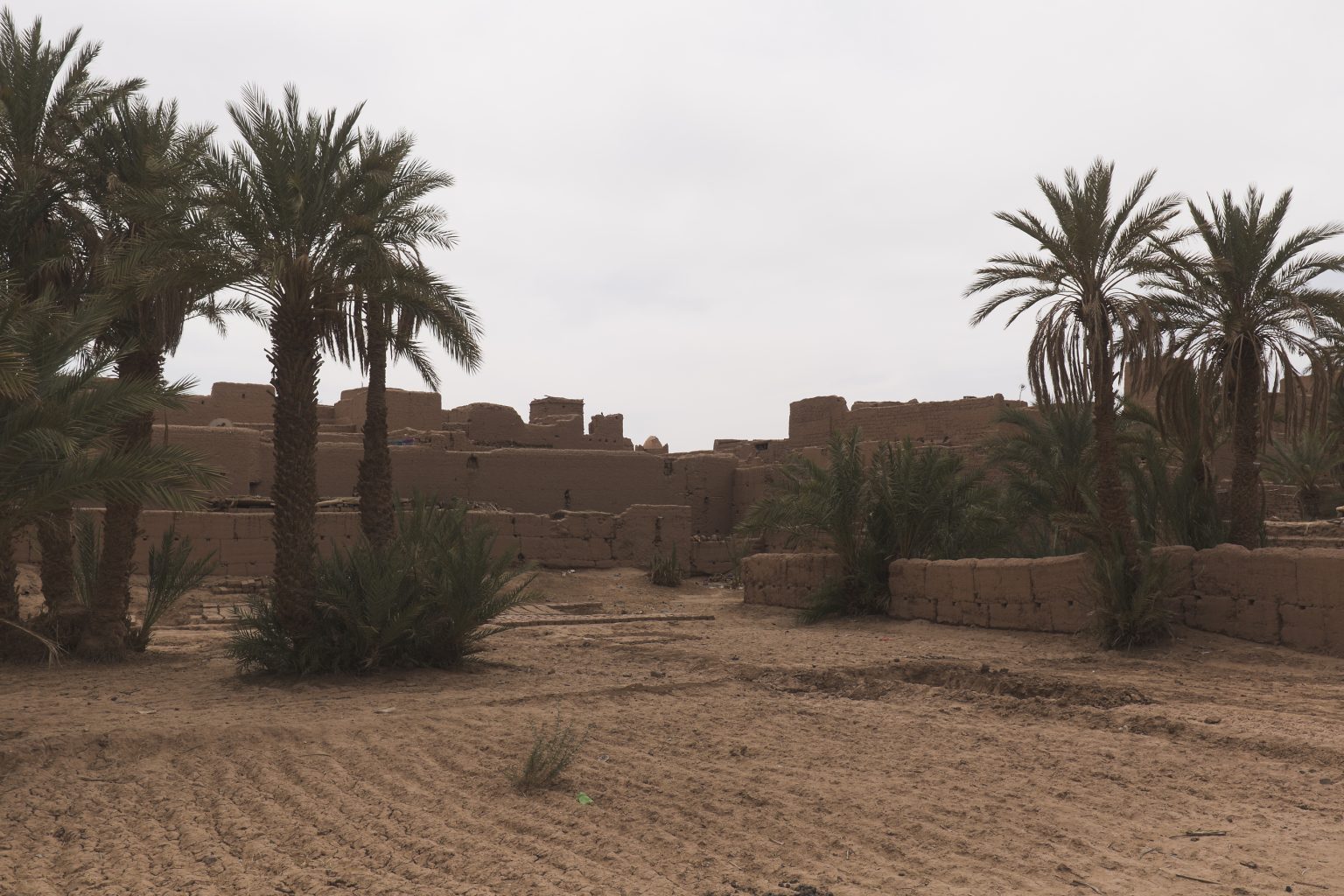
The road south of Zagora gradually leaves the palm groves behind as the landscape becomes drier, rockier, and more open. At the end of the Draa Valley, M’Hamid El Ghizlane marks the transition from Morocco’s settled oasis landscapes to the vast desert beyond.
- Where Is M’Hamid El Ghizlane Located?
- From Palm Groves to the Edge of the Sahara
- Climate at the Threshold of the Sahara
- Life on the Edge of the Desert
- Nomadic Culture and Desert Heritage
- Things to Do in M’Hamid El Ghizlane
- Two-Day M’Hamid Desert Itinerary
- Where to Stay in M’Hamid El Ghizlane
- Practical Travel Tips
- Hidden Gems Around M’Hamid
- Exploring M’Hamid, Morocco’s Desert Gateway
M’Hamid is the last major settlement before the remote dunes of the Sahara. It is also the main gateway to Erg Chigaga, one of Morocco’s largest and most isolated dune areas. Travelers come here for desert excursions, camel trekking, nomadic encounters, traditional camps, and the opportunity to experience a landscape far removed from Morocco’s larger cities.
Where Is M’Hamid El Ghizlane Located?
M’Hamid El Ghizlane lies in southern Morocco within the Draa-Tafilalet region, close to the Algerian border. It sits at the southern end of the Draa Valley, where the valley’s cultivated landscapes gradually give way to the wider desert.
Its approximate coordinates are 29.82°N, 5.72°W, at an elevation of about 430 meters above sea level.
Distances and Access
M’Hamid is approximately:
- 98 kilometers south of Zagora
- 290 kilometers from Ouarzazate
- 520 kilometers from Marrakech
The village is the main starting point for journeys toward Erg Chigaga, with the route becoming increasingly remote once travelers leave the paved roads.
From Palm Groves to the Edge of the Sahara
The landscape around M’Hamid changes noticeably as you travel south. The final stretches of the Draa Valley support palm groves and small agricultural plots, creating narrow cultivated areas within an otherwise arid environment.
Beyond the oasis, the terrain becomes increasingly dominated by the hamada, a rocky desert made up of stone and gravel. Small dunes appear around M’Hamid before becoming larger farther south toward Erg Chigaga.
The area also contains several historic ksars, traditional fortified settlements built from earth and other local materials. Their remains reflect the importance of agriculture, trade, and caravan routes in the history of the Draa Valley.
Climate at the Threshold of the Sahara
M’Hamid has a hot Saharan desert climate, with very little rainfall and large differences between summer and winter temperatures.
Key climate characteristics include:
- Annual rainfall generally remains below 100 millimeters
- Summer temperatures can reach 45 to 50°C
- Winter daytime temperatures are generally mild
- Winter nights can fall to around 5–10°C
The most comfortable period for visiting M’Hamid El Ghizlane is generally from October to April, when daytime temperatures are more suitable for desert activities. Spring can also be a particularly interesting period for cultural travelers, with the International Nomads Festival traditionally bringing together music, crafts, and representatives of nomadic communities.
Life on the Edge of the Desert
Although the environment is extremely dry, the oasis system around M’Hamid supports agriculture and a variety of desert-adapted species.
Plants found around the oasis and surrounding desert include:
- Date palms, which form the basis of the local oasis agriculture
- Acacia trees, adapted to dry conditions
- Tamarisk, which can tolerate saline and arid environments
- Crops such as wheat, alfalfa, henna, and pomegranates in areas with sufficient water
Camels remain important for desert travel and traditional livelihoods. The surrounding landscape is also home to reptiles and other species adapted to extreme heat and limited water. Fennec foxes may be encountered in the wider desert, while migratory birds use the Draa Valley and oasis areas as seasonal habitats.
Nomadic Culture and Desert Heritage
M’Hamid El Ghizlane developed along historic routes connecting the Draa Valley with wider trans-Saharan trade networks, including routes toward Timbuktu and Marrakech. The area retains strong links to Amazigh and Arab desert traditions.
Some families in the surrounding region continue elements of semi-nomadic life, moving seasonally with livestock such as goats and camels. Traditional tents made from woven goat hair remain an important part of desert heritage.
Hospitality is also central to local culture. Visitors may be offered mint tea, traditional food, music, and stories during desert stays. The Festival International des Nomades has helped highlight the cultural heritage of nomadic communities through music, poetry, crafts, and cultural activities.
Things to Do in M’Hamid El Ghizlane
Camel Trekking into the Sahara
Camel trekking is one of the most popular ways to explore the desert around M’Hamid. Short excursions can be arranged near the village, while longer journeys travel toward Erg Lehoudi and Erg Chigaga.
Multi-day treks allow travelers to spend nights in desert camps and experience the changing landscapes between rocky plains, smaller dunes, and larger dune fields.
Explore the Ksars of M’Hamid
The historic ksars around M’Hamid offer a glimpse into the settlement patterns of the Draa Valley. Narrow passageways, courtyards, earthen walls, and traditional architecture reflect the area’s former role in oasis agriculture and caravan trade.
Exploring the ksars is also a useful way to understand how communities adapted their settlements to the climate and limited resources of the region.
Nomadic Encounters and Desert Nights
Visits arranged with local guides can introduce travelers to aspects of nomadic life, including traditional tents, livestock herding, crafts, music, and knowledge of the desert environment.
After sunset, the lack of artificial light makes the area particularly suitable for stargazing. On clear nights, the Milky Way and numerous stars are visible above the desert.
Two-Day M’Hamid Desert Itinerary
Day 1
Arrive from Zagora or Ouarzazate and spend time exploring the ksars and palm oases around M’Hamid. In the afternoon, take a camel excursion toward Erg Lehoudi and watch the sunset from the dunes. Spend the evening at a desert camp with traditional food, music, and time outdoors.
Day 2
Travel deeper into the desert by 4×4 or camel toward Erg Chigaga. Depending on the route and tour arrangement, the journey can include desert landscapes, nomadic camps, and remote dunes. Return to M’Hamid later in the day or spend the night in a desert camp before returning.
Where to Stay in M’Hamid El Ghizlane
Accommodation around M’Hamid ranges from simple village guesthouses to desert camps and eco-oriented stays.
Some options include:
- Nomad Spirit Camp
- Camp Al Koutban
- Bivouac Le Pacha
- Riad Ma Bonne Étoile
- Dar Sidi Bounou
- Chez le Pacha
- M’Hamid Oasis Camp
- Erg Lehoudi Eco Camp
Desert camps generally focus on the experience of staying in a remote environment rather than offering the facilities found in large hotels. Village accommodation can be a practical choice for travelers who want easier access to local services and excursions.
Practical Travel Tips
The most comfortable period for visiting is generally October to April. The road from Zagora to M’Hamid is paved, while routes beyond the village toward the major dune areas often require a 4×4 vehicle and local desert knowledge.
Pack the following essentials:
- Sunscreen and sunglasses
- A scarf or light head covering
- Warm clothing for cold desert nights
- Comfortable walking shoes
- Reusable water bottles
- Sufficient drinking water for remote excursions
When visiting local communities, ask permission before photographing people, homes, or tents. Travelers should also follow local guidance and avoid leaving waste behind in the desert.
Hidden Gems Around M’Hamid
Several places around M’Hamid are worth adding to a desert itinerary:
- Erg Lehoudi, a quieter dune area close to M’Hamid, offers an alternative to the larger excursions toward Erg Chigaga.
- The old ksars around the oasis provide a closer look at the area’s traditional architecture and settlement history.
- Ouled Driss Oasis is known for its traditional earthen architecture and historic atmosphere.
- Ancient nomad wells can be found along some desert routes and illustrate the importance of water sources for people and livestock.
Exploring M’Hamid, Morocco’s Desert Gateway
M’Hamid El Ghizlane represents the transition from the cultivated Draa Valley to the more remote landscapes of southern Morocco. Its palm oases, historic ksars, desert routes, nomadic heritage, and proximity to Erg Chigaga make it an important destination for travelers seeking a deeper experience of Morocco’s desert regions.
For visitors, M’Hamid is less about reaching a final point and more about using the village as a starting point. From here, the landscape changes quickly, roads become less frequent, and journeys continue by camel, 4×4, or on foot into the wider Sahara.