
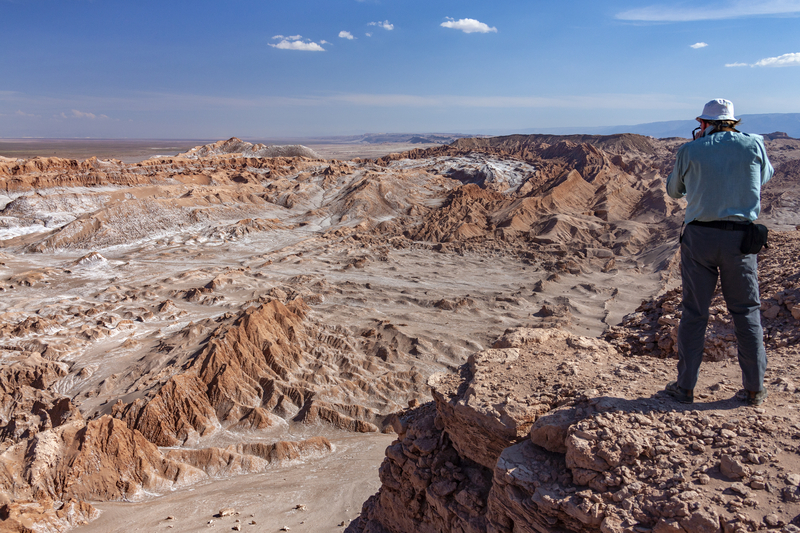
Stretching between the Pacific Ocean and the Andes Mountains, the Atacama Desert is the driest non-polar desert on Earth and one of South America’s most distinctive landscapes. Located in northern Chile, it combines extremely dry conditions with salt flats, volcanic mountains, high-altitude lagoons, geothermal fields, and some of the clearest skies in the world.
- Where Is the Atacama Desert Located?
- Why Is the Atacama Desert So Dry?
- Atacama Landscapes: Salt, Volcanoes, and High-Altitude Valleys
- Best Time to Visit the Atacama Desert
- How to Reach the Atacama Desert
- Valle de la Luna: Atacama’s Eroded Landscape
- El Tatio Geysers: Geothermal Activity at High Altitude
- Salar de Atacama: The White Heart of the Desert
- Lagunas Miscanti and Miñiques
- Stargazing in the Atacama Desert
- Atacameño Culture and Desert Heritage
- 2-Day Atacama Desert Itinerary
- Where to Stay in the Atacama
- Practical Travel Tips for Atacama
- Hidden Places Near Atacama
- Exploring Chile’s Extreme Desert Landscape
The landscape changes dramatically across the region. Red and ochre valleys contrast with white salt crusts, turquoise lagoons, dark volcanic terrain, and snow-covered peaks. After sunset, the exceptionally dry atmosphere creates excellent conditions for astronomical observation, making the Atacama one of the world’s leading destinations for stargazing.
For travelers, the Atacama offers a combination of geological landscapes, high-altitude environments, Indigenous heritage, and astronomy that is difficult to find in other desert regions.
Where Is the Atacama Desert Located?
The Atacama Desert lies in northern Chile, between the Pacific Coast and the Andes Mountains. The broader desert region covers more than 100,000 square kilometers (39,000 square miles), extending roughly from Arica in the north toward Copiapó in the south.
Geographic coordinates: approximately 24°S, 69°W
Elevation: from sea level to more than 4,000 meters (13,000 feet)
The desert transitions toward the Altiplano Plateau and extends close to the borders of Bolivia and Argentina. The town of San Pedro de Atacama is the main tourist base for exploring many of the region’s best-known attractions.
Why Is the Atacama Desert So Dry?
The Atacama’s extreme aridity results from several geographic and atmospheric factors working together:
- The Humboldt Current cools air along the Pacific coast and limits moisture reaching the region.
- The Andes Mountains form a major barrier to moist air arriving from the east.
- A persistent subtropical high-pressure system contributes to stable, dry atmospheric conditions.
- The surrounding geography limits the amount of moisture available to large parts of the desert.
Some parts of the Atacama receive extremely little precipitation, with certain locations experiencing exceptionally long periods without measurable rainfall. Despite this, specialized plants, animals, and microorganisms survive in areas where moisture is available.
Atacama Landscapes: Salt, Volcanoes, and High-Altitude Valleys
The Atacama contains several distinct desert environments within a relatively large region.
Visitors can encounter:
- Golden and reddish sand dunes
- Volcanic peaks and lava fields
- Red rock valleys shaped by erosion
- Large salt flats
- High-altitude lagoons
- Geothermal fields
- Mountain landscapes extending into the Altiplano
The combination of extreme aridity and volcanic geology gives many parts of the Atacama their unusual colors and landforms.
Best Time to Visit the Atacama Desert
The Atacama can be visited throughout the year, although conditions vary with altitude and season.
- April to October: generally dry with clear skies and comfortable conditions for many daytime activities
- January to March: temperatures can be warmer, with occasional rainfall in the highlands during the Altiplano’s summer rainfall period
- June to August: cold nights and excellent conditions for astronomy, although high-altitude excursions require warm clothing
For stargazing, the dry winter period often provides particularly favorable conditions, while daytime temperatures can still be comfortable in the lower desert.
How to Reach the Atacama Desert
From Santiago de Chile
The most practical route is a flight from Santiago to Calama Airport (CJC), followed by a drive of roughly one hour to San Pedro de Atacama.
By Road
Route 5 connects northern Chile with the rest of the country and can be used for long-distance road trips.
From Bolivia or Argentina
High-altitude routes connect the Atacama region with Uyuni in Bolivia and destinations in Jujuy, Argentina. These crossings involve significant elevation changes and should be planned with appropriate transport and acclimatization.
Valle de la Luna: Atacama’s Eroded Landscape
Valle de la Luna (Moon Valley) is one of the most visited landscapes near San Pedro de Atacama. Salt deposits, clay, rock formations, and wind erosion have created ridges and valleys with a highly irregular surface.
The area is particularly popular around sunset, when the low sunlight emphasizes the different colors and textures of the terrain.
El Tatio Geysers: Geothermal Activity at High Altitude
At approximately 4,320 meters above sea level, El Tatio is one of the world’s highest major geothermal fields.
Early morning is the best time to see the geysers, when the contrast between hot steam and the cold high-altitude air is strongest. The field contains numerous geothermal features, including geysers, fumaroles, and hot springs.
Because of the elevation, visitors should allow time to acclimatize before visiting El Tatio.
Salar de Atacama: The White Heart of the Desert
The Salar de Atacama is Chile’s largest salt flat, covering more than 3,000 square kilometers. Its extensive salt crusts and shallow lagoons create one of the region’s most distinctive landscapes.
The surrounding wetlands and lagoons provide habitat for several species of flamingos and other high-altitude wildlife.
The area also contains significant lithium resources, making the Salar important not only for its natural environment but also for Chile’s modern mining industry. Visitors should remain within designated areas because salt-flat surfaces and wetland habitats can be fragile.
Lagunas Miscanti and Miñiques
The Lagunas Miscanti and Miñiques are high-altitude lagoons located above 4,000 meters, surrounded by volcanoes and dry mountain terrain.
Their blue waters contrast sharply with the surrounding volcanic landscape, while flamingos and other birds can sometimes be seen around the shores.
The lagoons are also part of the cultural landscape of the Lickan Antay, whose traditional territories extend across the Atacama region.
Stargazing in the Atacama Desert
The Atacama is internationally recognized for its exceptional astronomical conditions. The region has a high number of clear nights, very low humidity, and limited light pollution in many remote areas.
Major observatories include:
- ALMA
- Cerro Paranal Observatory
- Other astronomical facilities located across northern Chile
Visitors can join guided astronomy tours near San Pedro de Atacama, where telescopes and expert explanations make it possible to observe planets, star clusters, nebulae, and other astronomical objects.
Atacameño Culture and Desert Heritage
The Atacameño, or Lickan Antay, people have lived in the Atacama region for thousands of years, developing communities adapted to one of the driest environments on Earth.
Their heritage can be seen in:
- Traditional irrigation and oasis agriculture
- Archaeological sites and ancient settlements
- Rock art and petroglyphs
- Regional festivals and ceremonies
- Stone architecture
- Traditional pottery and crafts
Villages such as Toconao, Socaire, and San Pedro de Atacama provide opportunities to learn about local history and contemporary Indigenous culture.
2-Day Atacama Desert Itinerary
Day 1: Valleys, Lagoons, and the Night Sky
- Morning: Explore the Salt Cordillera and Valle de la Luna
- Afternoon: Visit the Lagunas Miscanti and Miñiques
- Evening: Join a stargazing tour near San Pedro de Atacama
Day 2: Geysers, Springs, and Salt Flats
- Early morning: Visit the El Tatio Geysers
- Afternoon: Relax at the Puritama Hot Springs
- Sunset: Explore the Salar de Atacama and its surrounding lagoons
Because several attractions are located above 4,000 meters, travelers may prefer a longer itinerary that allows more time for acclimatization.
Where to Stay in the Atacama
Luxury
- Explora Atacama
- Tierra Atacama Hotel & Spa
Mid-Range
- Hotel Cumbres San Pedro
- Lodge Altiplánico
Budget
- Eco-lodges, guesthouses, and hostels throughout San Pedro de Atacama
San Pedro offers the widest range of accommodation and services, making it the most convenient base for visitors exploring the surrounding desert.
Practical Travel Tips for Atacama
- Acclimatize gradually, especially before visiting high-altitude locations.
- Drink enough water throughout the day.
- Wear layers, as temperatures can change sharply between day and night.
- Use strong sun protection, including sunscreen, sunglasses, and a hat.
- Carry some cash for smaller businesses and remote areas.
- Bring warm clothing for early-morning and nighttime excursions.
- Stay on designated paths around salt flats, lagoons, and protected areas.
- Respect wildlife and avoid disturbing fragile desert and wetland habitats.
Hidden Places Near Atacama
Travelers looking beyond the most popular attractions can consider:
- Piedras Rojas, known for red volcanic rock and nearby high-altitude lagoons
- Valle de Marte, a quieter alternative to some of the more visited valley landscapes
- Lagunas Escondidas de Baltinache, a group of saline lagoons known for their high salt concentration
- Puritama Hot Springs, located in a canyon surrounded by desert vegetation
- Viewpoints toward the region’s high volcanic peaks, depending on access and local conditions
Exploring Chile’s Extreme Desert Landscape
The Atacama Desert is defined by its extreme dryness, but its landscapes are far more varied than a simple expanse of sand. Salt flats, volcanic mountains, geothermal fields, high-altitude lagoons, red valleys, and desert oases create a region with strong contrasts in elevation, geology, and climate.
The same conditions that make the Atacama so dry also create some of the world’s best environments for astronomy. Combined with the long history of the Lickan Antay people, the region offers more than dramatic scenery.
For travelers, the Atacama brings together extreme desert geography, high-altitude landscapes, Indigenous heritage, wildlife, and world-class stargazing, making northern Chile one of the most distinctive desert destinations in South America.