
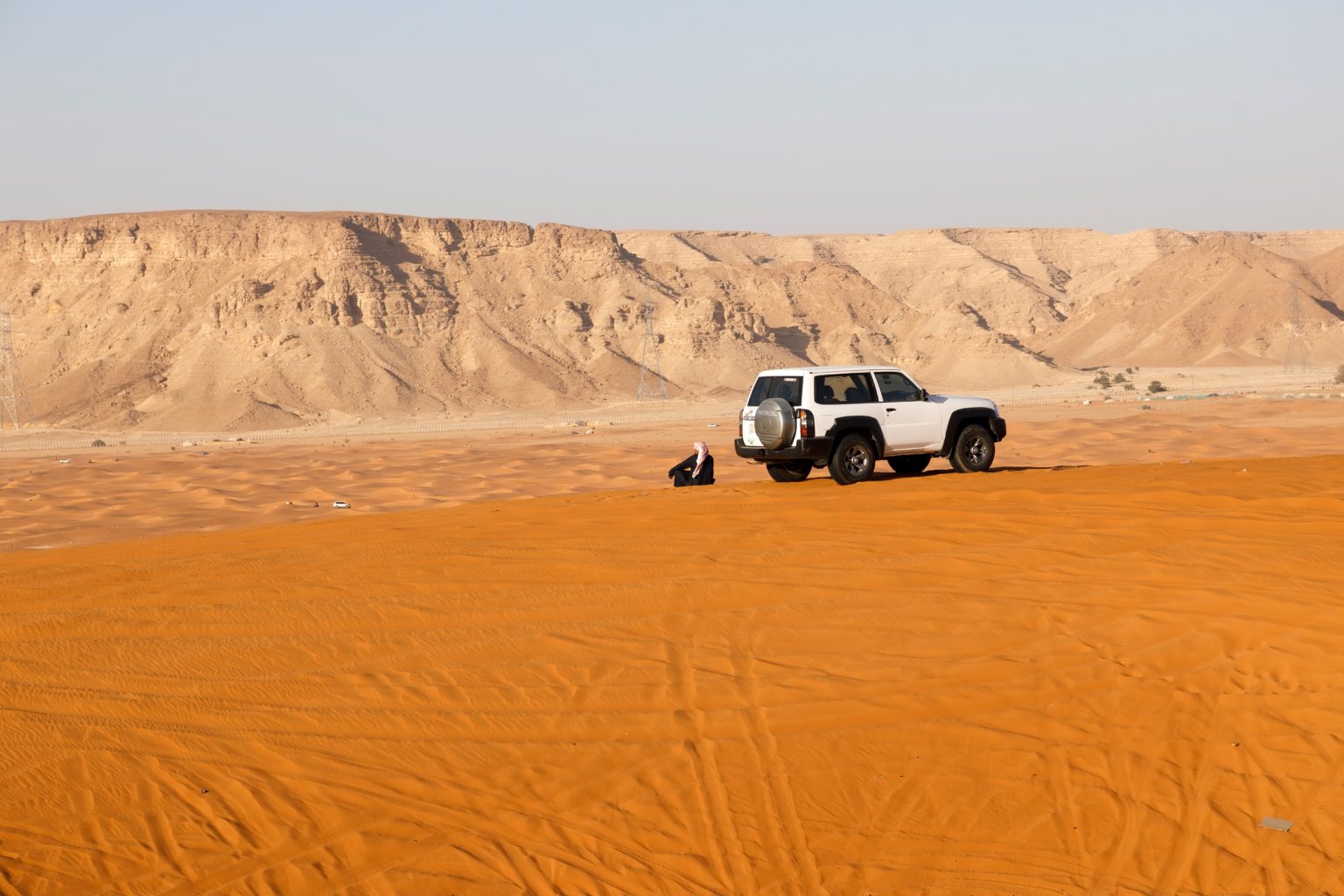
The engine rises in pitch as your 4×4 desert safari in Saudi Arabia climbs a sandy slope. At the crest, the view opens across rolling dunes and a wide Arabian sky. Then the vehicle descends, leaving the excitement of the drive behind as the desert settles into silence.
- Adventure, Culture and Open Landscapes
- Why Saudi Arabia Is a Great Destination for Desert Safaris
- The Best 4×4 Desert Safari Routes in Saudi Arabia
- Red Sand Dunes and Ad-Dahna Near Riyadh
- AlUla Desert and Sandstone Landscapes
- The Great Nafud Desert in the Ha’il Region
- Rub al Khali: The Empty Quarter
- Wadi Al Disah and the Tabuk Region
- What to Expect on a Saudi Desert Safari
- Safety Tips for 4×4 Desert Adventures
- Best Time for a Desert Safari in Saudi Arabia
- What to Bring on a Desert Safari
- Travel Responsibly and Respect Local Culture
- A Two-Day Desert Safari from Riyadh to the Red Sand Dunes
- Discover the Many Sides of Saudi Arabia’s Deserts
Saudi Arabia offers a remarkable range of desert landscapes, from the red dunes near Riyadh to the vast sands of the Empty Quarter and the sandstone formations around AlUla. Each destination offers a different experience, whether you want a short guided outing, a cultural excursion or a multi-day off-road expedition.
A desert journey is also an opportunity to learn about local heritage, wildlife and the practical skills needed to travel through remote terrain. This guide covers the main Saudi Arabia desert safari routes, what to expect from a guided tour and how to prepare for a safe, responsible adventure.
Adventure, Culture and Open Landscapes
A Saudi desert safari can be an energetic dune drive or a slower journey through a landscape shaped by wind, water and time. Some tours focus on recreation, while others combine off-road travel with wildlife observation, heritage visits and overnight camping.
Experiences vary by destination and operator, but may include:
- Guided 4×4 drives across suitable sandy terrain.
- Sandboarding on selected dunes.
- Camel rides and traditional refreshments.
- Visits to archaeological sites and historic landscapes.
- Photography stops at dunes, canyons and rock formations.
- Overnight camping and stargazing in designated areas.
Saudi Arabia’s deserts are not empty spaces. They contain plants, wildlife, geological features and traces of human history. Responsible travel means exploring these environments without damaging them or treating cultural heritage as a backdrop.
Why Saudi Arabia Is a Great Destination for Desert Safaris
The kingdom contains several distinct desert regions, each with its own terrain and travel requirements. Near Riyadh, visitors can arrange short excursions to red dunes. AlUla combines desert scenery with significant archaeological heritage, while the Great Nafud and Rub al Khali offer more remote landscapes that require careful planning.
Reasons to consider a 4×4 adventure in Saudi Arabia include:
- Varied terrain: Explore dunes, rocky plateaus, sandstone formations and mountain valleys.
- Cultural heritage: Discover historic settlements, rock art and archaeological sites through authorized visits.
- Guided outdoor activities: Join professional operators who know local routes and conditions.
- Wildlife observation: Learn about desert-adapted species without disturbing them.
- Stargazing: Enjoy dark skies in remote areas when weather and visibility are favorable.
- Different trip lengths: Choose a short outing near a major city or a longer expedition with specialist support.
Not every route is suitable for beginners, and a standard tourist safari is different from an independent off-road expedition. Choose the experience that matches your driving ability, available time and comfort with remote travel.
The Best 4×4 Desert Safari Routes in Saudi Arabia
Red Sand Dunes and Ad-Dahna Near Riyadh
The Red Sand Dunes near Riyadh are a popular choice for a short desert excursion without committing to a multi-day journey. Guided tours may include dune bashing, photography stops, refreshments and optional activities such as sandboarding or camel riding.
The exact driving time depends on the starting point, traffic and the particular dunes visited. Confirm the location with your operator rather than relying on a fixed journey time.
Popular activities may include:
- Guided dune driving with a trained driver.
- Sandboarding on suitable slopes.
- Photography during the softer light of morning or late afternoon.
- Traditional Saudi coffee and tea at an arranged camp.
- Optional camel rides or other activities offered by the operator.
The wider Ad-Dahna region is part of Saudi Arabia’s extensive sand landscape, but it should not be treated as one single, easily accessible route. Some areas are suitable for short guided trips, while others require more preparation.
This destination is a good introduction to desert safaris near Riyadh, particularly for first-time visitors and travelers with limited time.
AlUla Desert and Sandstone Landscapes
AlUla offers a distinctive combination of desert scenery, sandstone formations, oasis landscapes and archaeological heritage. It is known for Hegra, Saudi Arabia’s first UNESCO World Heritage Site, as well as AlUla Old Town and striking natural landmarks.
Visitors can arrange guided outdoor experiences, scenic drives and selected adventure activities through official tourism channels and local operators. Access rules vary between sites, particularly where archaeological remains or protected landscapes are involved.
Highlights may include:
- Guided excursions through selected desert landscapes.
- Visits to Hegra and other authorized heritage sites.
- Photography around sandstone formations and viewpoints.
- Hiking or outdoor activities offered by approved operators.
- Stargazing and selected overnight experiences.
A visit to AlUla should balance adventure with respect for its cultural heritage. Do not drive off-road toward archaeological features or enter restricted areas without permission.
AlUla is particularly suitable for desert adventure combined with history, geology and photography. It is not simply a dune-bashing destination, and not every excursion involves driving across deep sand.
The Great Nafud Desert in the Ha’il Region
The Great Nafud Desert, also called An Nafud, is a major sand desert in northern Saudi Arabia. Its broad dunes and open landscapes make it an appealing destination for travelers interested in longer desert journeys.
The wider Ha’il region also contains important archaeological and rock-art sites, including heritage areas associated with ancient human settlement. These locations should be visited through permitted access arrangements rather than treated as unrestricted off-road stops.
A guided excursion may include:
- Driving across suitable dune terrain with an experienced driver.
- Photography of the sand formations and surrounding landscape.
- Visits to selected cultural or archaeological sites.
- Overnight camping where permitted and properly arranged.
- Learning about the area’s geology and desert ecology.
The Great Nafud is not an appropriate place for an inexperienced driver to explore alone. Sand conditions, route-finding and recovery can become difficult far from paved roads.
This region is best for experienced off-road travelers and organized expeditions with suitable vehicles, navigation equipment and recovery support.
Rub al Khali: The Empty Quarter
The Rub al Khali, or Empty Quarter, is the largest continuous sand desert in the world and extends across parts of Saudi Arabia, Oman, the United Arab Emirates and Yemen. Its Saudi landscapes include immense dunes and remote sandy terrain that can be challenging even for experienced drivers.
Multi-day expeditions may depart from areas such as Wadi Ad-Dawasir or other regional access points. These journeys require careful route planning and should be organized with experienced guides who understand the terrain.
Possible experiences include:
- Guided drives across large dunes and sandy plains.
- Stops to observe geological features and remote desert landscapes.
- Overnight camping at planned locations.
- Stargazing away from urban lighting.
- Learning about desert travel and the region’s natural environment.
The Empty Quarter is not a casual extension of a city safari. Fuel, water, communication, vehicle recovery and emergency planning are essential. Travelers should book a specialist expedition rather than attempt to follow unmarked tracks independently.
This destination is best suited to experienced adventurers and guided multi-day tours.
Wadi Al Disah and the Tabuk Region
Wadi Al Disah, in the Tabuk region of northwestern Saudi Arabia, offers a different experience from the country’s open sand deserts. The valley is known for towering sandstone cliffs, palm-filled sections, springs and dramatic natural scenery.
Rather than focusing exclusively on dune driving, visitors often explore the area through guided drives, walking, photography and nature excursions. The valley also contains traces of historic settlement, including inscriptions and archaeological features.
Activities may include:
- Walking through suitable sections of the valley with local guidance.
- Photography of sandstone cliffs and palm-lined landscapes.
- Exploring designated viewpoints and natural features.
- Learning about the area’s cultural and geological history.
- Camping or overnight stays where permitted and appropriately arranged.
Water levels, road conditions and access can vary. Check local guidance before setting out, especially if rain could affect the valley or its routes.
Wadi Al Disah is a good option for travelers who want mountain scenery, oasis landscapes and outdoor exploration rather than a conventional dune-bashing safari.
What to Expect on a Saudi Desert Safari
A guided 4×4 desert tour usually begins with a pickup or meeting at an agreed location. The operator takes visitors to the planned route, explains the safety rules and provides information about the activities included.
Depending on the destination and package, a tour may include:
- Transport: A suitable vehicle and driver for the planned route.
- Dune driving: Guided off-road driving where terrain and conditions permit.
- Photo stops: Time to photograph dunes, rock formations or sunset views.
- Refreshments: Arabic coffee, tea or water, depending on the package.
- Optional activities: Sandboarding, camel rides or other arranged experiences.
- Meals and camping: Available on selected longer tours.
Vehicles used for desert excursions may include Toyota Land Cruiser models, Nissan Patrols, Jeep Wranglers or other suitable 4x4s. The appropriate vehicle depends on the terrain, group size, equipment and operator.
Before booking, ask whether the price includes pickup, meals, activities, insurance, camping equipment and any required permits. Confirm that the driver is trained for the type of terrain being visited.
Safety Tips for 4×4 Desert Adventures
Driving on sand requires different skills from driving on paved roads. Dunes can conceal steep drops, soft patches and sharp changes in terrain, while wind can alter the surface and reduce visibility.
For most visitors, a guided tour is the safest and simplest choice. If you plan an independent Saudi Arabia off-road adventure, prepare carefully and avoid remote routes beyond your experience.
Important precautions include:
- Travel with another suitable vehicle on remote expeditions instead of driving alone.
- Carry enough drinking water, food and fuel for the planned journey and possible delays.
- Bring navigation equipment and keep an offline route available.
- Carry appropriate recovery equipment and learn how to use it safely.
- Check weather forecasts, sandstorm warnings and local access restrictions.
- Share your itinerary and expected return time with someone who is not travelling with you.
- Avoid driving over vegetation, archaeological remains or sensitive terrain.
- Never assume that a phone signal or GPS navigation will work everywhere.
Tire pressure should not be reduced to one fixed figure for every vehicle. The appropriate setting depends on the tires, vehicle, load, terrain and manufacturer guidance. Reducing pressure on sand also requires experience and a reliable way to reinflate the tires before returning to paved roads.
For longer expeditions, book an operator with suitable communication equipment, recovery capability and an emergency plan. Do not attempt steep dunes or difficult recoveries without the necessary skills.
Best Time for a Desert Safari in Saudi Arabia
The most comfortable period for many outdoor desert activities is generally October to March, although conditions vary across the kingdom and by elevation.
October to March
Cooler weather often makes this period suitable for dune driving, camping, hiking and photography. Nights can still become cold, particularly in remote areas, so bring warm layers if you plan to camp.
April and May
Temperatures rise as summer approaches. Early-morning and late-afternoon excursions can be more comfortable than midday activities. Check the forecast and ask the operator whether the planned route is suitable for the conditions.
June to September
Summer heat can be intense, especially in exposed sandy terrain. Some tours continue to operate at adjusted times, but visitors should avoid prolonged exertion during extreme heat and follow the operator’s safety guidance.
There is no single temperature range that applies to every desert region. AlUla, the northern deserts, the Riyadh area and the Empty Quarter can experience different conditions. Check the local forecast before travelling and avoid relying on a seasonal average alone.
For many travelers, November through February is a useful starting point for planning a desert safari, particularly when overnight camping is part of the trip.
What to Bring on a Desert Safari
Packing depends on the length of the excursion, the weather and whether you are joining a guided tour or driving independently.
Recommended essentials include:
- Lightweight, breathable clothing for daytime warmth.
- Sunglasses, sunscreen and a hat.
- A scarf or face covering for blowing sand, if needed.
- Comfortable, closed footwear for walking over rough ground.
- Sufficient drinking water for the route and expected conditions.
- Snacks or meals for longer excursions.
- A flashlight or headlamp.
- A basic first-aid kit and any personal medication.
- A camera or phone protected against sand and dust.
- A power bank for long outings.
For overnight trips, add warm layers, suitable sleeping equipment if it is not provided, and any personal items required for camping.
For remote self-drive expeditions, ask an experienced local operator about extra fuel, vehicle recovery equipment, navigation, emergency communications and water supplies. Requirements should be based on the actual route and group size, not a universal checklist alone.
Travel Responsibly and Respect Local Culture
Saudi Arabia’s deserts contain fragile habitats, archaeological sites and places important to local communities. Responsible travel helps protect them while making the experience more rewarding.
- Stay on authorized routes and avoid damaging desert vegetation.
- Do not leave rubbish, food waste or other materials behind.
- Keep a respectful distance from wildlife.
- Never remove fossils, rocks, archaeological objects or cultural remains.
- Respect private property and local land-use restrictions.
- Ask permission before photographing people.
- Follow local guidance at heritage sites and protected areas.
- Keep noise to a reasonable level, especially near camps and wildlife.
- Choose operators who explain their safety and environmental practices.
A polite greeting, such as “As-salamu alaykum,” is a respectful way to begin an interaction, although customs vary by setting. Visitors should also follow local guidance on dress, photography and hospitality.
Desert environments may look resilient, but tracks, litter and disturbance can have lasting effects. Leave each place as you found it.
A Two-Day Desert Safari from Riyadh to the Red Sand Dunes
A short trip to the Red Sand Dunes can offer a taste of desert travel without requiring a multi-day expedition. The following outline assumes a guided tour and should be adjusted to the operator’s schedule.
Day 1: Guided Desert Drive and Sunset
Depart Riyadh at the time arranged with your operator and travel to a suitable red-dune area. After a safety briefing, enjoy a guided dune drive and stop at designated viewpoints for photographs.
Depending on the package, you may be able to try sandboarding, take a camel ride or relax at a camp with Arabic coffee and tea. Dinner and overnight camping are available only when included in the booking.
Confirm the camp’s location and return arrangements before departure.
Day 2: Morning in the Desert and Return to Riyadh
If your booking includes an overnight stay, begin the morning with breakfast and time to enjoy the cooler conditions. A short guided walk or another approved activity may be available, depending on the location and package.
Return to Riyadh according to the agreed schedule. Do not assume that every overnight tour includes camel riding or that every camp is close enough for a return by noon.
This itinerary works best as a short introduction. Travelers interested in the Great Nafud, AlUla or the Empty Quarter should plan separate trips rather than trying to combine widely separated regions in two days.
Discover the Many Sides of Saudi Arabia’s Deserts
A Saudi Arabia 4×4 desert safari can mean a short drive across red dunes near Riyadh, an outdoor excursion among AlUla’s sandstone formations or a carefully planned expedition into the vast sands of the Empty Quarter. Wadi Al Disah offers yet another perspective, with its cliffs, springs and palm-lined valley.
The key is to choose a route that matches your experience, allow enough time for the journey and prepare for the actual conditions. With an experienced guide, appropriate equipment and respect for local heritage, a desert safari becomes more than a drive across the sand. It becomes a chance to understand the landscapes and people that make Saudi Arabia’s deserts distinctive.