
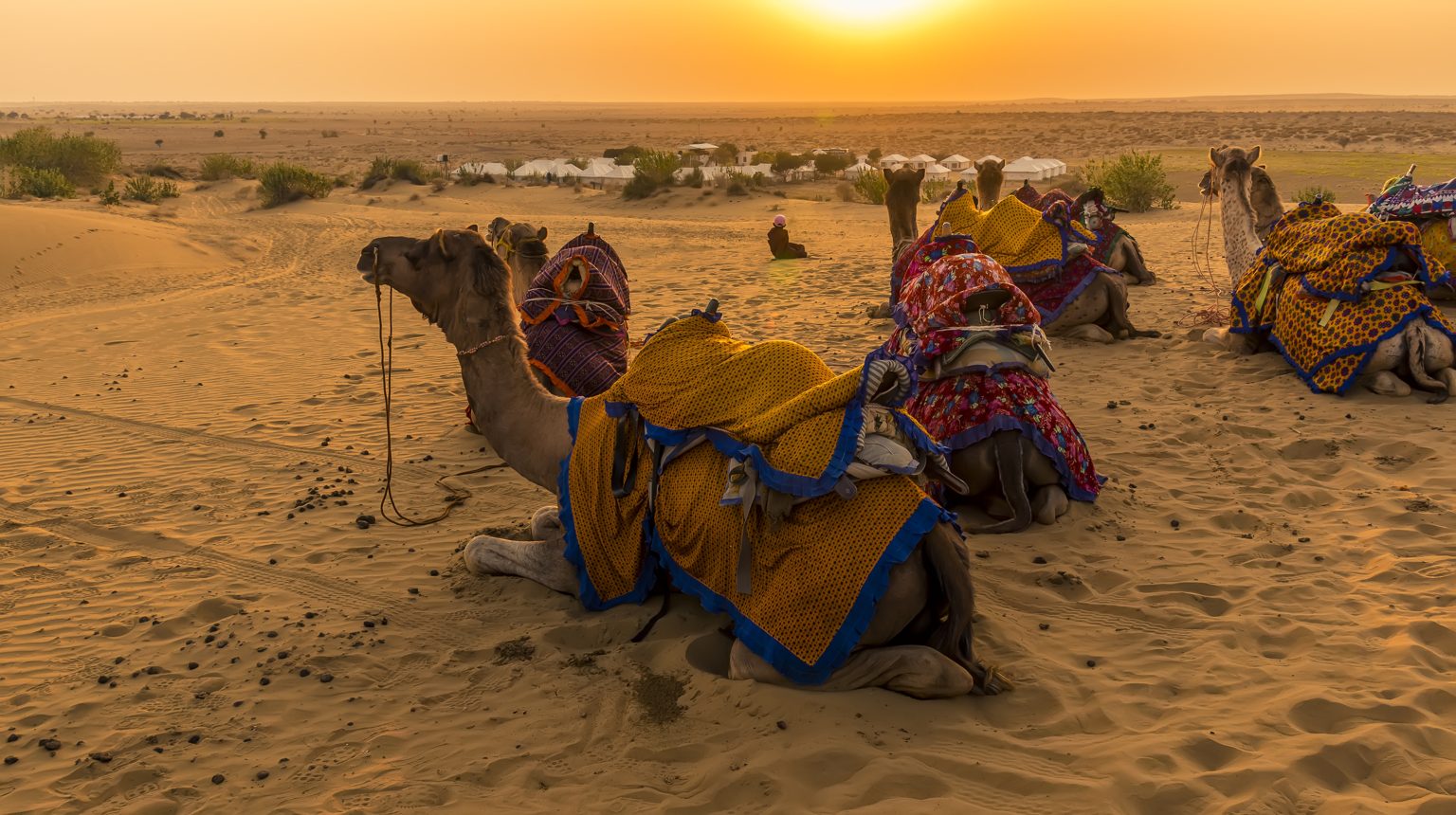
In northwestern India, the Thar Desert, also known as the Great Indian Desert, is one of South Asia’s most distinctive desert regions. Stretching across India and Pakistan, it combines sand dunes, grazing lands, seasonal agriculture, wildlife habitats, historic cities, and long-established communities.
- Where Is the Thar Desert Located?
- Landscape of Dunes, Plains, and Salt
- Climate and Seasonal Extremes of the Thar Desert
- Desert Plants That Sustain Life
- Wildlife of the Thar Desert
- Culture and People of the Thar Desert
- Ancient Trade Routes and Desert Forts
- Top Things to Do in the Thar Desert
- Where to Stay in the Thar Desert
- Best Places to Visit in the Thar Desert
- Two-Day Thar Desert Itinerary
- Hidden Gems of the Thar Desert
- Practical Travel Tips
- A Living Desert Landscape
Unlike many of the world’s sparsely populated deserts, the Thar supports a large population whose traditions have developed around limited water, seasonal rainfall, livestock, agriculture, and trade. Villages, forts, temples, craft traditions, and desert festivals are all part of the region’s identity.
The Thar is therefore not only a landscape of dunes. It is a cultural and historical region where desert environments and human settlement have developed alongside each other for centuries.
Where Is the Thar Desert Located?
The Thar Desert stretches across northwestern India and southeastern Pakistan. In India, it spans parts of Rajasthan, Gujarat, Punjab, and Haryana, while across the border it extends into Pakistan’s Punjab and Sindh regions.
The Indus River plain marks much of its western side, while the ancient Aravalli Range forms a natural boundary to the east. To the south lies the Rann of Kutch, and to the north, increasingly fertile agricultural areas gradually replace the desert landscape.
The desert is centered roughly around 27°N, 71°E.
Major cities associated with the Indian Thar include Jaisalmer, Bikaner, Jodhpur, and Barmer, each combining desert surroundings with historic architecture and regional culture.
Landscape of Dunes, Plains, and Salt
The Thar Desert landscape is more varied than a continuous field of sand dunes. Crescent-shaped dunes occur across large areas, while other parts consist of sandy plains, hard-packed ground, scrubland, and agricultural fields.
Many dunes are partly stabilized by vegetation, allowing settlements and grazing areas to exist nearby.
Between the dunes are sandy plains and harder surfaces used for grazing and seasonal farming. Toward the south, particularly around the Rann of Kutch, the landscape becomes more saline, with extensive salt flats and seasonal wetlands.
Along the eastern side, rocky outcrops associated with the Aravalli Hills add another geological element to the desert environment.
Climate and Seasonal Extremes of the Thar Desert
The Thar is a hot desert with strong seasonal variations.
- Annual precipitation: 100–500 mm
- Main rainfall period: July to September
- Summer temperatures: can exceed 48°C
- Winter nights: can fall to around 5°C
- Best time to visit: October to March
The seasonal monsoon is particularly important for agriculture, livestock, vegetation, and water supplies. The region supports one of the largest populations living in a desert environment.
The months from October to March generally offer the most comfortable conditions for sightseeing and outdoor activities.
Desert Plants That Sustain Life
Vegetation in the Thar Desert is adapted to heat, limited rainfall, grazing, and sandy soils.
- Khejri tree: valued for shade, fodder, fuel, and its role in soil protection
- Acacia trees: common around villages and agricultural areas
- Neem trees: widely found around settlements and cultivated land
- Desert grasses: provide important grazing resources
- Thorny shrubs: help protect the soil and provide habitat for wildlife
The khejri tree is particularly important to the region and has long been associated with local environmental traditions.
Wildlife of the Thar Desert
Despite its arid conditions, the Thar Desert wildlife is diverse.
- Indian gazelle (chinkara): found across open desert habitats
- Blackbuck: protected populations survive in several areas
- Nilgai: occurs in suitable grassland and scrub habitats
- Desert fox: adapted to the region’s dry environment
- Great Indian bustard: an endangered bird found in protected desert and grassland areas
- Vultures and other raptors: common across suitable habitats
- Desert monitor lizard: adapted to hot, dry conditions
- Spiny-tailed lizard: well adapted to sandy and rocky terrain
Wildlife activity varies with temperature and season, with many species becoming more active during the cooler parts of the day.
Culture and People of the Thar Desert
The Thar is home to communities including Rajputs, Bishnois, Jats, and Charans, among many other groups that have contributed to the region’s cultural identity.
Traditional homes built from mud, clay, stone, and other local materials are designed to provide protection from extreme temperatures.
The region is also known for:
- Colorful turbans and traditional clothing
- Embroidery and textile crafts
- Kamaicha and dholak music
- Traditional village architecture
- Bishnoi conservation traditions
The Bishnoi community is particularly known for traditions emphasizing the protection of trees and wildlife.
Ancient Trade Routes and Desert Forts
For centuries, the Thar formed part of trade networks connecting the Indian subcontinent with regions farther west and north.
Camel caravans transported a range of goods across desert routes, including:
- Spices
- Salt
- Textiles
- Other regional goods
Settlements along these routes developed into important commercial centers.
Fort cities such as Jaisalmer gained importance because of their position along these trade routes. Their architecture, markets, temples, and defensive walls still reflect the economic importance the desert once had for regional commerce.
Top Things to Do in the Thar Desert
Explore Jaisalmer Fort, a historic fortified city overlooking the surrounding desert.
Experience a camel safari through the dunes and nearby villages, ideally with a responsible local operator.
Spend a night at a desert camp and observe the night sky away from major cities.
Visit Bikaner and Jodhpur to explore forts, stepwells, palaces, and regional architecture.
Attend local cultural festivals featuring traditional music, dance, crafts, food, and camel-related events.
Where to Stay in the Thar Desert
The Thar offers a wide range of accommodation:
- Desert camps near Jaisalmer: convenient for dune experiences and camel safaris
- Historic havelis: traditional accommodation in desert cities
- Hotels in Jaisalmer, Bikaner, and Jodhpur: suitable for travelers who prefer modern facilities
- Rural guesthouses and eco-lodges: closer to local communities and agricultural areas
Accommodation standards vary considerably, so travelers should choose according to location, facilities, and environmental practices.
Best Places to Visit in the Thar Desert
- Jaisalmer Fort: a major historic landmark and former trading center
- Sam Sand Dunes: one of the most popular dune areas near Jaisalmer
- Junagarh Fort in Bikaner: an important example of regional fort architecture
- Mehrangarh Fort in Jodhpur: a major historic fort overlooking the city
- Villages around Barmer: known for traditional textiles, embroidery, handicrafts, and rural desert life
Two-Day Thar Desert Itinerary
Day 1: Explore Jaisalmer Fort and nearby villages. In the evening, take a camel safari in the surrounding dunes and stay overnight at a desert camp.
Day 2: Watch sunrise over the dunes, visit the Bada Bagh cenotaphs, and return to Jaisalmer for further sightseeing or onward travel.
Hidden Gems of the Thar Desert
- Bishnoi villages: known for conservation traditions and close connections with local wildlife
- Khuri: quieter dune landscapes away from some of the busier areas around Jaisalmer
- Historic stepwells: traditional water structures found in several settlements
- Desert shrines: religious sites connected to local communities
- Smaller temples and villages: places to experience regional architecture and everyday desert life
Practical Travel Tips
- Best time to travel: October to March
- Daytime clothing: light and breathable
- Night clothing: carry warm layers during winter
- Sun protection: bring sunscreen, sunglasses, and a hat
- Water: carry sufficient drinking water, especially outside towns
- Local customs: respect village traditions, religious sites, and photography restrictions
- Wildlife: observe animals from a safe distance and avoid disturbing protected species
A Living Desert Landscape
The Thar Desert stands out because of the close relationship between its environment and its people. Sand dunes, grazing lands, seasonal farms, wildlife habitats, historic trade routes, and populated settlements all form part of the same desert region.
For travelers, the Thar offers much more than a dune safari. A journey can combine Jaisalmer’s historic architecture, camel routes, village life, traditional crafts, wildlife reserves, desert camps, and centuries-old trading history.
This combination of landscape, culture, and history makes the Thar one of the most distinctive desert regions in South Asia and one of the world’s most densely settled desert environments.