
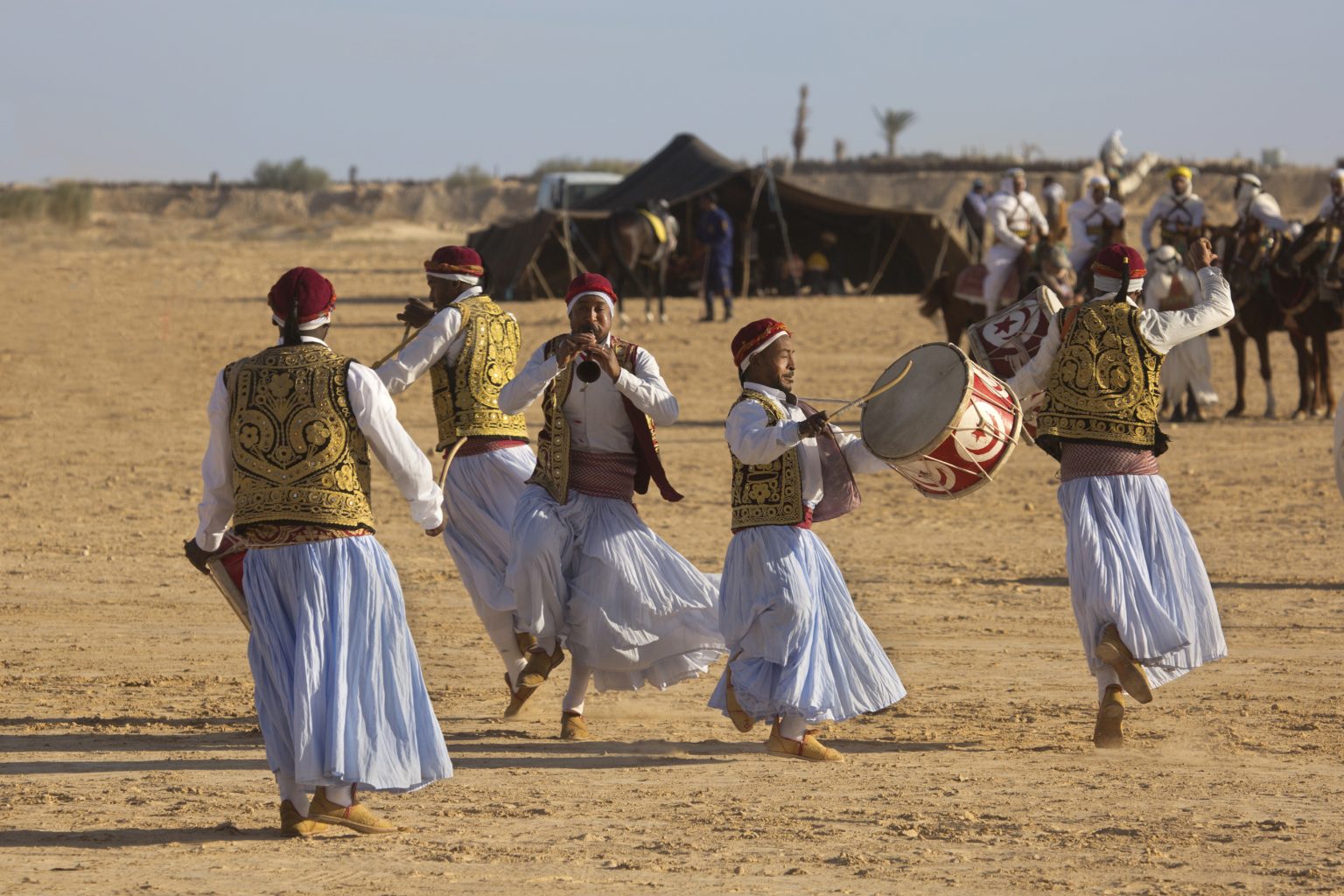
Southern Tunisia has a rich musical heritage shaped by Amazigh traditions, Bedouin poetry, local celebrations, and life in oasis communities. From Saharan music in Tunisia to the folk traditions of Douz, Tozeur, and Tataouine, songs and rhythms remain important parts of family gatherings, festivals, and cultural events. Traditional Tunisian desert music brings together different regional influences, while Amazigh and Bedouin musical traditions preserve forms of expression passed between generations.
- The Origins of Saharan Music
- Instruments and Rhythms of Saharan Music
- Themes in Saharan Songs
- Love, Separation, and Travel
- Freedom, Movement, and the Landscape
- Spirituality and Religious Expression
- Oral Traditions and Community Performances
- Musical Traditions Across Southern Tunisia
- Douz: A Gateway to Saharan Culture
- Tozeur and Nefta: Music in the Oasis Towns
- Tataouine, Chenini, and Douiret: Amazigh Cultural Heritage
- Music, Healing, and Ritual Practices
- Festivals, Cultural Preservation, and Contemporary Music
- The International Festival of the Sahara
- Contemporary Music and New Influences
- Keeping Musical Traditions Alive
- The Emotional Power of Saharan Music
- The Continuing Musical Heritage of Southern Tunisia
The Origins of Saharan Music
Amazigh Musical Heritage
Amazigh communities have lived across North Africa for centuries, including the mountain villages and oasis regions of southern Tunisia. Their musical traditions developed in different local settings and reflect community life, celebrations, oral poetry, and religious and social occasions.
Traditional performances may combine singing, hand clapping, percussion, and regional instruments. Music can accompany weddings, seasonal celebrations, and gatherings where people share stories and maintain connections with their cultural heritage.
There is no single musical style shared by all Amazigh communities. The rhythms, instruments, languages, and performance practices of southern Tunisia vary from one locality to another.
Bedouin Poetry and the Qasida Tradition
Arab Bedouin traditions also contributed to the cultural life of southern Tunisia. Oral poetry has long been used to express love, courage, hospitality, longing, and experiences of travel and community life.
The qasida, a form of Arabic poetry with a long history, is associated with several literary and oral traditions. In performance, poetry may be recited or sung, sometimes accompanied by percussion or other instruments.
In southern Tunisia, Arabic poetic traditions coexist with Amazigh cultural heritage and other regional influences. Their interaction forms part of the area’s diverse musical landscape, although the exact styles and histories differ between communities.
Instruments and Rhythms of Saharan Music
Bendir
The bendir is a frame drum found in several North African musical traditions. It generally consists of a circular wooden frame covered with a stretched membrane, traditionally made from animal skin, although modern versions may use synthetic materials.
Its deep, resonant sound provides rhythm for songs, dances, and communal performances. Depending on the tradition, the bendir may accompany:
- Vocal poetry and group singing
- Festive music and dancing
- Weddings and community gatherings
- Cultural performances
Gasba: The Reed Flute
The gasba is a traditional end-blown reed flute used in various North African musical styles. Its sound can be soft and expressive or more forceful, depending on the instrument and playing technique.
Gasba melodies may accompany songs about:
- Love and separation
- Everyday experiences
- Travel and personal memories
- Local celebrations
Its use varies across regions, so it should not be treated as the defining instrument of every Tunisian desert community.
Zokra
The zokra is a traditional double-reed wind instrument used in parts of North Africa. Its penetrating sound makes it suitable for outdoor performances, dancing, and festive gatherings.
The instrument is associated with lively musical settings in some regional traditions. Its exact construction, name, and performance style can vary across the wider region.
Rababa
The rababa, also spelled rabab or rebab in different contexts, is a traditional bowed string instrument found in several Middle Eastern and North African musical traditions. Some forms have a single string, while construction varies by region.
It can accompany vocal poetry and narrative singing, providing a sustained melody beneath the singer’s voice. Its sound is often associated with reflective or expressive performances, depending on the local musical style.
Clapping, Footwork, and Percussion
Rhythm does not depend on instruments alone. Hand clapping, foot stamping, and coordinated movement can form an essential part of group performances.
These elements help singers and dancers maintain a shared rhythm and allow audiences to participate. In many festive settings, the interaction between performers and spectators is as important as the melody itself.
Themes in Saharan Songs
Love, Separation, and Travel
Love and separation are common themes in Arabic and Amazigh oral poetry, although the subjects vary by region and performance tradition. Songs may describe distance between lovers, family separation, travel, or the difficulties of maintaining relationships across long distances.
Desert journeys and remote settlements can provide a setting for these themes, but the songs also address ordinary human experiences that are not unique to desert life.
Freedom, Movement, and the Landscape
Travel, mobility, hospitality, and the open landscape appear in different forms of Saharan poetry and song. Camels, journeys, seasonal movement, and encounters between communities may feature in lyrics or oral narratives.
These images reflect the historical importance of travel and trade across arid regions. Their meaning depends on the particular song and the context in which it is performed.
Spirituality and Religious Expression
Music and spoken poetry can accompany religious occasions, community gatherings, and celebrations. Some performances express gratitude, hope, or requests for protection and well-being.
Religious singing, devotional practices, and secular folk music should be distinguished from one another, even when they share instruments or performance techniques. Southern Tunisia contains a range of musical practices, each shaped by its own local and religious context.
Oral Traditions and Community Performances
Poetry Shared at Gatherings
Oral poetry allows stories and verses to pass from one generation to the next. Performers may recite established poems, sing familiar lines, or adapt verses to suit a particular gathering.
Some performances include responses from other singers or members of the audience. This exchange keeps the event interactive and gives participants an opportunity to contribute to the performance.
The balance between memorized material and improvisation differs between traditions and performers.
Women’s Role in Preserving Songs
Women have an important role in preserving many forms of traditional music and oral culture. Depending on the community, women’s songs may accompany:
- Lullabies and caring for children
- Weddings and family celebrations
- Everyday work and social gatherings
- Expressions of love, memory, and personal experience
These songs can preserve local vocabulary, memories, social experiences, and musical styles. Women’s participation and performance traditions differ between communities, so their role should not be reduced to one uniform practice.
Dance and Collective Rhythm
Dance is closely connected with many festive musical traditions in southern Tunisia. Performers may coordinate steps, shoulder movements, hand gestures, and the movement of their clothing with the rhythm.
Group dancing can bring participants together during weddings, festivals, and other celebrations. The movements and musical patterns vary according to the event and the local tradition.
Musical Traditions Across Southern Tunisia
Douz: A Gateway to Saharan Culture
Douz is widely associated with Saharan heritage and the International Festival of the Sahara, which brings together performances and activities connected with regional culture.
Depending on the program, visitors may encounter:
- Traditional music and percussion
- Poetry and dance performances
- Camel-related events
- Cultural presentations and local crafts
The festival provides an opportunity to see how music remains part of public celebrations and the region’s cultural identity.
Tozeur and Nefta: Music in the Oasis Towns
Tozeur and Nefta have long histories as oasis towns with connections to regional trade, agriculture, and cultural exchange. Their musical life forms part of the wider heritage of southern Tunisia.
Local performances may include vocal music, percussion, and regional instrumental traditions. Songs can address love, family, work, religious life, and the surrounding landscape, although themes and styles vary between performers.
Tataouine, Chenini, and Douiret: Amazigh Cultural Heritage
The areas around Tataouine, Chenini, and Douiret are associated with Amazigh history and distinctive local cultural traditions. Music and oral expression form part of this heritage, alongside language, architecture, crafts, and family customs.
Performances may involve singing, rhythmic clapping, and group participation. Some use Tamazight, while others use Arabic or a mixture of linguistic influences. The specific traditions differ between villages and communities.
Music, Healing, and Ritual Practices
Stambeli and Trance Traditions
Tunisia is home to Stambeli, a musical and ritual tradition with deep roots in the country’s cultural history, particularly among communities with sub-Saharan African heritage. It is associated with devotional and healing contexts and has its own repertoire, instruments, and ceremonial practices.
Stambeli should not be treated as interchangeable with all Saharan music or with every trance tradition in North Africa. Its cultural and spiritual significance depends on the community and the setting in which it is performed.
Music and Well-Being
Music can support social connection, emotional expression, and a sense of belonging. Repeated rhythms, singing, and collective movement are important in many cultural and ceremonial settings.
Some communities also associate particular musical practices with spiritual protection or healing. These beliefs should be understood within their cultural context rather than presented as universal features of desert life or as medically established effects.
Festivals, Cultural Preservation, and Contemporary Music
The International Festival of the Sahara
Douz hosts the International Festival of the Sahara, a major cultural event associated with the region’s Saharan heritage. The festival is known for presenting elements of traditional music, poetry, dance, and camel culture.
Its program can vary from year to year, so visitors should check the current dates and activities before planning a trip.
Contemporary Music and New Influences
Younger Tunisian musicians continue to explore ways of combining regional musical traditions with contemporary styles. Depending on the artist, these experiments may bring traditional rhythms or instruments into contact with:
- Electronic music
- Jazz
- Contemporary Arabic music
- International folk and fusion styles
Such projects do not replace older traditions. Instead, they create new contexts in which selected elements of regional music can reach different audiences.
Keeping Musical Traditions Alive
Traditional music is preserved through several channels:
- Family teaching and community performances
- Festivals and cultural associations
- Music recordings and oral-history projects
- Workshops and instrument lessons
- Research and cultural archives
Local musicians and cultural organizations can play an important role in documenting songs, teaching instruments, and supporting younger performers. The involvement of UNESCO or another institution should be confirmed for each specific project rather than assumed.
The Emotional Power of Saharan Music
Music in southern Tunisia carries personal memories, local histories, and shared experiences. A song may recall a wedding, express longing for someone far away, accompany a celebration, or preserve words and melodies learned from older generations.
The meaning of a performance often comes from the people involved, the occasion, and the traditions surrounding it. Instruments, voices, and rhythm provide a way to share experiences that might otherwise remain within a family or community.
For visitors, listening respectfully to local music can offer a deeper understanding of the cultural life of southern Tunisia, beyond the region’s dunes, salt flats, and oasis landscapes.
The Continuing Musical Heritage of Southern Tunisia
The music of southern Tunisia brings together a range of Amazigh, Arab, and other regional influences. From the bendir and gasba to oral poetry, group singing, dance, and ceremonial traditions, these practices reflect the diversity of the communities that maintain them.
Douz, Tozeur, Nefta, Tataouine, and nearby villages each offer their own cultural context. Their musical traditions continue through family gatherings, festivals, local performances, and the work of contemporary artists.
For travelers interested in Saharan heritage, music provides an opportunity to learn about the people, languages, and customs of southern Tunisia. It is not one single sound, but a collection of traditions that continue to develop while remaining connected to the region’s history.