
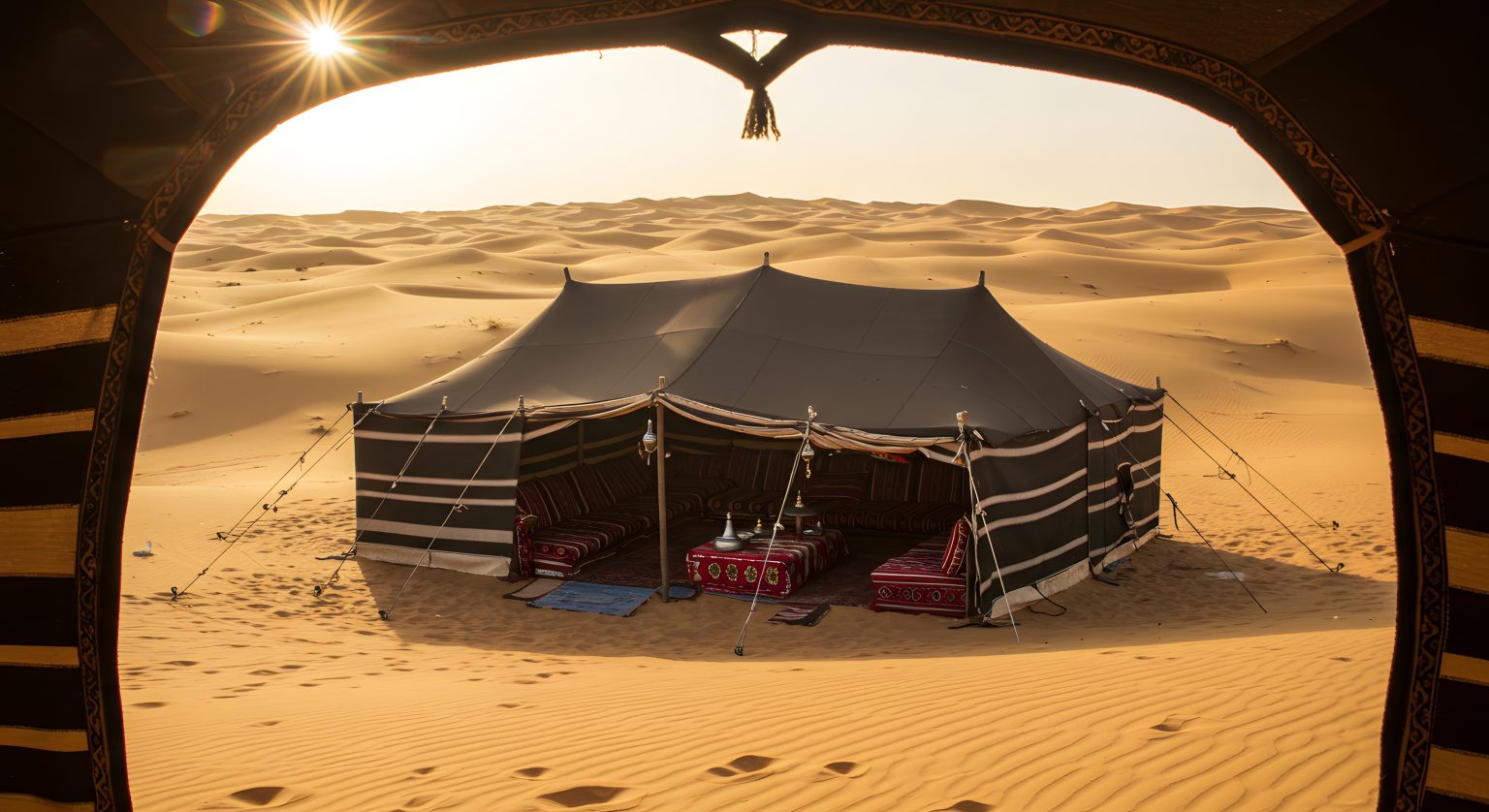
The aroma of cardamom coffee and the warmth of a shared gathering offer a glimpse into the traditions that have shaped life across the Arabian Peninsula. In desert communities, knowledge of the land, oral storytelling, and hospitality have long played important roles in daily life, although customs vary between regions and families.
- Who Are the Bedouins of Saudi Arabia?
- Bedouin Hospitality: A Longstanding Tradition
- Bedouin Poetry, Music and Oral Heritage
- Camping With Bedouin Hosts Under the Stars
- Best Places in Saudi Arabia to Explore Bedouin Heritage
- AlUla and Its Desert Heritage
- The Rub’ al Khali: The Empty Quarter
- Asir and Najran Regions
- Riyadh’s Red Sands and the Dahna Desert
- What to Expect During a Bedouin-Inspired Camp Visit
- What to Bring for Desert Camping
- Best Time to Camp in the Saudi Desert
- Cultural Etiquette and Respect
- An Overnight Desert Experience in AlUla
- Discover the Heritage Behind Saudi Arabia’s Deserts
Bedouin culture in Saudi Arabia reflects a rich heritage connected to pastoralism, travel, poetry, and community life. From traditional coffee ceremonies to stories passed between generations, Bedouin traditions remain an important part of the country’s cultural history. For travelers interested in Saudi desert experiences, visiting a local cultural camp or joining a knowledgeable guide can provide a closer look at this heritage while distinguishing historical practices from modern tourism.
Who Are the Bedouins of Saudi Arabia?
The English word Bedouin comes from the Arabic Badawi, a term traditionally associated with people of the desert. Historically, many Bedouin communities across the Arabian Peninsula practiced nomadic or semi-nomadic pastoralism, moving with their livestock according to seasonal conditions, grazing opportunities, and access to water. Today, lifestyles vary widely, and many people with Bedouin heritage live in towns and cities while maintaining connections to family traditions and tribal histories.
In Saudi Arabia, Bedouin heritage is associated with several regions, including Najd, the northern deserts around Tabuk, parts of AlUla, and areas near the Rub’ al Khali and Najran. These regions are geographically and culturally diverse, and not every desert community shares the same history or customs.
Traditional Bedouin life often involved:
- Camels, sheep, and goats: Livestock provided transport, food, and other resources, with the animals raised depending on local conditions.
- Portable tents: Some communities used bayt al-sha’ar, tents traditionally woven from goat or sheep hair. Their construction and use varied by region.
- Oral poetry and storytelling: Poetry, family histories, and accounts of travel helped transmit knowledge and cultural values.
- Knowledge of the desert: Experience with water sources, grazing areas, weather, and travel routes was essential in arid environments.
- Community relationships: Kinship networks and mutual assistance played important roles in many traditional pastoral societies.
These practices developed in response to local environments and social circumstances. Modern Bedouin heritage is not frozen in the past: families and communities continue to adapt while preserving traditions they consider meaningful.
Bedouin Hospitality: A Longstanding Tradition
Hospitality is an important value in Saudi society, with deep historical connections to travel, family life, and the responsibilities associated with welcoming guests. In desert environments, offering food, water, and assistance to travelers could also be a practical necessity.
Saudi coffee, often called qahwa, is a familiar part of traditional hospitality. It is commonly flavored with cardamom and served in small cups, often alongside dates. The details of serving coffee differ between households and regions, but the gesture commonly expresses welcome and respect.
Important elements of hospitality may include:
- Arabic or Saudi coffee: Guests may be offered small cups of coffee as part of a greeting.
- Dates and refreshments: Dates are a familiar accompaniment to coffee, while other foods depend on the occasion and local customs.
- Shared meals: Families and guests may gather around dishes prepared for everyday meals, celebrations, or special visits.
- The majlis: This traditional gathering space provides a setting for conversation, receiving visitors, and discussing family or community matters.
- Respectful conversation: Welcoming guests often involves attentive listening, offering refreshments, and making visitors feel comfortable.
Some desert camps also serve meals cooked in underground ovens, including zarb in certain regional and tourism settings. However, this dish should not be treated as a universal feature of Bedouin food in Saudi Arabia. Regional Saudi cuisine is diverse, with dishes and preparation methods varying across the Kingdom.
Visitors may be invited to participate in a coffee ceremony or share a meal during a cultural experience. Accepting refreshments can be a polite gesture, but customs vary, and guests should feel comfortable communicating dietary requirements or declining something respectfully.
Bedouin Poetry, Music and Oral Heritage
Poetry has a long history across the Arabian Peninsula and remains an important part of Saudi cultural life. In traditional Bedouin communities, oral verse could communicate emotion, preserve memories, celebrate achievements, express criticism, or convey messages between people.
Nabati poetry, composed in regional forms of Arabic, is especially associated with the cultural heritage of the Arabian Peninsula. It has been used to express love, pride, grief, hospitality, and observations about social life. Today, Nabati poetry can be encountered through cultural gatherings, performances, recordings, and literary events.
Oral traditions have taken different forms across the region:
- Nabati poetry: Verse that draws on regional Arabic expression and subjects connected to everyday life, relationships, and heritage.
- Storytelling: Accounts of family history, travel, historical events, and memorable figures shared between generations.
- Traditional songs and chants: Musical and spoken forms associated with particular communities, occasions, and activities.
- Poetry gatherings: Events where performers recite verses and audiences listen, respond, or discuss the meaning of the words.
One tradition often mentioned in discussions of Bedouin heritage is Al-Taghrooda, a form of chanted poetry traditionally performed by Bedouins in the United Arab Emirates and Oman. It is recognized by UNESCO as intangible cultural heritage. Although it shares broader regional connections with Bedouin oral traditions, it should not be presented as a custom exclusive to Saudi Arabia. <Cite refs={[“turn457162search0″,”turn457162search4″,”turn457162search9”]}/>
The instruments, rhythms, and performance styles associated with traditional music also vary. Rather than assuming that every camp features the same instruments or songs, ask local hosts about the particular traditions they share.
Camping With Bedouin Hosts Under the Stars
A desert camp can offer an introduction to the landscapes and cultural traditions associated with Bedouin heritage. The experience depends on the location and operator: some camps emphasize local hospitality and food, while others focus mainly on outdoor activities and accommodation.
Traditional tent designs may draw inspiration from bayt al-sha’ar, with woven materials, rugs, and seating arranged for comfort. Modern camps may instead use permanent structures, furnished tents, or luxury accommodation. A contemporary camp should not automatically be treated as a reconstruction of historical Bedouin life.
A cultural camp visit may include:
- Coffee and conversation: Learn about local customs while sharing refreshments with a host or guide.
- Traditional food: Sample regional dishes and ask about their ingredients and cultural background.
- Poetry or music: Some operators arrange performances or introductions to local oral traditions.
- Desert walks or camel rides: These activities may be available through authorized operators, depending on the location.
- Stargazing: Clear skies and limited artificial lighting can make remote desert areas suitable for observing stars.
- Local knowledge: Guides may explain the landscape, traditional travel routes, water sources, and the ways communities adapted to arid conditions.
Before booking, ask who operates the camp, which cultural activities are included, and whether local community members lead the experience. This helps set realistic expectations and supports more meaningful cultural encounters.
Best Places in Saudi Arabia to Explore Bedouin Heritage
Saudi Arabia offers several destinations where visitors can explore desert landscapes, regional history, and cultural experiences. These places differ in their historical background and visitor facilities, so it is important not to assume that every destination offers the same kind of Bedouin encounter.
AlUla and Its Desert Heritage
AlUla is known for its sandstone formations, oasis landscapes, historic settlements, and archaeological sites. It is an excellent destination for travelers interested in the relationship between desert environments and the communities that have lived in the region.
Visitors can explore Hegra, the archaeological site associated with the Nabataean civilization, and learn about the history of AlUla’s oasis and Old Town. These heritage sites are not exclusively Bedouin, and their histories should be distinguished from the traditions of later pastoral communities.
Depending on the season and available programs, travelers may also find guided desert excursions, local cultural activities, and accommodation experiences inspired by regional heritage.
Consider the following when planning a visit:
- Explore heritage sites with authorized guides.
- Ask about cultural activities led by local residents.
- Check access requirements and opening arrangements for archaeological locations.
- Choose a desert excursion that explains the landscape as well as its cultural history.
AlUla suits travelers seeking a combination of desert scenery, archaeology, and contemporary cultural tourism. <Cite refs={[“turn457162search10″,”turn457162search3”]}/>
The Rub’ al Khali: The Empty Quarter
The Rub’ al Khali, known in English as the Empty Quarter, is one of the Arabian Peninsula’s most extensive sand deserts. It extends across parts of Saudi Arabia, Oman, the United Arab Emirates, and Yemen.
Its vast dunes and remote terrain make it a striking destination for travelers interested in desert landscapes and overland exploration. However, it is not a place to enter casually without planning. Distances are considerable, services are limited in remote areas, and routes may require specialized vehicles and experienced guides.
A responsible visit should include:
- Booking with an experienced desert operator familiar with the intended route.
- Confirming whether the excursion is suitable for your experience and fitness level.
- Carrying sufficient water, food, fuel, communications equipment, and emergency supplies as advised by the operator.
- Checking weather conditions and access restrictions before departure.
- Respecting local communities, private land, and sensitive areas.
Some operators offer guided excursions that introduce visitors to desert environments and regional heritage. Confirm whether a tour includes a genuine cultural component rather than assuming that every 4×4 trip or overnight camp provides direct contact with Bedouin communities.
Asir and Najran Regions
Asir and Najran offer landscapes and cultural traditions distinct from the central and northern deserts. Asir is known for its mountainous terrain, traditional architecture, and regional crafts, while Najran has its own architectural, agricultural, and cultural heritage near the country’s southern border.
These regions should not be described simply as places where Bedouin traditions remain unchanged. Their communities include diverse histories and lifestyles, shaped by mountains, settlements, farming, trade, and regional connections.
Travelers interested in local culture can look for:
- Traditional markets and craft workshops.
- Regional food and architecture.
- Heritage museums and cultural centers.
- Local festivals and community events, when scheduled.
- Guided visits that explain the area’s distinct history and customs.
Ask local tourism offices or guides about the cultural activities available during your travel dates. This is a better way to find relevant experiences than assuming that a particular performance or festival is always available.
Riyadh’s Red Sands and the Dahna Desert
The red-sand landscapes around Riyadh and sections of the Dahna Desert are accessible options for visitors who want to experience desert scenery without undertaking a long journey into the Empty Quarter.
Depending on the location and operator, activities may include guided 4×4 excursions, short walks, sunset viewing, camel experiences, or overnight camping. Some camps provide meals and seating areas inspired by traditional hospitality, while others offer more contemporary facilities.
For a safe and enjoyable visit:
- Choose a reputable operator and confirm the meeting point.
- Check whether transport, meals, equipment, and accommodation are included.
- Ask about facilities such as toilets, shade, drinking water, and sleeping arrangements.
- Follow the guide’s instructions and stay within permitted areas.
- Avoid driving onto dunes without the appropriate vehicle, experience, and authorization.
These areas can suit families and first-time desert visitors, but a modern desert camp is a tourism experience rather than a complete representation of historical nomadic life.
What to Expect During a Bedouin-Inspired Camp Visit
A typical organized camp visit may begin with a welcome and refreshments, followed by a guided activity before sunset. The precise schedule depends on the location, weather, operator, and package booked.
A visit may include:
- Arrival and welcome: Meet the host or guide and receive information about the camp and planned activities.
- Desert exploration: Join a guided walk, a 4×4 excursion, or another activity offered at the location.
- Sunset viewing: Stop at a suitable viewpoint to observe the changing colors of the landscape.
- Dinner: Enjoy regional food or a meal prepared by the camp team.
- Cultural activities: Some camps arrange poetry, music, storytelling, or explanations of local customs.
- Stargazing: If the sky is clear, spend time observing the stars away from bright lights.
- Morning refreshments: Depending on the package, breakfast and a short morning excursion may be available.
Not every visit includes all these elements. Confirm the schedule and the cultural activities in advance, especially if meeting local hosts or learning about a specific tradition is a priority.
What to Bring for Desert Camping
Desert conditions can change significantly between day and night. A warm afternoon does not guarantee a comfortable evening, particularly during the cooler months or in exposed areas.
Pack the following essentials:
- Layered clothing: Wear breathable clothes during the day and bring a warm jacket for the evening.
- Comfortable footwear: Closed shoes are useful for walking on uneven ground and rocky terrain.
- Sun protection: Bring sunscreen, sunglasses, and a hat.
- A reusable water bottle: Carry enough drinking water for the planned activities and follow the operator’s advice about supplies.
- A flashlight or headlamp: Useful when moving around camp after dark.
- A power bank: Helpful when charging facilities are limited.
- Personal medication and toiletries: Bring everything you need, especially when staying at a remote site.
- A scarf or shemagh: This can help protect against wind and blowing sand.
- A camera or tripod: Optional equipment for landscape and night photography.
If you plan to stay overnight, ask whether bedding, blankets, heating, and towels are provided. Remote camps vary considerably in their facilities, so checking beforehand can prevent unpleasant surprises.
Best Time to Camp in the Saudi Desert
The best time for desert camping in Saudi Arabia depends on the destination, planned activities, and your tolerance for heat or cold. The country covers several climatic regions, so one temperature range cannot accurately describe every desert.
Winter: November to March
Winter is often a popular period for outdoor desert activities because daytime temperatures are generally more manageable than during the hottest months. However, nights can become cold, particularly in open desert areas.
Bring warm layers, check the forecast, and ask your camp about suitable bedding and heating.
Spring: March to May
Spring can provide favorable conditions for desert excursions, although temperatures rise as the season progresses. Plan longer walks and strenuous activities for cooler hours, and carry sufficient water.
Conditions differ between AlUla, the Riyadh region, and the southern desert areas, so check the forecast for your exact destination.
Summer: June to September
Summer can bring intense heat to many desert regions, making exposed daytime activities uncomfortable or unsafe. Some excursions may be restricted, rescheduled, or unsuitable during periods of extreme heat.
If you travel in summer, follow local advice and choose activities that avoid the hottest part of the day. Never rely on a general seasonal temperature estimate when planning a remote journey.
December to February can be a good period to consider for many desert camping trips, but confirm the expected temperatures, wind, and accommodation arrangements for your specific destination.
Cultural Etiquette and Respect
A respectful approach helps visitors enjoy cultural experiences without treating local traditions as a performance staged solely for tourists.
Keep these guidelines in mind:
- Greet people politely: As-salamu alaykum is a common Arabic greeting.
- Respect local customs: Observe how your hosts behave and follow their guidance on appropriate conduct.
- Dress appropriately: Choose clothing that respects the setting and local expectations.
- Ask before taking photographs: Always seek permission before photographing people, particularly in private or family settings.
- Be considerate about food and drink: If offered coffee or refreshments, respond politely. You can explain dietary restrictions or decline respectfully when needed.
- Listen and ask questions: Show interest in the history and meaning of traditions instead of assuming that all communities follow the same practices.
- Respect private and cultural spaces: Follow instructions about access and avoid entering restricted areas.
- Support local providers: Where possible, choose reputable operators who work with local guides and explain their cultural and environmental practices.
Hospitality customs vary between families and regions. There is no single set of behaviors that applies to every Saudi or Bedouin host, so politeness, attention, and open communication are the most useful guides.
An Overnight Desert Experience in AlUla
AlUla can provide a convenient base for combining desert scenery with archaeological and cultural visits. This sample plan is flexible and should be adapted to the accommodation and activities available on your dates.
Day 1: Desert Landscapes and Evening Hospitality
- Arrival: Check in to your accommodation and confirm the timing of any booked excursions.
- Afternoon exploration: Join a guided trip through selected desert landscapes or visit a scheduled heritage attraction.
- Sunset: Stop at an authorized viewpoint to photograph the sandstone formations.
- Evening meal: Enjoy dinner at your accommodation or a local dining venue.
- Cultural experience: If available, attend a locally led program featuring regional food, storytelling, poetry, or heritage interpretation.
- Overnight stay: Rest at your accommodation and enjoy the night sky if weather and lighting conditions permit.
Day 2: Heritage and Morning Exploration
- Morning refreshments: Have breakfast before the day’s activities.
- Heritage visit: Explore Hegra, AlUla Old Town, or another suitable site according to opening times and advance booking requirements.
- Local context: Use a knowledgeable guide to understand the region’s history and distinguish archaeological heritage from later pastoral traditions.
- Departure: Continue your journey or return to your next destination.
This itinerary combines desert scenery with the region’s wider heritage rather than presenting every activity as a traditional Bedouin custom. If your priority is a direct cultural exchange with Bedouin hosts, confirm that your chosen experience is locally led and includes that opportunity.
Discover the Heritage Behind Saudi Arabia’s Deserts
Bedouin heritage is part of the wider cultural history of Saudi Arabia, shaped by pastoral traditions, poetry, hospitality, travel, and knowledge of arid landscapes. Yet there is no single Bedouin lifestyle that represents every region or family. Traditions have changed over time, and communities continue to express their heritage in different ways.
For travelers, the most rewarding experiences begin with curiosity and respect. Choose knowledgeable local guides, ask about the origins of the customs you encounter, and distinguish genuine cultural learning from activities designed primarily for entertainment.
From the sandstone landscapes of AlUla to the remote dunes of the Empty Quarter and the accessible desert areas around Riyadh, Bedouin heritage in Saudi Arabia offers many ways to understand the relationship between people, landscape, and tradition. A thoughtful visit can provide more than a night in the desert: it can offer a deeper appreciation of the diverse communities and histories that have shaped the Arabian Peninsula.