
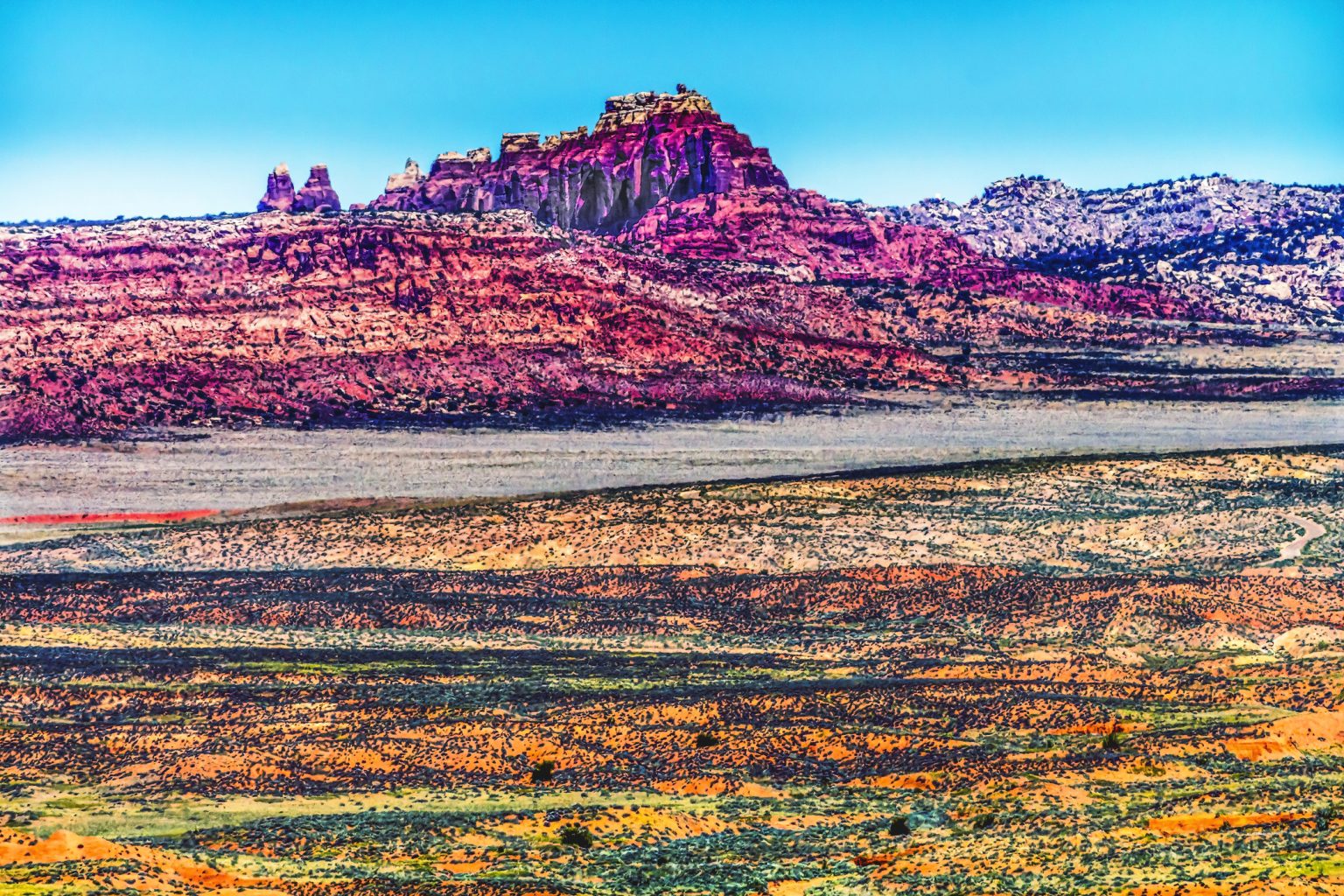
In northeastern Arizona, the landscape changes dramatically across broad badlands, mesas, and mineral-rich hills. The Painted Desert is known for its layered shades of red, orange, pink, gray, and purple, while the nearby Petrified Forest preserves fossilized trees from a prehistoric ecosystem that existed more than 200 million years ago.
- Where Are the Painted Desert and Petrified Forest Located?
- The Painted Desert Landscape: A Geological Palette
- The Petrified Forest: Ancient Trees Turned to Stone
- Climate and Best Time to Visit
- Plants and Wildlife of the Painted Desert
- Geological History Written in Color
- Cultural Heritage of the Painted Desert
- Best Things to Do in the Painted Desert and Petrified Forest
- Walk the Painted Desert Rim Trail
- Hike the Blue Mesa Trail
- Explore the Crystal Forest
- Visit the Rainbow Forest Museum
- See Newspaper Rock
- Two-Day Painted Desert and Petrified Forest Itinerary
- Where to Stay Near Petrified Forest National Park
- Practical Travel Tips
- Hidden Corners Worth Exploring
- Exploring a Desert Shaped by Geological Time
Together, the Painted Desert and Petrified Forest form one of North America’s most distinctive geological landscapes. Visitors can explore colorful sedimentary formations, fossilized wood, ancient archaeological sites, and desert trails within Petrified Forest National Park.
Where Are the Painted Desert and Petrified Forest Located?
Both landscapes are located in northeastern Arizona, approximately 300 kilometers (185 miles) east of Flagstaff, along Interstate 40, within Petrified Forest National Park.
The park covers approximately 900 km² (350 square miles) and sits at elevations of roughly 1,500 to 1,800 meters (4,900–5,900 feet).
The Petrified Forest occupies much of the southern portion of the park, while the Painted Desert extends across the northern section. Together, they form a diverse landscape of badlands, mesas, fossil deposits, and desert vegetation.
The Painted Desert Landscape: A Geological Palette
The Painted Desert is characterized by rolling badlands, broad mesas, shallow valleys, and exposed sedimentary layers.
Its distinctive colors come largely from minerals within ancient sediments:
- Red and orange tones are associated with iron-rich minerals.
- Pink and purple shades occur in several sedimentary layers containing different mineral compositions.
- Gray and blue-gray tones can be associated with clay and volcanic ash deposits.
- White layers occur in areas where lighter sedimentary materials are exposed.
Erosion has gradually exposed these layers, while changing sunlight alters their appearance throughout the day. Sunrise and sunset are particularly effective times for viewing the strongest contrasts across the badlands.
The Petrified Forest: Ancient Trees Turned to Stone
The Petrified Forest preserves fossilized trees from the Late Triassic Period, when the region supported a very different environment roughly 225 million years ago.
Fallen trees were buried under sediment and volcanic material. Over long periods, silica-rich groundwater moved through the buried wood and gradually replaced its organic material with minerals. The original structure of the trees was preserved while the wood became stone.
Today, pieces of petrified wood can be found throughout the park, with mineral deposits producing colors that range from brown and red to yellow, purple, and gray.
Climate and Best Time to Visit
The park’s elevation gives the region a cool semi-arid climate, with significant differences between summer days and winter nights.
Typical conditions include:
- Annual precipitation of around 200 mm (8 inches)
- Summer temperatures that can reach approximately 35°C (95°F)
- Winter nights that can fall below freezing, sometimes reaching around -5°C (23°F)
Spring and autumn are generally comfortable seasons for hiking and sightseeing. Summer can also be suitable for visiting, although midday temperatures may be hot, while winter brings colder conditions and occasional snow.
Plants and Wildlife of the Painted Desert
Vegetation is adapted to the region’s dry conditions and relatively high elevation.
Common plants include:
- Sagebrush
- Rabbitbrush
- Yucca
- Four-wing saltbush
- Prickly pear cactus
Seasonal rainfall can produce short-lived wildflower displays.
Wildlife found in the broader park and surrounding desert includes:
- Prairie dogs
- Jackrabbits
- Coyotes
- Hawks
- Ravens
- Small desert reptiles
Wildlife activity is generally easier to observe during the cooler parts of the day.
Geological History Written in Color
The exposed rock layers of the Painted Desert provide evidence of changing environments during the region’s geological history.
Different layers reflect different conditions and mineral compositions, including:
- Iron-rich sediments deposited in ancient floodplain environments
- Layers influenced by volcanic ash and manganese-bearing minerals
- Ancient river and floodplain deposits
- Compacted clay and ash
Together, these formations preserve a geological record extending back more than 200 million years.
Cultural Heritage of the Painted Desert
People have lived in the region for thousands of years, with archaeological evidence documenting human activity going back more than 13,000 years.
Ancestral Puebloan communities established settlements, agricultural areas, and ceremonial spaces in the region. Later Indigenous communities, including the Hopi and Navajo, maintained cultural connections with the wider landscape.
Important cultural sites within the park include:
- Puerco Pueblo
- Newspaper Rock, known for its concentration of petroglyphs
- Agate House, an archaeological structure constructed partly from petrified wood
Visitors should treat archaeological sites and rock art as protected cultural resources and avoid touching or disturbing them.
Best Things to Do in the Painted Desert and Petrified Forest
Walk the Painted Desert Rim Trail
This short scenic trail provides views across the colorful badlands and is particularly attractive in the early morning and late afternoon.
Hike the Blue Mesa Trail
The Blue Mesa Trail is a 2.4-kilometer loop through blue-gray, purple, and white sedimentary formations. It provides a closer look at the geology of the Painted Desert.
Explore the Crystal Forest
The Crystal Forest trail passes through an area containing numerous pieces of petrified wood. The trail provides a convenient way to see the fossilized material without entering sensitive areas.
Visit the Rainbow Forest Museum
The museum provides information about the geological history of the Petrified Forest, fossil formation, and the prehistoric ecosystems that once existed in the region.
See Newspaper Rock
Newspaper Rock contains hundreds of petroglyphs created by Indigenous peoples over different periods. A viewing area allows visitors to observe the rock art without approaching the protected surface.
Two-Day Painted Desert and Petrified Forest Itinerary
Day 1: Painted Desert
- Morning walk along the Painted Desert Rim
- Visit scenic overlooks during the afternoon
- Explore additional viewpoints around the northern section of the park
- Watch sunset from Kachina Point
Day 2: Petrified Forest
- Morning hike through Blue Mesa
- Explore the Crystal Forest
- Visit Puerco Pueblo and Newspaper Rock
- Finish at the Rainbow Forest Museum
- Photograph the petrified wood during late afternoon light
Where to Stay Near Petrified Forest National Park
Holbrook, Arizona, is one of the main accommodation bases for visitors exploring the park and provides easy access from Interstate 40 and historic Route 66.
Accommodation options in the area include:
- Globetrotter Lodge
- Brad’s Desert Inn
- Other hotels and motels around Holbrook
The historic Painted Desert Inn is located within the park and is an important landmark, although it is not a conventional overnight hotel.
Camping opportunities inside the park are limited and more basic, so travelers should check current park regulations and availability before planning an overnight stay.
Practical Travel Tips
Keep the following points in mind when planning your visit:
- Best seasons: Spring and autumn generally offer comfortable conditions.
- Main access: Interstate 40 provides convenient access near Holbrook.
- Park hours: Check current operating hours before visiting, as schedules can change seasonally.
- Night access: The park is not generally open for unrestricted nighttime access.
- Backcountry travel: Some remote areas require permits and advance planning.
- Petrified wood: Removing petrified wood from the park is prohibited.
- Weather: Conditions can change quickly because of the park’s elevation and exposed terrain.
Hidden Corners Worth Exploring
For travelers with additional time, several less-central locations add variety to a visit:
- Devil’s Playground, accessible under specific backcountry conditions and permit requirements
- Jasper Forest Overlook, offering views across an area rich in petrified wood
- Agate Bridge, a natural stone formation created from petrified wood
- The historic Route 66 alignment, which passes through the park and connects the landscape with the history of America’s famous highway
Exploring a Desert Shaped by Geological Time
The Painted Desert and Petrified Forest are closely connected landscapes, but each offers a different way to understand northeastern Arizona. The Painted Desert reveals layers of sediment, minerals, erosion, and changing environments, while the Petrified Forest preserves fossilized wood from the Late Triassic period.
Together, they allow visitors to see geological history directly in the landscape, alongside archaeological sites, desert vegetation, and wildlife. Exploring the park is therefore less about covering long distances and more about understanding the formations, fossils, and cultural remains preserved across this unusual Arizona desert.