
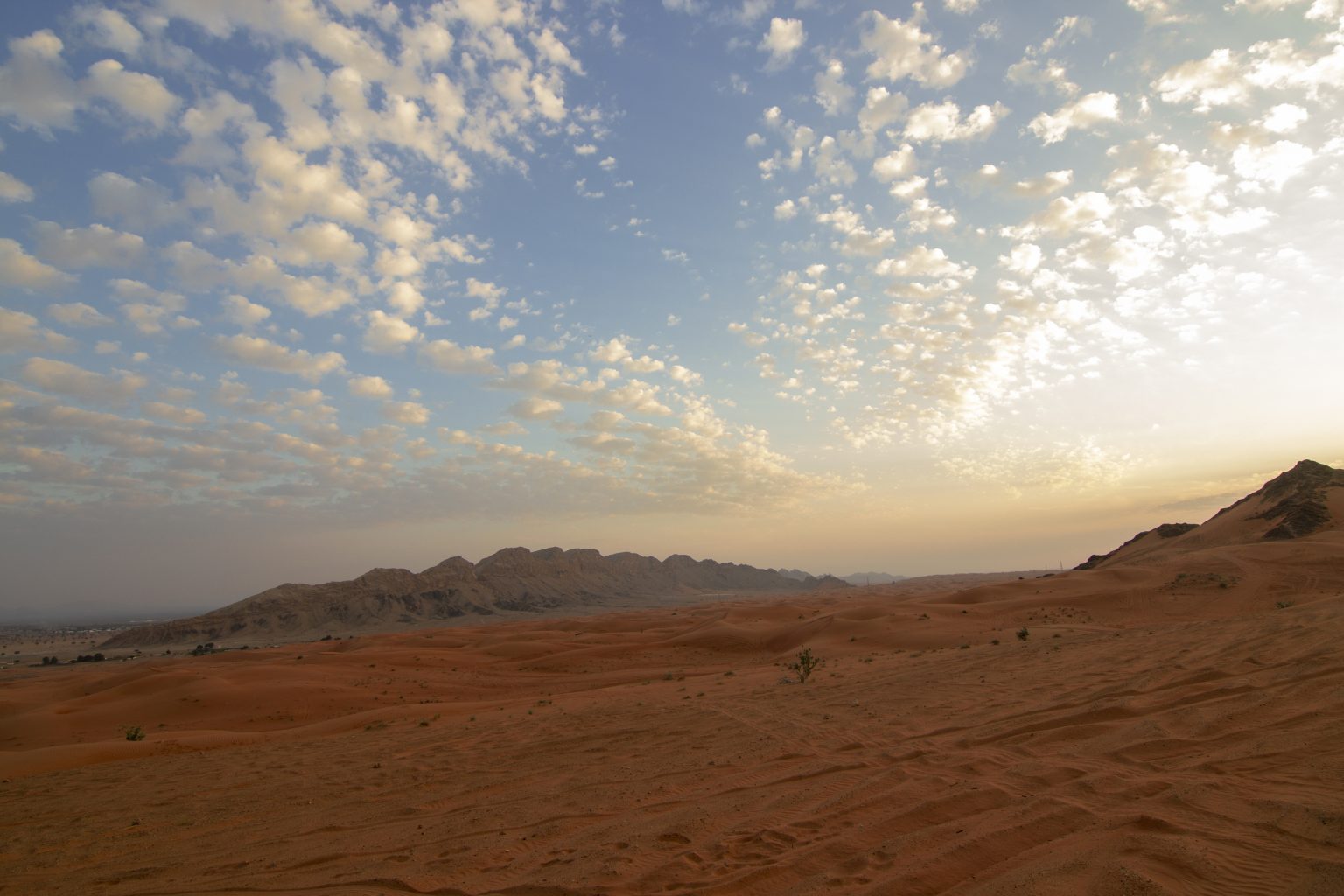
In the heart of Sharjah’s central desert, the dunes give way to a landscape shaped by millions of years of geological and human history. Fossil Rock and the Mleiha Desert bring together ancient marine fossils, prehistoric archaeological sites, rocky landscapes, and red sand dunes.
- Where Are Fossil Rock and the Mleiha Desert Located?
- How to Reach Mleiha from Dubai or Sharjah
- Best Time to Visit Mleiha
- Things to Do in Mleiha and Fossil Rock
- Hike Fossil Rock (Jebel Maleihah)
- Visit the Mleiha Archaeological Center
- Explore the Camel Fossil Site
- Desert Adventures and Dune Exploration
- Stargazing at the Mleiha Astronomy Center
- Fossilized Reefs, Caves, and Petroglyphs
- Suggested 2-Day Mleiha Itinerary
- Where to Stay Near Mleiha
- Culture and Bedouin Heritage
- Practical Travel Tips
- Hidden Gems Around Mleiha
- A Desert Landscape Shaped by Deep History
Mleiha offers a rare opportunity to see geological and archaeological history within the same landscape. Ancient marine deposits, fossilized remains, prehistoric settlements, and traces of early human activity can all be found across the region.
Where Are Fossil Rock and the Mleiha Desert Located?
The Mleiha Desert lies in the central region of the Sharjah Emirate, approximately:
- 60 km east of Sharjah City
- 70 km from Dubai
- 30 km west of Kalba on the east coast
At its heart rises Fossil Rock (Jebel Maleihah), a limestone outcrop surrounded by red dunes. The wider area includes rolling sands, ancient wadis, and rocky plateaus that were once associated with the Tethys Sea.
The area is protected by the Sharjah Environment and Protected Areas Authority (EPAA) as part of the Mleiha Archaeological and Natural Reserve, preserving an important geological and archaeological landscape in the UAE.
How to Reach Mleiha from Dubai or Sharjah
By car, the journey is straightforward and fully paved.
- Follow E102 (Sharjah–Kalba Road)
- Exit toward Mleiha Archaeological Center
- Total travel time: about 1 hour
Guided tours are also available from Dubai, Sharjah, and Ajman, offering 4×4 safaris, fossil walks, archaeological tours, and night stargazing experiences.
Best Time to Visit Mleiha
Mleiha can be visited year-round, but the cooler months offer the most comfortable conditions for exploring the desert.
- November–March (20–30°C): Ideal for hiking, exploration, and night activities
- April–May (30–36°C): Warm days with more comfortable evenings
- June–September (38–45°C): Extremely hot; visits are best limited to dawn or dusk
- October (~30°C): Comfortable conditions and excellent light for photography
Winter nights are especially clear, making Mleiha a popular destination for desert stargazing in the UAE.
Things to Do in Mleiha and Fossil Rock
Hike Fossil Rock (Jebel Maleihah)
Fossil Rock is the region’s most iconic landmark. Its limestone layers contain marine fossils over 65 million years old, including corals, shells, and ammonites from a period when the area was covered by the sea.
A hike to its 300-meter summit offers wide views of the red dunes stretching westward and the Hajar Mountains rising to the east. The combination of fossil-rich rock and surrounding desert makes Fossil Rock one of the most distinctive geological sites in the region.
Visit the Mleiha Archaeological Center
This center is the main starting point for understanding the region’s archaeological heritage. Exhibits trace human presence from the Paleolithic period through the Bronze, Iron, and Islamic ages.
Highlights include:
- Bronze Age tombs
- Iron Age fortifications and wells
- Prehistoric camel fossils
- Tools, pottery, and burial artifacts
Interactive displays and guided walks provide more context about the archaeological sites and discoveries found around Mleiha.
Explore the Camel Fossil Site
One of Mleiha’s notable discoveries, this site preserves the remains of ancient wild camels, some dating back over 7,000 years. The remains provide insight into the animals that lived in Arabia and the relationship between humans and wildlife in the region.
Desert Adventures and Dune Exploration
Mleiha combines archaeological exploration with a range of desert activities.
Popular options include:
- 4×4 dune safaris
- Sandboarding
- Fat biking
- Sunset picnics among the dunes
The surrounding terrain changes noticeably with the position of the sun, making the area particularly attractive for photography and outdoor exploration.
Stargazing at the Mleiha Astronomy Center
Away from major city lights, Mleiha offers clear desert skies for astronomy. Through telescopes, visitors can observe Saturn’s rings, Jupiter’s moons, and the Milky Way when conditions are favorable.
Astronomy sessions also introduce visitors to Bedouin star lore, providing a cultural perspective on how desert communities used the night sky for navigation and seasonal awareness.
Fossilized Reefs, Caves, and Petroglyphs
Fossilized coral and other marine remains can be found across parts of the Mleiha landscape, reflecting the region’s geological history. Nearby caves and archaeological sites provide evidence of prehistoric human activity.
Across surrounding hills, petroglyphs depict camels, hunters, and symbolic forms, offering further evidence of human activity in the Arabian Peninsula.
Suggested 2-Day Mleiha Itinerary
Day 1: Geological and Archaeological Mleiha
Morning: Visit the Camel Fossil Site and Archaeological Center
Afternoon: Hike Fossil Rock
Evening: Stargazing and tea at the Astronomy Center
Day 2: Desert Exploration
Morning: 4×4 safari or sandboarding
Afternoon: Explore caves and Al Faya Mountain
Evening: Return to Dubai or camp beneath the stars
Where to Stay Near Mleiha
Luxury & Eco-Stays
- Mleiha Glamping Domes with private decks and telescopes
- Al Badayer Oasis Retreat (40 minutes away)
Camping
Designated desert camping areas surround Fossil Rock. Bring water, camping gear, and supplies, or join guided overnight camps where meals and equipment may be provided.
Culture and Bedouin Heritage
Mleiha connects the archaeological heritage of ancient Arabia with traditions that remain important in the region today. Bedouin traditions of hospitality, storytelling, falconry, and desert navigation continue to influence local cultural experiences.
Visitors may experience:
- Traditional Emirati meals
- Camel riding and falconry
- Lantern-lit desert camps with music
The desert landscape around Mleiha is closely connected to the history and culture of the communities that have lived and traveled across this part of Arabia.
Practical Travel Tips
- Best season: November–March
- Roads are accessible by regular car; 4×4 required for Fossil Rock
- Carry plenty of water
- Dress lightly by day and bring warmer clothing for the evening
- Fossils and archaeological artifacts are protected by law
- Guided tours are strongly recommended
Hidden Gems Around Mleiha
- Al Faya Mountain, a volcanic ridge with panoramic views
- Fossil Valley, scattered with ancient shells
- Mleiha Caves, associated with prehistoric human activity
- Al Madam Ghost Village, partly buried by shifting sand
- Kalba Mangroves, a contrasting coastal landscape nearby
A Desert Landscape Shaped by Deep History
Fossil Rock and the Mleiha Desert offer a combination of geological formations, archaeological sites, desert scenery, and cultural experiences that is difficult to find elsewhere in the UAE.
From marine fossils preserved in limestone to prehistoric settlements and wide views across the dunes, Mleiha allows visitors to see different periods of the region’s history within a relatively compact area.
A visit to Fossil Rock at sunset brings many of these elements together, with the red dunes, rocky outcrops, and distant Hajar Mountains creating one of Sharjah’s most distinctive desert landscapes.