
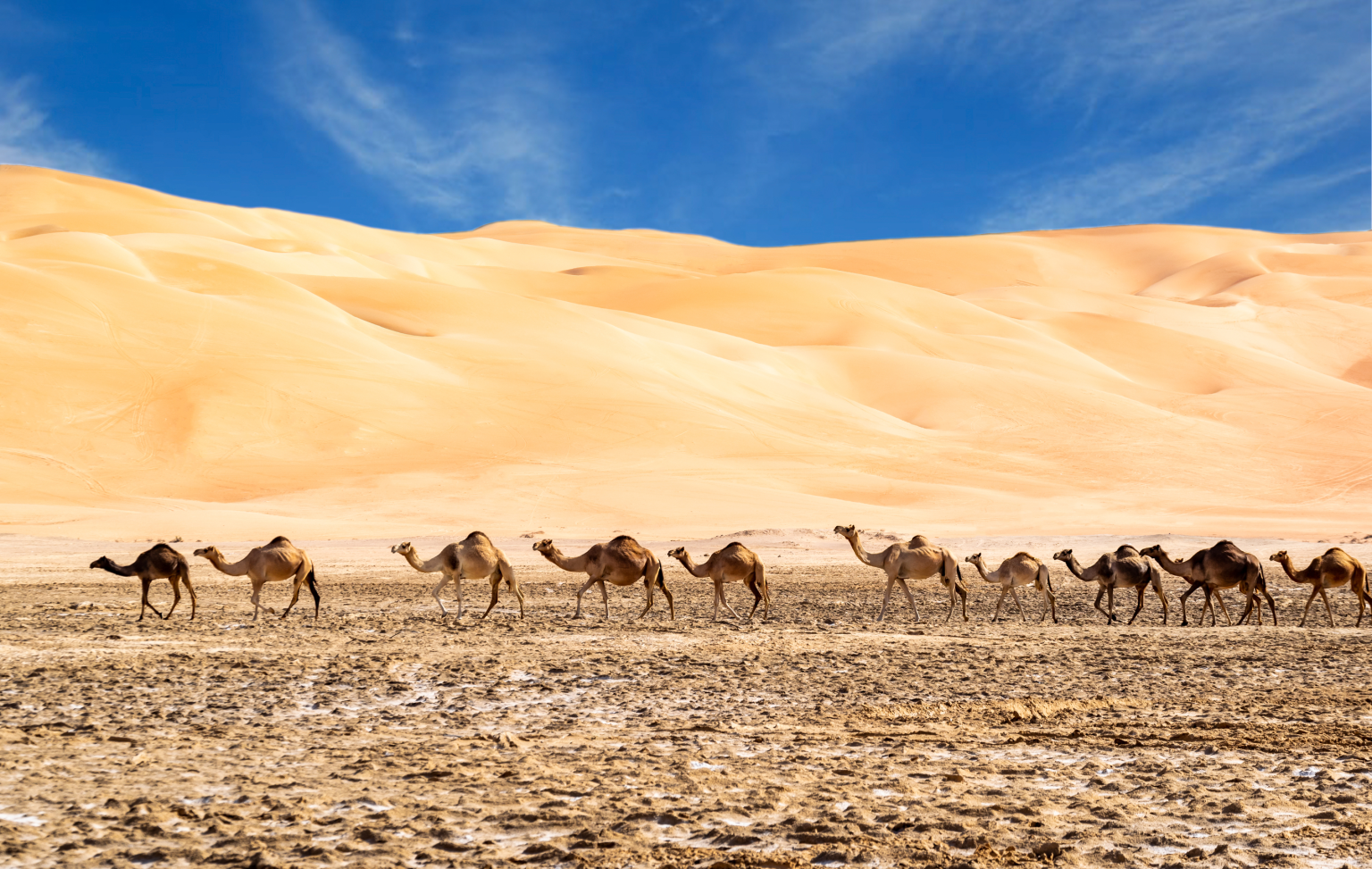
Southwest of Abu Dhabi, the landscape gradually changes from paved roads and settled areas to wide stretches of sand. The Liwa Desert occupies the northern edge of the Rub al Khali (Empty Quarter), the largest continuous sand desert on Earth and one of the most distinctive desert regions in Arabia.
- Where Is the Liwa Desert Located?
- How to Get to the Liwa Desert
- Best Time to Visit the Liwa Desert
- Things to Do in the Liwa Desert
- Explore Moreeb Dune
- Discover the Liwa Oasis
- Desert Safaris and Cultural Experiences
- Stand at the Edge of the Empty Quarter
- Bedouin Heritage and Living Traditions
- Two-Day Liwa Desert Itinerary
- Where to Stay in Liwa
- Practical Travel Tips
- Hidden Gems of the Liwa Desert
- Exploring Liwa at the Edge of the Empty Quarter
The desert extends in a broad crescent from Madinat Zayed toward Ghayathi and the Saudi border. Its enormous dunes surround the Liwa Oasis, a chain of palm-filled settlements that has supported communities in this arid region for centuries. The combination of vast dunes, oasis agriculture, and deep-rooted Bedouin traditions makes Liwa one of the most important desert destinations in the United Arab Emirates.
Where Is the Liwa Desert Located?
The Liwa Desert lies about 250 kilometers southwest of Abu Dhabi, in the Al Dhafra region of the United Arab Emirates. It forms the northern frontier of the Rub al Khali and contains some of the country’s highest and most impressive sand dunes.
The Liwa Oasis consists of numerous settlements surrounded by date palms, farms, and historic water sources. Villages such as Mezairaa, Muzaira’a, and Hameem serve as local centers for residents and travelers exploring the region.
Liwa also has major historical importance. It is traditionally associated with the Bani Yas tribe, whose descendants include the ruling families of Abu Dhabi and Dubai.
How to Get to the Liwa Desert
From Abu Dhabi, the drive to Liwa generally takes around three to four hours. Travelers can follow the E11 highway before continuing south toward the Liwa region via roads connecting with Madinat Zayed.
From Dubai, the journey takes approximately five hours, depending on the route and destination within Liwa.
The main roads are paved and suitable for standard vehicles, while access to remote dunes requires a 4×4 vehicle. Guided desert tours and overnight safaris are also available from Abu Dhabi and Al Ain.
Best Time to Visit the Liwa Desert
The cooler months are the most comfortable period for exploring Liwa, particularly for outdoor activities such as dune driving, camping, hiking, and photography.
Seasonal conditions can be summarized as follows:
- November to March: Generally the most comfortable period, with daytime temperatures often around 20–30°C.
- April and May: Warmer conditions, but outdoor activities remain possible with appropriate planning.
- June to September: Extremely hot, with temperatures frequently exceeding 45°C during the day.
The cooler season also overlaps with the Liwa International Festival, which features camel racing, falconry, dune sports, and cultural activities connected with Emirati desert heritage.
Things to Do in the Liwa Desert
Explore Moreeb Dune
Tal Moreeb, also known as Moreeb Dune, rises more than 300 meters above the surrounding landscape and is one of the most famous dunes in the UAE.
Its steep slopes make it a major destination for off-road driving and dune-sport events. The summit and surrounding viewpoints also provide excellent opportunities for watching sunrise and sunset across the Liwa sand dunes.
Discover the Liwa Oasis
The Liwa Oasis provides a sharp contrast to the surrounding desert. Date palm groves, farms, traditional settlements, and historic water sources form a green agricultural belt within the wider sand landscape.
Mezairaa is one of the main settlements in the oasis and an important base for exploring the region. Local farms are particularly known for date cultivation.
Desert Safaris and Cultural Experiences
Guided desert excursions provide several ways to experience Liwa:
- 4×4 dune drives across the large sand formations
- Camel rides through the desert
- Falconry demonstrations
- Bedouin-style meals and cultural experiences
- Desert camping and overnight stays
Local guides can also provide insight into the region’s history, traditional desert travel, and oasis agriculture.
Stand at the Edge of the Empty Quarter
Liwa offers direct access to the northern edge of the Rub al Khali. From elevated dunes, travelers can see extensive stretches of sand continuing south toward the Empty Quarter.
The scale of the landscape is one of Liwa’s defining features, particularly in areas away from settlements and major roads.
Bedouin Heritage and Living Traditions
Liwa has strong connections to Bedouin culture and the history of desert communities in the UAE. For generations, people in the region developed detailed knowledge of desert routes, water sources, seasonal conditions, and navigation.
Several traditions remain important today:
- Falconry, an important part of Emirati heritage
- Camel racing, reflecting the historical importance of camels in desert life
- Nabati poetry, which preserves stories, experiences, and expressions of desert culture
- Arabic coffee and dates, traditionally offered as part of Emirati hospitality
These traditions remain visible through festivals, cultural programs, family practices, and tourism experiences throughout the Liwa region.
Two-Day Liwa Desert Itinerary
Day 1
Depart Abu Dhabi in the morning and travel toward Liwa. Spend the afternoon exploring the oasis villages and palm groves before continuing toward Moreeb Dune for sunset. Stay overnight at a desert camp or resort.
Day 2
Start with a guided dune safari in the morning, when temperatures are more comfortable. Visit a date farm or explore another section of the oasis during the afternoon. Return to Abu Dhabi in the evening.
Where to Stay in Liwa
Accommodation ranges from high-end desert resorts to simpler camping options.
- Qasr Al Sarab Desert Resort by Anantara offers a luxury desert setting surrounded by large dunes.
- Tilal Liwa Hotel near Madinat Zayed provides hotel accommodation with an Arabian-inspired atmosphere.
- Desert camping is another option for travelers who want to spend the night closer to the dunes.
Independent camping in remote areas requires suitable equipment, sufficient water, navigation planning, and a capable 4×4 vehicle.
Practical Travel Tips
Most of the main settlements and roads in Liwa are accessible by paved roads, but travelers heading into the dunes should use a suitable 4×4 vehicle and avoid entering remote areas without preparation.
Keep these points in mind:
- Refuel in Madinat Zayed before traveling farther into the desert.
- Carry sufficient drinking water, especially during warmer months.
- Bring sunscreen, sunglasses, and protective clothing.
- Download offline maps because mobile coverage can become weaker in remote areas.
- Check desert driving conditions before entering the dunes.
- Visit between November and March if you want the most comfortable outdoor conditions.
Hidden Gems of the Liwa Desert
Beyond the major attractions, several quieter experiences can add more depth to a Liwa trip.
Quiet viewpoints around Tal Moreeb offer excellent opportunities for landscape photography. Camel farms provide a closer look at an important part of contemporary desert life, while historic fort remains and smaller oasis settlements offer insight into Liwa’s earlier communities and defensive structures.
Exploring these less-visited areas with a local guide can also reveal traditional water sources, agricultural areas, and routes away from the main tourist circuit.
Exploring Liwa at the Edge of the Empty Quarter
The Liwa Desert is defined by the meeting of two very different landscapes: the cultivated Liwa Oasis and the enormous dunes of the Rub al Khali. This combination gives the region its distinctive character and explains its importance in the history of southern Abu Dhabi.
For travelers, Liwa offers more than a desert safari. Its dunes provide dramatic landscapes for driving and photography, while the oasis reveals the agricultural traditions and communities that made life possible in one of Arabia’s driest environments. Together, they make Liwa a natural gateway to the Empty Quarter and one of the UAE’s most significant desert destinations.