
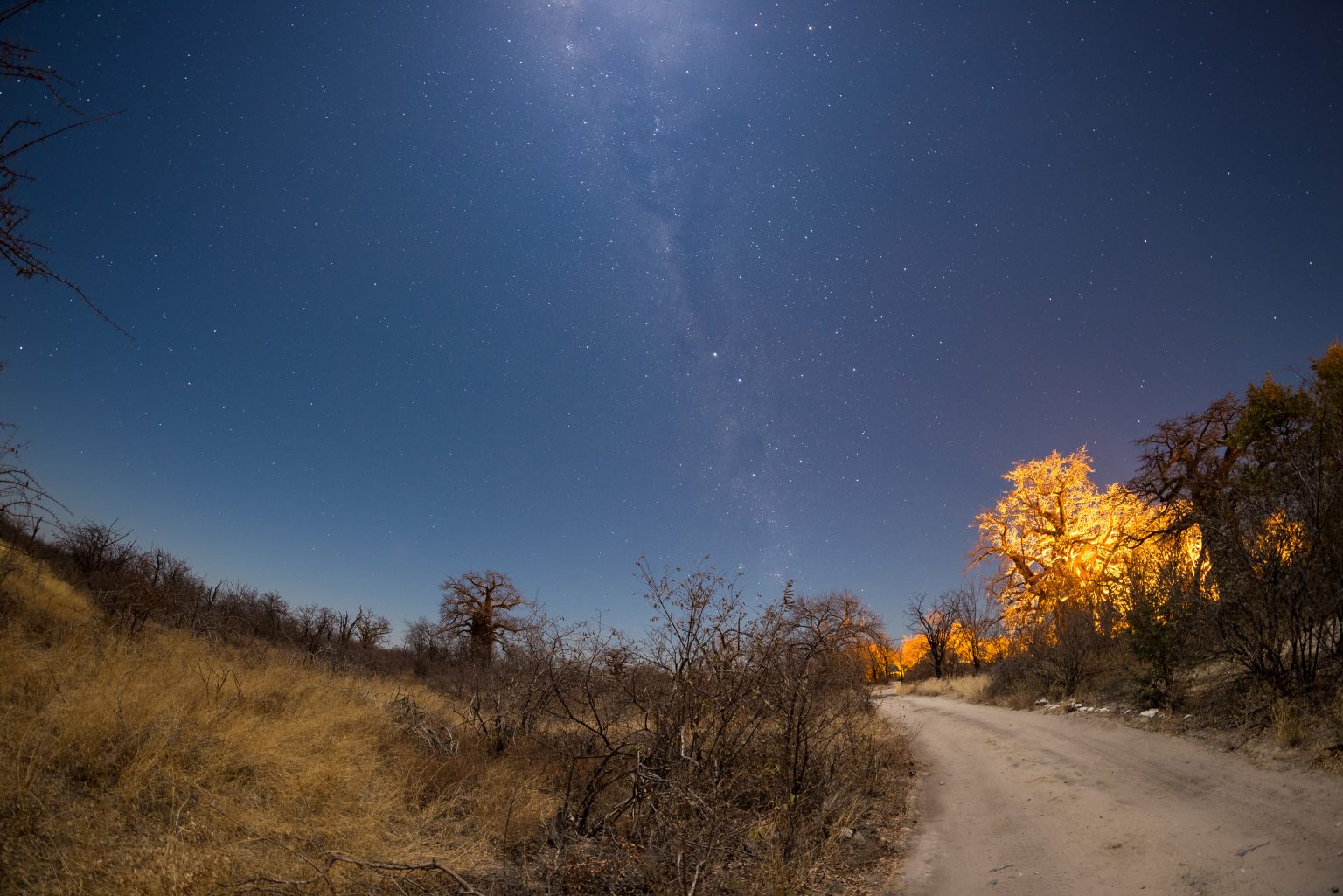
Stargazing in Botswana’s Kalahari Desert offers travelers the chance to experience a remarkably dark night sky far from major towns and urban lighting. Across the region, open landscapes and dry-season conditions can create excellent opportunities to observe stars, planets, and the Milky Way. From the remote Central Kalahari Game Reserve to the open pans of Mabuasehube, the Kalahari combines astronomy with wilderness camping and the distinctive landscapes of southern Africa. This guide explores the best places to observe the night sky, when to visit, what to bring, and how to enjoy the experience responsibly.
- Why the Kalahari Is Ideal for Stargazing
- Best Places for Stargazing in Botswana’s Kalahari
- Central Kalahari Game Reserve
- Mabuasehube Pans in Kgalagadi Transfrontier Park
- Khutse Game Reserve
- Polentswa and Rooiputs in Kgalagadi Transfrontier Park
- What You Can See in the Kalahari Night Sky
- Best Time of Year for Stargazing in Botswana
- What to Bring for Stargazing in the Kalahari
- Cultural Connections with the San People
- Stargazing Etiquette and Safety
- Planning a Three-Day Stargazing Trip in Botswana’s Kalahari
- Day 1: Arrive and Settle into Camp
- Day 2: Explore the Landscape and Observe the Milky Way
- Day 3: Enjoy a Final Morning and Return
- Experience the Kalahari Under the Stars
Why the Kalahari Is Ideal for Stargazing
Botswana’s sparsely populated wilderness areas offer favorable conditions for observing the night sky. Away from settlements and artificial lighting, more stars become visible, while the region’s dry season often brings clearer nights.
Several features make the Kalahari appealing to astronomy enthusiasts:
- Dark skies: Remote areas have limited artificial lighting, although conditions vary by location and nearby camps.
- Dry-season weather: The months with less rainfall often provide more opportunities for clear-sky observations.
- Open horizons: Pans, grasslands, and broad desert landscapes offer unobstructed views across much of the sky.
- Southern Hemisphere astronomy: Visitors can observe prominent southern constellations and celestial objects that are difficult or impossible to see from many northern locations.
- Wilderness camping: In suitable campsites, travelers can observe the sky after sunset without needing to travel back to a town.
The quality of a stargazing session depends on more than the destination. Cloud cover, dust, moonlight, and the time of night all affect visibility. For the darkest conditions, plan around the new moon and check the forecast before setting out.
Best Places for Stargazing in Botswana’s Kalahari
Central Kalahari Game Reserve
The Central Kalahari Game Reserve (CKGR) is one of Botswana’s most remote protected areas. Its expansive grasslands, fossil river valleys, pans, and scattered dunes create a wilderness setting that can be particularly rewarding after dark.
Areas worth considering include:
- Deception Valley: A well-known part of the reserve with open landscapes and access to established camping areas.
- Sunday Pan: One of the reserve’s distinctive open areas, surrounded by the characteristic scenery of the central Kalahari.
- Passarge Valley: A remote landscape of grasslands and pans that forms part of the reserve’s wider wilderness.
- Tau Pan: The area around Tau Pan Camp offers opportunities for stargazing, and the camp lists stargazing among its activities.
The CKGR is well suited to travelers who want to combine wildlife viewing, remote camping, and night-sky observation. However, not every location has accommodation, facilities, or guided astronomy activities. Check campsite locations, access requirements, and availability before choosing a route.
A self-drive trip requires careful planning. Many routes are sandy, distances between services are substantial, and a suitable 4×4 is important for remote travel. Confirm current permit requirements, camping reservations, fuel arrangements, and road conditions before entering the reserve.
Mabuasehube Pans in Kgalagadi Transfrontier Park
The Mabuasehube area lies within the Botswana section of Kgalagadi Transfrontier Park. Its broad pans, sandy tracks, and open Kalahari vegetation provide a striking setting for observing the stars.
Potential highlights include:
- Wide views across open pans and surrounding dune landscapes.
- Remote campsites at locations such as Mpayathutlwa and Khiding.
- Opportunities to combine night-sky observation with wildlife viewing.
- A sense of isolation that appeals to experienced self-drive travelers.
The open landscape can make it easier to find a broad view of the sky, but a white or pale pan does not guarantee a stronger reflection of starlight. The visual effect depends on the surface, lighting, and weather conditions.
Mabuasehube is a remote destination rather than an easy roadside stop. A suitable 4×4, advance campsite reservations, adequate water, and careful route planning are essential. Official park guidance also specifies vehicle requirements for the Botswana side and particular wilderness routes. Check the latest rules before departure.
Khutse Game Reserve
Khutse Game Reserve offers another option for travelers interested in Botswana’s Kalahari landscapes. Its open grasslands, sandy terrain, and pans provide a setting for quiet evenings and potential stargazing away from major urban centers.
Reasons to consider Khutse include:
- Open views of the night sky from suitable camping locations.
- Opportunities to combine stargazing with wildlife observation.
- A wilderness experience that can be planned as part of a broader Kalahari trip.
- A chance to explore a protected area beyond Botswana’s most familiar safari destinations.
Khutse is not a fully serviced astronomy destination, and conditions vary between campsites. Confirm access, camping arrangements, and road conditions before traveling. Visitors should also check how much water, fuel, and other supplies they need to carry.
Although Khutse can be included in a trip from the Gaborone region, travel times depend on the chosen route and conditions. Do not assume that every part of the reserve is easily accessible by ordinary passenger car.
Polentswa and Rooiputs in Kgalagadi Transfrontier Park
Polentswa and Rooiputs are wilderness camping areas on the Botswana side of Kgalagadi Transfrontier Park. They appeal to travelers who want to combine wildlife watching with nights under a dark sky.
Their main attractions include:
- Remote camping in the Kalahari’s sandy landscape.
- Open views across parts of the surrounding dune belt and dry river system.
- Opportunities to observe stars after a day of wildlife viewing.
- A more independent camping experience than staying at a conventional lodge.
These are wilderness camps rather than luxury accommodations with guaranteed private viewing decks or astronomy equipment. Facilities and services are limited, so check what is provided before arrival and bring the necessary supplies.
Access requires suitable preparation, and some routes are restricted to 4×4 vehicles. Check reservation conditions and park regulations carefully, particularly if you plan to travel between camps or cross an international border.
What You Can See in the Kalahari Night Sky
Botswana’s position in the Southern Hemisphere provides excellent views of many southern celestial features when the sky is clear. What you see depends on the season, the time of night, the direction you face, and the moon’s phase.
Notable sights include:
- The Milky Way: Its dense central region can be particularly impressive during the cooler, dry months when the Galactic Centre is well positioned in the evening sky.
- The Southern Cross (Crux): A distinctive southern constellation that has long been useful as a navigation reference.
- Scorpius and Sagittarius: These constellations contain rich star fields and lie in the region of the Milky Way’s bright central area.
- Sirius: The brightest star in the night sky as seen from Earth, visible from Botswana during the appropriate part of the year.
- The Magellanic Clouds: Two nearby dwarf galaxies that are prominent sights in dark southern skies.
- Planets and meteor showers: Depending on the date, visitors may see bright planets and meteor activity associated with annual showers.
Orion is also visible from Botswana, but its position and viewing season differ from those in the Northern Hemisphere. Likewise, meteor showers such as the Perseids and Geminids can be observed under suitable conditions, but their visibility depends on the radiant’s position, moonlight, and the timing of the shower.
You do not need a telescope to enjoy the sky. Start with the naked eye, then use binoculars or a star map to identify constellations and brighter celestial objects.
Best Time of Year for Stargazing in Botswana
Botswana’s dry season generally offers the most reliable conditions for stargazing. The country’s rainy season typically runs from around October to April, while the months from May to September are often drier and clearer.
- May to September: Usually the most dependable period for clear nights, with little rainfall across much of the region.
- June to August: Particularly attractive for observing the Milky Way’s central region, which is well positioned during the southern winter.
- October to November: Warmer evenings can still provide good opportunities, although clouds and storms may begin to affect conditions.
- December to April: Rainy-season weather can bring cloud cover and interruptions, but clear nights are still possible between weather systems.
For many visitors, June through August offers a useful combination of dry weather and favorable Milky Way viewing. Winter nights can become very cold, especially in open pans and remote camps, so warm clothing is essential.
Moonlight also makes a major difference. A bright full moon can wash out faint stars and much of the Milky Way. If dark-sky viewing is your priority, check the lunar calendar and plan your stay near the new moon.
What to Bring for Stargazing in the Kalahari
You can enjoy the night sky without specialized equipment, but a few practical items make the experience more comfortable and productive.
Essential items
- Warm layers: Temperatures can drop sharply after sunset during the dry season.
- A comfortable chair or blanket: Useful for longer periods of observation.
- A red-light torch: Helps preserve night vision while moving around camp.
- Drinking water and a hot drink: Helpful during extended outdoor sessions.
- Closed shoes: Appropriate for moving around a wilderness campsite at night.
- A fully charged phone or offline star map: Useful for identifying constellations, although you should not rely on mobile coverage in remote areas.
Equipment for enthusiasts
- Binoculars: A pair of 10×50 binoculars can reveal star clusters and other objects that are difficult to distinguish with the naked eye.
- A tripod: Essential for keeping a camera steady during long exposures.
- A wide-angle lens: Useful for photographing the Milky Way and broad night-sky scenes.
- A camera with manual controls: Allows you to adjust exposure, aperture, and ISO.
- A star-mapping app: Stellarium and similar applications can help identify celestial objects. Download the required information before entering areas without reliable internet access.
Basic astrophotography tips
- Use a sturdy tripod and switch off image stabilization when the camera manufacturer recommends doing so for tripod use.
- Begin with a wide aperture, such as f/2.8 if your lens supports it.
- Experiment with ISO settings around 1600 to 3200, adjusting for your camera and the available light.
- Start with exposures of approximately 10 to 20 seconds using a wide-angle lens, then check whether the stars remain sharp.
- Include a tree, dune, tent, or other foreground feature to give the photograph a sense of scale.
- Take test shots and adjust the settings instead of relying on one fixed exposure for every night.
Avoid using bright white lights while others are observing or photographing the sky. Dim your screen, use red lighting when practical, and keep equipment positioned so that it does not obstruct paths or disturb other campers.
Cultural Connections with the San People
The San peoples of southern Africa have diverse histories, languages, and cultural traditions. Some San communities possess detailed knowledge of celestial objects and incorporate observations of the sky into stories, seasonal knowledge, and understandings of the natural world.
Research into Indigenous astronomy in southern Africa documents traditions that connect stars and celestial patterns with animals, landscapes, and cultural narratives. These traditions differ between communities and should not be presented as one shared belief system.
Travelers interested in this heritage can look for respectful, community-led cultural experiences where local knowledge holders choose what they wish to share.
To approach these experiences responsibly:
- Seek activities led or approved by members of the relevant community.
- Ask before photographing people or recording stories.
- Recognize that knowledge and traditions vary between San communities.
- Avoid presenting sacred or culturally specific stories as universal San beliefs.
- Support locally organized experiences when they are available and appropriate.
A guided cultural experience can add important context to a visit, but the night sky should not be used as a reason to make unsupported claims about Indigenous beliefs.
Stargazing Etiquette and Safety
Dark-sky environments require consideration for both other visitors and the surrounding wildlife. In remote parts of the Kalahari, safety also means remembering that camps may be unfenced and wildlife can move through the area.
Follow these precautions:
- Keep lighting low: Use a red-light torch when appropriate and avoid shining lights into other camps or toward wildlife.
- Stay near camp: Do not wander into the bush alone at night. Follow campsite rules and ask staff or guides about safe viewing areas.
- Listen to local guidance: Wildlife procedures differ between camps, so follow the instructions provided by your host or park staff.
- Avoid disturbing animals: Do not approach wildlife or use flash photography on animals.
- Prepare for cold weather: Bring sufficient insulation and avoid remaining outdoors if you are becoming dangerously cold.
- Check the weather: Clouds, wind, and storms can affect both visibility and safety.
- Protect the environment: Keep noise low, take all rubbish with you, and avoid damaging vegetation.
- Plan remote travel carefully: Check vehicle requirements, fuel, water, reservations, and emergency arrangements before setting out.
If you are using a camera, set it up in a safe place before darkness falls. This reduces the need to walk around unfamiliar terrain while looking at a screen or adjusting equipment.
Planning a Three-Day Stargazing Trip in Botswana’s Kalahari
A three-day trip can combine a remote landscape, wildlife observation, and several opportunities to explore the night sky. The following is a general planning framework, not a fixed driving itinerary. Choose one reserve or camping area and confirm access before finalizing the schedule.
Day 1: Arrive and Settle into Camp
Travel to your chosen reserve or campsite, allowing enough time for the drive and any required check-in procedures. Set up camp before dark and ask the local staff about wildlife safety, nighttime movement, and the best place to observe the sky.
After sunset, begin with the brightest stars and constellations visible from your location. Give your eyes time to adapt to the darkness before using a phone or torch.
Day 2: Explore the Landscape and Observe the Milky Way
Spend the day on an authorized game drive or exploring the surrounding landscape with a qualified guide, depending on what your location permits. Rest during the warmer hours and prepare your camera or binoculars before evening.
After dark, choose a safe observation point with a clear view of the sky. If the moon is low or absent and clouds are limited, look toward the Milky Way’s central region during the appropriate season.
Day 3: Enjoy a Final Morning and Return
Enjoy the early morning landscape before packing up. Check your vehicle, water supplies, and route before leaving the reserve. Allow sufficient time to reach your next destination, particularly if you are driving on sandy or remote tracks.
Planning note: The Central Kalahari Game Reserve, Khutse, and Mabuasehube are separate destinations. Do not try to combine them into a short trip without checking distances, road conditions, and overnight stops.
Experience the Kalahari Under the Stars
Stargazing in Botswana’s Kalahari combines dark skies with expansive landscapes and a strong sense of remoteness. Whether you choose the Central Kalahari Game Reserve, Khutse, or the pans of Mabuasehube, the best experience begins with realistic planning and respect for the environment.
Travel during the dry season when possible, check the moon phase, bring warm clothing, and confirm access and camping arrangements before departure. With the right preparation, a night beneath the Kalahari Desert night sky can become a memorable part of a Botswana wilderness journey.