
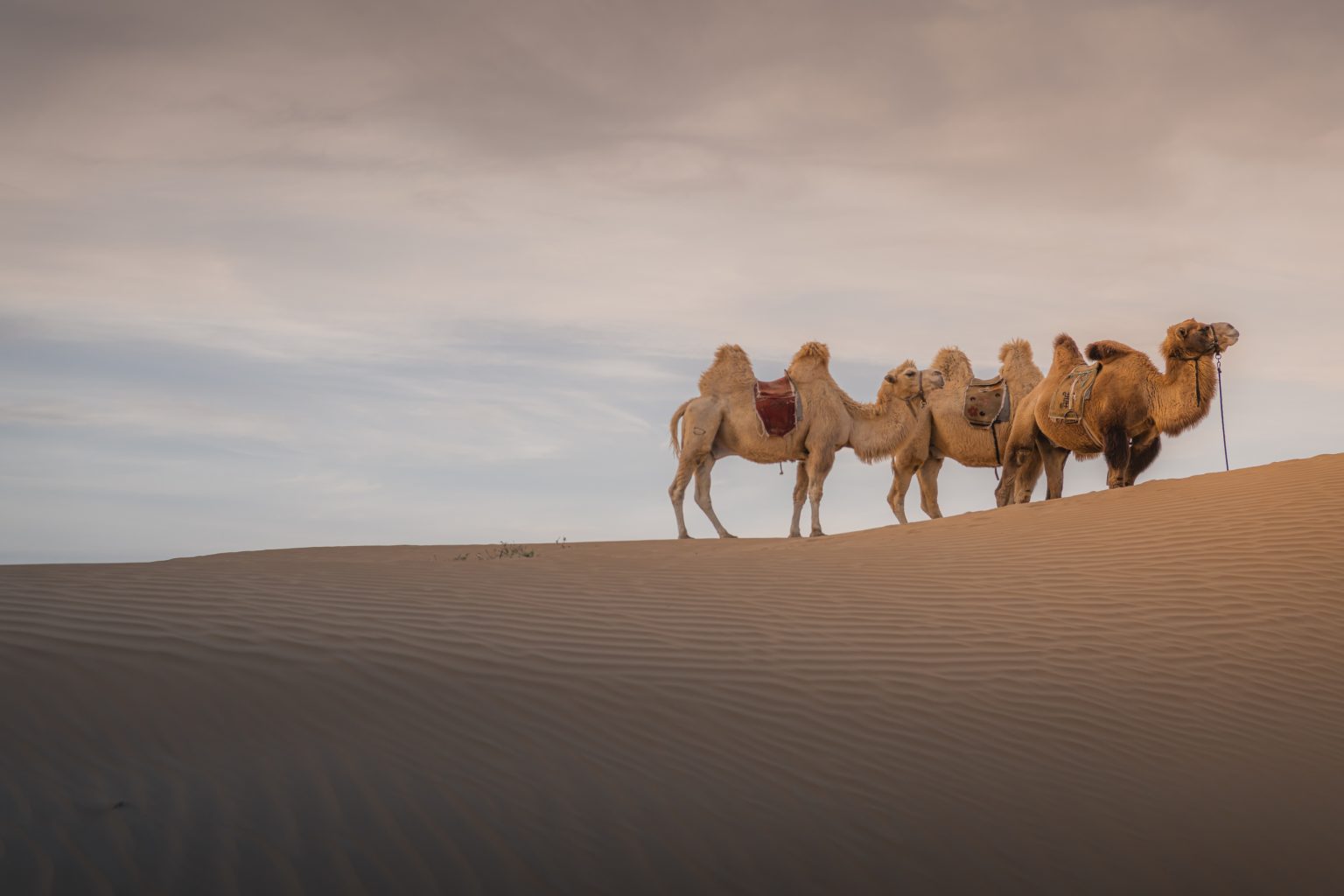
China is known for its major cities, historic temples, and mountain scenery, but its northwestern deserts offer a very different side of the country. The Chinese deserts include vast dune fields, rocky plateaus, dry valleys, and oasis landscapes shaped by extreme climates. From the Taklamakan Desert to the Gobi, these regions also preserve important traces of the Silk Road and support wildlife adapted to some of Asia’s harshest environments.
- The Chinese Deserts
- Taklamakan Desert: The “Sea of Death”
- Gobi Desert: Rocky Plains, Valleys, and Dunes
- Oases and Desert Lakes
- The Hexi Corridor and Silk Road Landscapes
- Animals That Live in China’s Deserts
- Mammals: Adapted to Extreme Conditions
- Birds of the Desert and Steppe
- Reptiles and Desert Invertebrates
- Plants That Survive in China’s Deserts
- The Best Desert Areas in China for Wildlife and Nature
- Dunhuang and the Mingsha Sand Dunes
- The Lop Nur and Taklamakan Edges
- Inner Mongolia’s Gobi Landscapes
- Yumenguan and the Ancient Desert Frontier
- The Junggar Basin
- Desert Activities Close to Nature
- Camel Rides Across the Dunes
- Desert Camping and Stargazing
- Wildlife Watching
- Walking and Photography Around Oases
- Exploring the Gobi by 4WD
- Weather and the Best Time to Visit
- How to Stay Safe in China’s Deserts
- Exploring China’s Desert Landscapes
The Chinese Deserts
China contains several major desert and dryland regions, each with its own landscape and ecological character.
Taklamakan Desert: The “Sea of Death”
The Taklamakan Desert lies in Xinjiang and is one of the world’s largest shifting-sand deserts. Its vast dune fields can reach impressive heights, with some dunes rising to around 200 meters.
The desert is bordered by the Kunlun, Pamir, and Tian Shan mountain systems, while rivers flowing from these mountains support oases along its margins. These settlements played an important role in the history of the Silk Road, providing water and shelter for travelers crossing the region.
Despite its harsh reputation, the Taklamakan is not completely lifeless. Its edges contain oases, river corridors, and habitats for animals adapted to the dry environment.
Gobi Desert: Rocky Plains, Valleys, and Dunes
The Gobi Desert in northern China differs from the classic image of a desert covered entirely by sand. Large areas consist of gravel plains, rocky terrain, dry valleys, and open steppe, with dunes appearing in some regions.
The landscape extends across parts of Inner Mongolia and other northern areas, with mountains visible across many sections. Wildlife includes gazelles, wild asses, foxes, birds of prey, and other species adapted to the region’s cold and dry conditions.
Oases and Desert Lakes
Water has always played an important role in China’s desert regions. Crescent Lake near Dunhuang is one of the country’s best-known desert oases. The lake lies beside the Mingsha Sand Dunes and has long provided an important stop for travelers in the area.
Other oases occur around the margins of the Taklamakan and Gobi, where rivers, groundwater, and irrigation support vegetation and human settlements.
The Hexi Corridor and Silk Road Landscapes
The Hexi Corridor runs between the Qilian Mountains and the Gobi Desert in northwestern China. For centuries, it formed an important route through which merchants, travelers, armies, and ideas moved between China and Central Asia.
Historic towns, fortifications, temples, and agricultural settlements developed along this corridor. Today, the region combines desert scenery with archaeological sites and landscapes associated with the ancient Silk Road.
Together, China’s desert regions show a wide range of environments shaped by wind, water, geology, climate, and human activity.
Animals That Live in China’s Deserts
China’s deserts and dry steppes support wildlife that has adapted to limited water, large temperature changes, and sparse vegetation.
Mammals: Adapted to Extreme Conditions
The Bactrian camel is one of the best-known animals associated with the deserts of northern China. Its two humps and ability to cope with dry conditions made it valuable for long-distance travel along historic trade routes.
Other desert and steppe mammals include:
- Goitered gazelles, which can move quickly across open terrain.
- Khulan, or Asiatic wild asses, which can travel long distances in search of food and water.
- Jerboas, small rodents with powerful hind legs adapted for jumping across sandy and gravelly ground.
- Corsac foxes, small predators that are particularly active around dusk and at night.
- Mongolian gazelles, which occupy open steppe habitats in northern China.
- Przewalski’s horses, a rare wild horse species that has been reintroduced to protected areas in China.
- Argali sheep, which live in rocky and mountainous parts of northern and western China.
These animals are not always easy to see. Many are most active during cooler parts of the day or avoid areas with heavy human activity.
Birds of the Desert and Steppe
Birdlife varies according to the season and habitat. Open desert, grassland, wetlands, and mountain areas can all attract different species.
Commonly encountered groups include:
- Lammergeiers, also known as bearded vultures, in mountainous regions.
- Kestrels and other birds of prey hunting over open ground.
- Wheatears, which forage around rocky and sandy areas.
- Sandgrouse, adapted to dry environments.
- Mongolian larks and other steppe birds.
Wetlands and oasis areas can also attract cranes, geese, ducks, and shorebirds during migration.
Bird activity is often easier to observe in the cooler morning hours, particularly around water sources and vegetated areas.
Reptiles and Desert Invertebrates
China’s dry regions are also home to reptiles and many smaller animals that are well adapted to heat, cold, and limited water.
Visitors may encounter:
- Agama lizards on rocky ground.
- Geckos sheltering among rocks and sandy areas.
- Skinks moving across gravel plains.
- Steppe tortoises in suitable grassland and semi-arid habitats.
- Various snakes, although they are generally difficult to spot.
- Grasshoppers, beetles, ants, and other insects, which form an important part of desert food webs.
These smaller species are easy to overlook, but they play an important role in supporting birds, reptiles, and mammals.
Plants That Survive in China’s Deserts
Vegetation in China’s deserts is adapted to strong winds, limited rainfall, saline soils, and major temperature changes.
Some important desert plants include:
- Saxaul, a hardy shrub or small tree that helps stabilize sandy ground.
- Tamarisk, which can tolerate saline soils and dry conditions.
- Poplars, particularly around rivers and oasis environments where water is available.
- Haloxylon, a drought-resistant desert plant with deep roots that help it access underground moisture.
- Wormwood and saltbush, which are common in dry and semi-arid areas.
- Short-lived desert flowers, which can appear after seasonal rainfall and add brief patches of color to otherwise dry ground.
Oasis vegetation is particularly important because it provides food and shelter for insects, birds, and small mammals while also supporting agriculture and local communities.
The Best Desert Areas in China for Wildlife and Nature
Dunhuang and the Mingsha Sand Dunes
Dunhuang combines desert scenery with one of the most important historic landscapes along the Silk Road. The Mingsha Sand Dunes surround Crescent Lake, while the nearby Mogao Caves add an important cultural dimension to the area.
The Lop Nur and Taklamakan Edges
The Lop Nur region and the margins of the Taklamakan offer remote desert landscapes for travelers interested in geology, archaeology, and extreme environments. Access to some areas is restricted, so organized travel and local guidance are important.
Inner Mongolia’s Gobi Landscapes
The Gobi landscapes of Inner Mongolia include broad gravel plains, rocky terrain, dry valleys, and sections of sandy desert. Wildlife can include gazelles, wild asses, foxes, camels, and birds of prey.
Yumenguan and the Ancient Desert Frontier
Yumenguan, an ancient frontier pass near Dunhuang, shows how closely the Silk Road was connected to the surrounding desert. Historic walls and ruins stand within a landscape that remains dry and sparsely vegetated.
The Junggar Basin
The Junggar Basin in northern Xinjiang contains extensive desert and semi-desert landscapes surrounded by mountain ranges. Its varied terrain supports wildlife, reptiles, and plant communities adapted to dry conditions.
Desert Activities Close to Nature
Camel Rides Across the Dunes
Camel excursions are especially popular around Dunhuang and other accessible desert areas. Bactrian camels also provide a connection to the region’s historic caravan routes.
Desert Camping and Stargazing
Remote desert areas offer dark skies with limited artificial light. Camping can provide opportunities to observe stars and experience the large temperature difference between daytime and nighttime.
Wildlife Watching
Wildlife excursions can focus on tracks, watering areas, oasis vegetation, and open steppe. Early mornings and late afternoons are generally more comfortable for observation and photography.
Walking and Photography Around Oases
Oases such as Crescent Lake provide a striking contrast between vegetation, water, and surrounding dunes. They are also useful places for observing birds and smaller wildlife.
Exploring the Gobi by 4WD
Off-road trips allow visitors to reach remote sections of the Gobi and explore rocky plains, dry valleys, dunes, and mountain landscapes. Travel in remote areas should be organized with experienced local operators.
Weather and the Best Time to Visit
The best travel periods generally fall in spring and autumn, when temperatures are more suitable for outdoor activities.
- April to June: Comfortable conditions in many desert areas, with spring vegetation and active wildlife.
- September to October: Cooler temperatures and generally favorable conditions for sightseeing and photography.
- Summer: Temperatures can become very high in some desert regions, particularly in the Taklamakan and Turpan areas.
- Winter: The Gobi can become extremely cold, with strong winds and freezing temperatures.
Conditions vary considerably because China’s deserts cover a huge area. Travelers should check the specific forecast for their destination rather than relying on general desert conditions.
How to Stay Safe in China’s Deserts
Remote desert travel requires preparation, particularly in areas far from towns and reliable services.
- Carry sufficient water and food for the planned journey.
- Wear sturdy footwear, sun protection, and clothing suitable for large temperature changes.
- Use a local guide or experienced operator for remote areas.
- Follow restrictions around military facilities, protected zones, and other areas closed to visitors.
- Take care around unstable dunes, steep slopes, rocky terrain, and sudden changes in weather.
- Carry offline maps and GPS navigation, since mobile coverage may be unavailable in remote areas.
- Inform someone about your route when traveling independently.
Wild animals should be observed from a safe distance and never approached, fed, or disturbed.
Exploring China’s Desert Landscapes
China’s deserts are far more varied than their reputation might suggest. The Taklamakan is dominated by enormous shifting dunes, while the Gobi includes broad gravel plains, rocky valleys, steppe, and scattered sandy areas. Around them, mountain ranges, rivers, and oases have supported wildlife and human settlements for centuries.
The connection with the Silk Road adds another layer to these landscapes. Ancient routes, frontier walls, oasis towns, and archaeological sites show how people adapted to crossing and living beside these difficult environments.
For travelers, the appeal lies in that combination of desert scenery, wildlife, and history. A journey through China’s northwest can include dunes at Dunhuang, remote Gobi landscapes, oasis communities, and traces of one of the world’s most important historic trade networks. These places offer a different perspective on China, far beyond its better-known cities and cultural landmarks.