
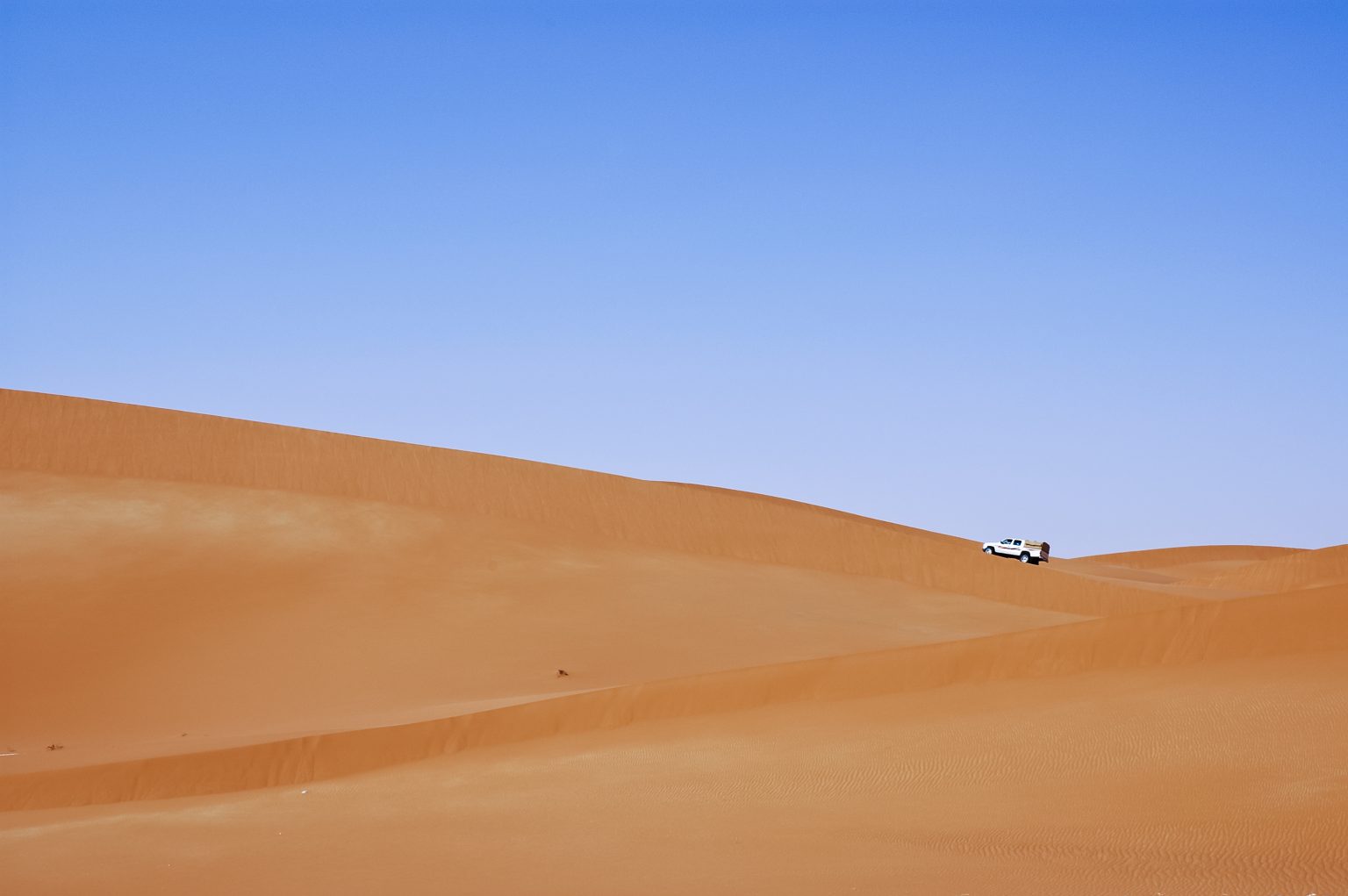
At dawn, the dunes of the Rub al Khali, or Empty Quarter, emerge in shades of gold, red, and bronze. Long ridges of sand stretch toward the horizon, interrupted by occasional gravel plains and salt flats. In this remote part of the Arabian Peninsula, careful planning is essential because distances are immense and services are scarce.
- The Geography and Natural Environment of the Empty Quarter
- History, Exploration, and Desert Traditions
- How to Access the Empty Quarter
- Saudi Arabia: The Western and Southern Desert Margins
- Liwa and the UAE’s Desert Landscapes
- Oman: The Western Desert
- Experiences in the Empty Quarter
- Best Time to Visit Rub al Khali
- What to Bring for a Safe Desert Journey
- Bedouin Heritage and Life Around the Desert
- Wildlife and Fragile Desert Ecosystems
- A Three-Day Itinerary on the Edge of the Empty Quarter
- Why the Empty Quarter Is Worth Exploring
The Empty Quarter Desert is the largest continuous sand desert in the world, covering approximately 650,000 square kilometres across parts of Saudi Arabia, Oman, the United Arab Emirates, and Yemen. Its immense dunes, extreme climate, and remote terrain make it one of Arabia’s most distinctive landscapes.
For travelers interested in Rub al Khali desert adventures, the region offers opportunities for guided 4×4 excursions, desert photography, stargazing, and cultural experiences near established settlements. Reaching the deeper dunes, however, requires specialist knowledge, suitable equipment, and careful attention to access restrictions.
The Geography and Natural Environment of the Empty Quarter
Located in the southern Arabian Peninsula, Rub al Khali extends across a vast area of southern Saudi Arabia and into neighboring countries. Although it is often described as a sea of sand, the landscape also includes gravel plains, salt flats, and areas between dunes where vegetation can survive.
Key geographical features include:
- Vast desert area: Estimates commonly place its area at around 650,000 square kilometres, although published figures vary according to the boundaries used.
- Towering dunes: Some dunes exceed 300 metres in height, creating dramatic ridges and steep sandy slopes.
- Salt flats: Known locally as sabkhas, these areas occur between dunes and may have surfaces that are difficult to judge from a distance.
- Extreme aridity: Rainfall is scarce and irregular, while summer temperatures can become dangerously high.
- Subsurface water and ancient landscapes: Geological evidence indicates that parts of Arabia experienced wetter periods in the past, leaving traces of former lakes, river systems, and human activity.
The desert is not a uniform landscape. Long, parallel dunes dominate some areas, while other sections contain star-shaped dunes, rocky ground, and broad interdune plains. These differences influence both the scenery and the difficulty of traveling through the region.
The Empty Quarter’s size and isolation are major reasons why independent travel can be hazardous. Routes that appear straightforward on a map may involve deep sand, difficult crossings, and long distances without fuel, water, or mobile coverage.
History, Exploration, and Desert Traditions
Rub al Khali has a long relationship with the people of the Arabian Peninsula. Communities living around its margins developed ways to travel, trade, and manage scarce resources in an exceptionally dry environment.
Historical connections include:
- Incense and regional trade: Southern Arabia was historically associated with the production and movement of frankincense and other valuable goods. Trade networks connected settlements and oases around the desert, although not every route crossed its deepest sands.
- Early European expeditions: British explorer Bertram Thomas crossed the Empty Quarter in 1930. Wilfred Thesiger later made journeys through the region during the 1940s, documenting its landscapes and Bedouin communities.
- Desert legends: The name Ubar, often linked to the expression “Atlantis of the Sands,” has been associated with stories of a lost settlement. Its precise identification and relationship to ancient trade routes remain subjects of historical and archaeological discussion.
- Bedouin heritage: Different communities, including Al Murrah in parts of the Arabian Peninsula, have longstanding connections with desert travel and pastoral life.
These stories help explain why the Empty Quarter occupies such an important place in the cultural imagination of Arabia. However, traditions differ between communities, and the lifestyles of people living near the desert today are not identical to those described in historical accounts.
Travelers interested in this heritage can learn more through local guides, regional museums, and respectful encounters arranged with communities near established visitor areas.
How to Access the Empty Quarter
The Empty Quarter is not a single tourist destination with one entrance. Access depends on the country, the intended route, local regulations, and whether the journey enters remote or restricted areas.
Saudi Arabia: The Western and Southern Desert Margins
Parts of the Empty Quarter can be approached from southern Saudi Arabia. The region around Uruq Bani Ma’arid, in the western part of the desert, is especially significant for its dunes, interdune valleys, and protected ecosystems.
Visitors should consider:
- Booking an excursion with an operator experienced in the relevant area.
- Confirming whether permits, advance registration, or special access arrangements are required.
- Checking whether the intended route enters a protected area or an industrial security zone.
- Allowing sufficient time for travel from the nearest town and for the return journey.
Shaybah is associated with major oil facilities and a wildlife sanctuary. It should not be treated as a routine public tourist access point, and industrial or protected-area access must be confirmed before planning a visit.
Liwa and the UAE’s Desert Landscapes
In the United Arab Emirates, the Liwa region on the edge of the Empty Quarter is a well-known base for exploring large dunes and the surrounding desert landscape.
Possible experiences include:
- Guided 4×4 excursions on suitable routes.
- Dune photography during early morning or late afternoon.
- Desert camping at an established site or through an authorized operator.
- Learning about local heritage and the history of settlements around the oasis region.
Not every excursion from Liwa enters the remote interior of Rub al Khali. Ask the operator where the trip goes, how long it lasts, and whether the route involves deep sand or restricted areas.
Oman: The Western Desert
The Empty Quarter extends into western Oman, where remote desert terrain requires particular care. Access options depend on the precise location, local arrangements, and current road or track conditions.
Before traveling:
- Arrange a knowledgeable local guide for remote routes.
- Confirm the vehicle and recovery equipment required.
- Carry adequate water, food, fuel, and emergency supplies.
- Verify any restrictions affecting the planned destination.
Cross-border journeys should never be assumed to be possible simply because the desert spans several countries. Each country has its own border procedures, and remote routes may not provide legal or practical crossing points.
Experiences in the Empty Quarter
The most suitable activities depend on the location and the level of remoteness. Visitors staying near established access points can enjoy desert scenery without attempting a long expedition into the deepest dunes.
4×4 Desert Driving
A guided 4×4 adventure in Rub al Khali provides an opportunity to explore large dunes and sandy corridors. Driving conditions can change quickly, and soft sand requires appropriate vehicle preparation and experienced handling.
Choose an operator that explains the route, recovery arrangements, and safety procedures before departure. Do not attempt steep dune crossings or remote tracks without the necessary skills and equipment.
Camel Experiences
Camel rides may be available through local operators in some desert tourism areas. These excursions offer a slower way to experience the landscape and learn about the camel’s historical role in Arabian life.
Availability varies by destination. A short camel ride near a tourist camp should not be confused with a multi-day camel expedition across the Empty Quarter, which requires substantially more planning and support.
Sandboarding
Some dune areas near established tourism destinations offer sandboarding. The suitability of a slope depends on its shape, sand conditions, access rules, and operator arrangements.
Ask whether boards and safety instruction are included, and avoid attempting steep descents without suitable guidance.
Desert Camping
An overnight stay provides an opportunity to experience the changing light and cooler evening temperatures. Travelers can choose an established desert camp or a guided expedition that includes camping at an authorized location.
Before booking, check whether the package includes tents, sleeping equipment, meals, drinking water, and transport. Remote camping requires additional preparation because emergency assistance may be far away.
Photography and Stargazing
The Empty Quarter’s large dunes and broad horizons create excellent photographic opportunities when weather and visibility cooperate.
For better results:
- Photograph dunes during the softer light of sunrise and sunset.
- Protect cameras and lenses from blowing sand.
- Use a tripod for night photography where permitted.
- Check moon phases if dark skies are a priority.
- Follow local rules concerning drones and protected areas.
Clear skies are not guaranteed, and atmospheric dust or haze can affect visibility. Never leave the group or established camp to find a darker location without telling your guide.
Best Time to Visit Rub al Khali
Seasonal temperatures strongly influence the comfort and safety of a desert excursion. Conditions also vary across the Empty Quarter’s enormous area, so forecasts should be checked for the specific destination.
- November to February: Generally the most comfortable period for many outdoor activities, although nights can be cold.
- March to April: Daytime temperatures rise, making early starts increasingly important.
- May to September: Extreme heat can make outdoor activity hazardous, particularly during the middle of the day.
- October: Conditions begin to become more suitable in many areas, but heat can remain intense.
For many visitors, November to February is a sensible period to plan a guided desert trip. This does not eliminate risks from cold nights, strong winds, or difficult terrain.
Avoid setting out during extreme heat, and follow the guide’s advice if weather conditions make the planned route unsafe.
What to Bring for a Safe Desert Journey
A trip into Rub al Khali requires more preparation than a normal day excursion. The necessary supplies depend on the distance, duration, vehicle, season, and availability of support.
Essential Equipment
- A suitable 4×4 vehicle: Use a properly maintained vehicle equipped for the planned terrain.
- Navigation equipment: Carry reliable GPS navigation and offline maps.
- Emergency communication: Satellite communication may be essential where mobile networks are unavailable.
- Drinking water: Carry enough for every traveler, including a reserve for delays or emergencies.
- Food and supplies: Bring sufficient food for the planned journey and an appropriate emergency reserve.
- Recovery equipment: Include suitable recovery gear and ensure someone in the group knows how to use it safely.
- Spare tires and repair tools: Confirm that the vehicle carries suitable spares and equipment.
- Fuel reserve: Plan fuel requirements around the actual route and the availability of refueling points.
- Sun protection: Pack a hat, sunglasses, sunscreen, and protective clothing.
- Warm layers: Nights can become cold, especially during the winter season.
- First-aid supplies: Carry a kit appropriate for the group and the length of the expedition.
Water needs vary with temperature and physical effort, so a fixed daily quantity cannot guarantee safety. Ask the expedition operator to specify the water allowance and emergency reserve for the exact route. In extreme heat, dehydration can develop quickly.
Useful Extras
- A camera and spare batteries.
- Binoculars for observing wildlife from a distance.
- A headlamp with spare batteries.
- A power bank or suitable charging system.
- A satellite messenger or emergency beacon where appropriate.
- A sandboard, if the activity is included in the itinerary.
A satellite device is useful only when it is charged, functioning, and understood by the people carrying it. Before departure, establish a communication schedule and agree on what to do if the group becomes separated.
Important: Do not enter remote dunes alone. A guided trip with suitable support is the safer choice for visitors unfamiliar with the Empty Quarter.
Bedouin Heritage and Life Around the Desert
The communities connected with Rub al Khali have diverse histories, traditions, and relationships with the desert. Historically, knowledge of water sources, grazing conditions, animal care, and travel routes helped people adapt to the region’s difficult environment.
Visitors may encounter regional hospitality and cultural experiences arranged by local hosts, such as:
- Arabic coffee, known as gahwa, and dates.
- Traditional meals and refreshments.
- Stories about desert travel, local history, and family traditions.
- Information about camels and their role in regional life.
These experiences depend on the host and location. Fresh camel milk, poetry, or particular customs should not be assumed to be available on every tour.
When visiting a local community, ask permission before taking photographs, follow the host’s guidance, and respect privacy. Choosing a locally operated experience can help direct tourism income toward the people who maintain these traditions.
Wildlife and Fragile Desert Ecosystems
Although much of the Empty Quarter appears barren, it supports plants and animals adapted to arid conditions. Life is concentrated in suitable habitats, including some interdune areas and locations where water or vegetation is available.
Wildlife and conservation highlights include:
- Arabian oryx: This antelope has been reintroduced into protected areas in Arabia. The Uruq Bani Ma’arid Protected Area is particularly important for its conservation.
- Arabian gazelles and sand gazelles: These species occur in parts of the Arabian desert, with distributions influenced by habitat and conservation measures.
- Desert-adapted plants: Specialized shrubs and other hardy plants survive in sandy or gravelly habitats.
- Seasonal growth: Occasional rainfall can encourage short-lived vegetation, although the timing and extent of growth are unpredictable.
Wildlife sightings are not guaranteed, particularly in the vast open desert. The Arabian oryx is associated with protected conservation areas and should not be expected on every ordinary desert drive.
Responsible visitors should stay on authorized tracks, avoid disturbing animals, and never collect plants or other natural material. Some conservation areas restrict vehicle access to protect fragile habitats.
A Three-Day Itinerary on the Edge of the Empty Quarter
A realistic itinerary should focus on an established access area rather than assume that a short trip can cross the remote interior of Rub al Khali. The following example is a flexible plan for travelers arranging a guided desert experience from the Liwa region of the UAE. Exact activities and travel times depend on the operator.
Day 1: Arrive in the Liwa Region
Travel to the Liwa area and check in to your accommodation or established desert camp.
In the afternoon:
- Learn about the region’s oasis settlements and desert heritage.
- Meet the local operator and review the planned route.
- Check the vehicle, supplies, communication equipment, and weather forecast.
- Enjoy sunset views from an authorized viewpoint.
Spend the night at the confirmed accommodation or campsite. Use the evening to prepare for the following day rather than attempting an unplanned night drive into remote dunes.
Day 2: Guided Desert Exploration
Begin early, when temperatures are generally more comfortable. Follow a planned route with an experienced driver who knows the terrain.
Depending on the excursion, the day may include:
- Guided 4×4 driving across suitable dune areas.
- Stops for landscape photography.
- A short camel experience, where available.
- An explanation of the desert’s geology and local history.
- A sunset stop at an authorized location.
Return to the planned overnight base unless the operator has arranged a properly supported expedition farther into the desert.
Day 3: Morning Views and Departure
Enjoy the cooler morning conditions before leaving the desert area.
Possible activities include:
- Sunrise photography.
- A short guided walk in a suitable location.
- A visit to a local heritage site or oasis area.
- A final review of the return route and fuel requirements.
Depart with enough time for the onward journey. If you want to explore the deeper Saudi or Omani sections of Rub al Khali, arrange that as a separate expedition with the appropriate local operator and access permissions.
Why the Empty Quarter Is Worth Exploring
Rub al Khali is remarkable for its scale, its changing dune formations, and the challenges of traveling through one of the world’s largest sand deserts. Its landscapes are impressive, but its cultural history and conservation areas are equally important parts of the experience.
The best Empty Quarter desert adventure is not necessarily the longest or most remote. It is the one that matches your experience, follows an appropriate route, and gives you time to understand the landscape without putting people or the environment at unnecessary risk.
Choose the season carefully, prepare for difficult conditions, and travel with experienced local support. Whether you explore the dunes near Liwa or arrange a specialist excursion in Saudi Arabia or Oman, the Empty Quarter rewards patience, preparation, and respect for the desert.