
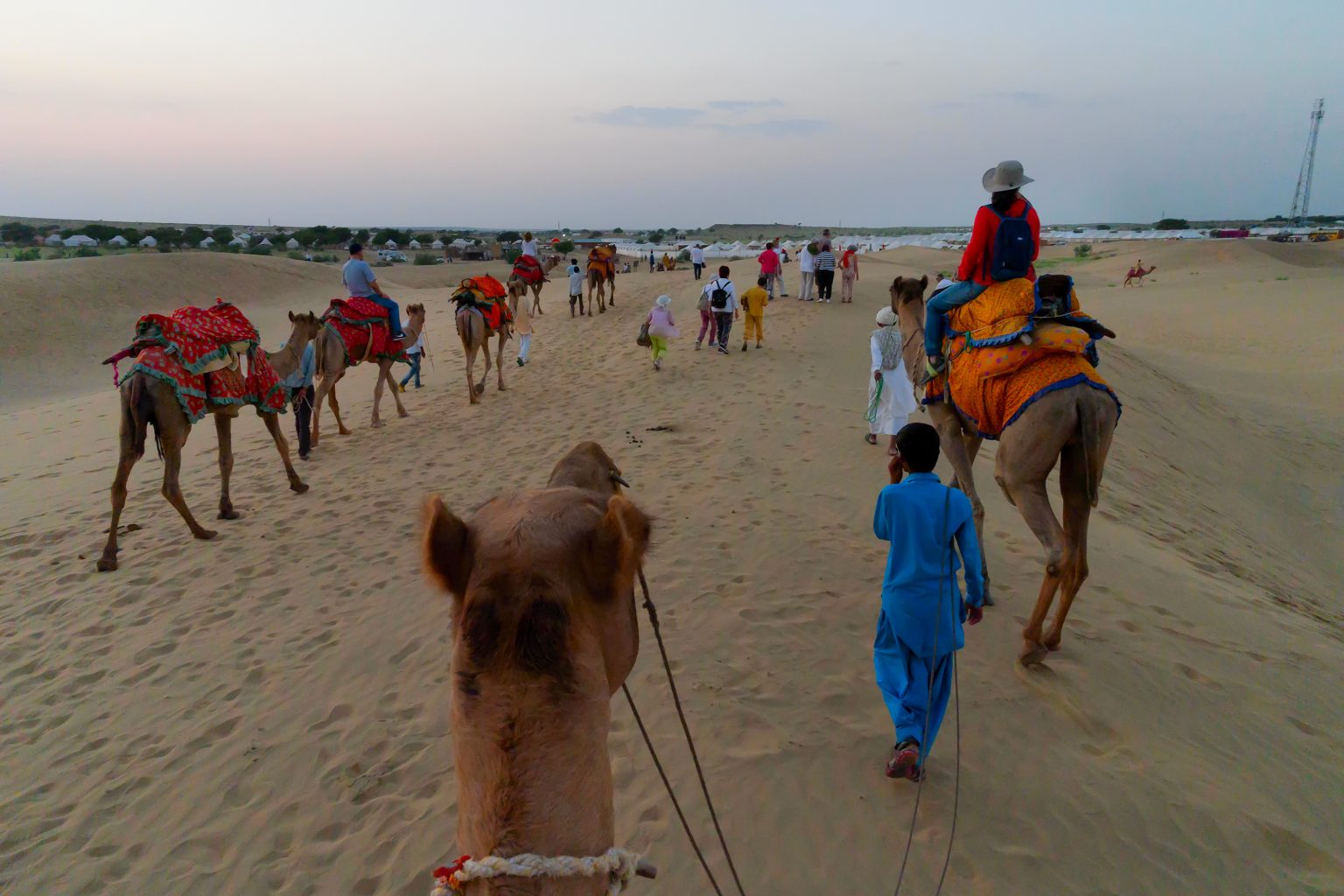
As the sun rises over Rajasthan, the dunes around Jaisalmer take on shades of gold and amber. A camel safari offers a slower way to explore the Thar Desert, passing sandy stretches, rural settlements and landscapes shaped by centuries of life in western India.
- Discover the Thar Desert in Western India
- Why Choose a Camel Safari in Rajasthan?
- Best Places for Camel Trekking in Rajasthan
- Jaisalmer and Sam Sand Dunes
- Khuri Village and the Surrounding Desert
- Bikaner and Raisar
- Barmer and the Western Rajasthan Countryside
- Popular Camel Safari Options in the Thar Desert
- When to Go Camel Trekking in Rajasthan
- What to Pack for a Camel Safari
- Cultural Encounters and Local Traditions
- Responsible Camel Trekking and Animal Welfare
- Sample Two-Day Camel Safari from Jaisalmer
- Let the Thar Set the Pace
Camel trekking in Rajasthan ranges from short sunset rides to longer excursions arranged with local operators. Popular starting points include Sam Sand Dunes and Khuri near Jaisalmer, while Bikaner and other parts of western Rajasthan offer different ways to experience the region’s camel heritage. This Thar Desert camel safari guide explains where to go, what to expect, when to travel and how to choose a responsible excursion.
Discover the Thar Desert in Western India
The Thar Desert, also called the Great Indian Desert, extends across northwestern India and southeastern Pakistan. Within India, much of its best-known tourist landscape lies in western Rajasthan, where sandy areas meet rocky terrain, agricultural settlements and historic towns.
The desert is not an uninhabited sea of dunes. Communities live across the region, maintaining farming, pastoral traditions, crafts, music and local trading networks adapted to a dry climate.
Essential Facts About the Thar Desert
- Main camel safari destinations: Jaisalmer, Sam Sand Dunes, Khuri and Bikaner.
- Landscape: Sandy dunes, scrubland, rocky ground and cultivated areas.
- Climate: Summers can be extremely hot, while winter nights can be cold.
- Popular travel season: October to March, with conditions varying by location.
- Cultural experiences: Camel rides, local food, traditional music, village visits and desert camping.
The scenery changes from one part of Rajasthan to another. A ride near Sam focuses on accessible dunes and established tourism camps, while a longer excursion arranged with a local operator may include rural landscapes and overnight stays farther from the main visitor areas.
Why Choose a Camel Safari in Rajasthan?
Camels have long been important to life in Rajasthan’s arid regions, where they have been used for transport, carrying goods and supporting pastoral livelihoods. Today, camel safaris provide visitors with an opportunity to experience parts of the desert at a slower pace.
A well-planned excursion may include:
- Dune landscapes: Watch the changing colors of the sand around sunrise or sunset.
- Rural scenery: Travel through desert scrubland and, where the route allows, near agricultural settlements.
- Desert camping: Spend an evening at an established camp or an authorized overnight site.
- Rajasthani cuisine: Sample regional dishes prepared by local cooks or camp staff.
- Music and cultural performances: Some organized camps offer folk music and dance in the evening.
Experiences vary by operator. A short camel ride at a busy tourist site is different from a multi-day trek, so confirm the route, group size, overnight arrangements and activities before booking.
Best Places for Camel Trekking in Rajasthan
Jaisalmer and Sam Sand Dunes
Jaisalmer, known as the Golden City, is one of Rajasthan’s main gateways to the Thar Desert. Its sandstone fort, historic havelis and surrounding desert landscapes make it a popular base for travelers.
Around 40 kilometers from the city, Sam Sand Dunes is one of the best-known places for camel safaris. Local camel owners and tourism operators offer rides, including excursions timed for sunset. The area also has desert camps and organized cultural evenings. <Cite refs={[“turn878222search0″,”turn878222search8”]}/>
Activities may include:
- Short camel rides across accessible sandy areas.
- Sunset excursions with views over the dunes.
- Overnight stays at established desert camps.
- Evening meals and cultural performances offered by participating camps.
- Photography during the early morning or late afternoon.
Sam is popular and can become busy, especially during the winter tourist season. If you prefer a quieter ride, ask operators about departure times, less crowded routes and smaller groups.
Best for: First-time visitors, families and travelers who want a camel safari with convenient access to Jaisalmer.
Khuri Village and the Surrounding Desert
Khuri, southwest of Jaisalmer, is another established base for camel safaris. It offers access to sandy landscapes and village surroundings, with accommodation ranging from simple stays to organized desert camps.
Depending on the provider, an excursion may include:
- Camel rides across nearby dunes and open desert terrain.
- An overnight stay at a camp or village accommodation.
- Home-style regional meals arranged by the host.
- Opportunities to learn about local life through respectful conversation and guided visits.
Khuri is sometimes promoted as a quieter alternative to Sam, although visitor numbers and the atmosphere vary by season and individual campsite. Check the precise location of your accommodation and the route included in the safari package.
Best for: Travelers seeking a smaller-scale desert stay and a combination of camel riding and village-based accommodation.
Bikaner and Raisar
Bikaner offers a different perspective on Rajasthan’s camel heritage. The city is known for its historic fort, desert architecture and the National Research Centre on Camel, which is located a short distance from the city.
Possible activities include:
- Visiting Junagarh Fort and exploring Bikaner’s historic center.
- Learning about camel research and breeding at the National Research Centre on Camel, subject to visitor arrangements.
- Booking a camel ride through an available local operator.
- Exploring the surrounding arid landscapes and nearby settlements.
Raisar and other areas around Bikaner may offer desert experiences, but routes and facilities differ by provider. Do not assume that a camel safari follows a fixed route between Bikaner, Raisar and Kolayat. Confirm the itinerary, travel time and overnight arrangements in advance.
Best for: History enthusiasts and travelers interested in camel heritage beyond Jaisalmer’s main tourist circuit.
Barmer and the Western Rajasthan Countryside
Barmer lies in western Rajasthan and is known for regional crafts, textiles and rural traditions. The surrounding area includes arid landscapes and settlements, but organized camel trekking is less standardized than the familiar safari offerings around Jaisalmer.
For a trip in this region:
- Contact a local tourism provider to confirm whether camel treks are available on your dates.
- Ask whether the route passes through public land, village areas or private property.
- Confirm access restrictions before planning travel near the international border.
- Arrange food, drinking water and overnight accommodation before leaving a town.
A longer journey through western Rajasthan can offer a broader view of the region, but it should be organized as a specific itinerary rather than assumed to be an established Barmer-to-Pokhran camel trail.
Best for: Travelers interested in regional crafts, rural landscapes and less familiar parts of Rajasthan who are prepared to arrange activities in advance.
Popular Camel Safari Options in the Thar Desert
Rather than assuming that every destination is connected by a standard trekking trail, choose an excursion based on the length of time available and the level of support you need.
Short Sunset Camel Ride
A short ride near Sam Sand Dunes or Khuri is suitable for travelers who want to experience the desert without committing to an overnight trek.
A typical outing may include:
- Transfer to the camel safari starting point.
- A guided ride along an established route.
- Time to watch the sunset or photograph the dunes.
- Return to the starting point or a nearby camp.
Confirm the ride duration, what the price includes and whether transport is provided.
Overnight Camel Safari
An overnight excursion can include a longer ride, dinner and a night at a designated camp or authorized desert site. The precise arrangement depends on the operator.
Before booking, ask about:
- The length of the ride and total time spent on the camel.
- The type of sleeping accommodation.
- Toilet and washing facilities.
- Drinking water and meal arrangements.
- The return journey and emergency support.
Sleeping outdoors is not guaranteed with every package, and some camps offer tents or other accommodation instead.
Multi-Day Camel Trek
Longer treks may be available through specialist local operators. These require more planning than a standard sunset ride, particularly if the itinerary passes through remote areas or includes village visits.
Check that the operator has a defined route, experienced handlers, appropriate supplies and a realistic daily riding schedule. Confirm where the group will sleep, how luggage will be carried and what happens if weather or health conditions require a change of plan.
Do not book a multi-day trek solely on the assumption that a route shown on a map is an established camel trail.
When to Go Camel Trekking in Rajasthan
The cooler months are generally the most comfortable time for camel trekking in the Thar Desert. However, daytime temperatures, nighttime cold and local conditions vary, so check the forecast for your specific destination.
October to November
These months can be a good time to visit as temperatures begin to moderate after the summer. Conditions may still be warm during the day, so morning and late-afternoon rides are often preferable.
December to February
Winter is a popular season for camel safaris around Jaisalmer and other tourist destinations in Rajasthan.
Advantages include:
- More comfortable conditions for daytime outdoor activities.
- Pleasant light for sunrise and sunset photography.
- A busy tourism season with a wider choice of organized excursions.
Nights can become very cold, particularly in exposed desert camps. Bring warm layers and check what bedding the accommodation provides.
March to April
Temperatures rise as spring progresses. Short rides remain possible, but it is important to avoid unnecessary exposure during the hottest part of the day.
- Choose early-morning or late-afternoon departures.
- Carry sufficient drinking water.
- Use sun protection and lightweight clothing.
- Confirm the expected temperature before arranging an overnight stay.
May to September
Summer and the monsoon period can bring intense heat, humidity and changing weather. Daytime camel trekking may be uncomfortable or unsafe during extreme heat, and rain can affect some routes.
For many visitors, November to February is the most practical period to plan a camel safari, with the final choice depending on local forecasts and the type of excursion.
What to Pack for a Camel Safari
Packing depends on whether you are taking a short ride or spending one or more nights in the desert.
Essential Items
- Comfortable clothing: Lightweight, breathable clothes that cover the skin and protect against sun and dust.
- Warm layers: A jacket or fleece for cold evenings and early mornings.
- Sun protection: A wide-brimmed hat or head covering, sunglasses and sunscreen.
- Drinking water: Carry water suitable for the duration of the excursion and follow your operator’s guidance.
- Closed footwear: Comfortable shoes that protect your feet from hot sand and uneven ground.
- Personal medication: Bring any medication you may need during the trip.
- Small day bag: Keep essentials accessible without carrying unnecessary weight on the camel.
Useful Extras for Overnight Trips
- A flashlight or headlamp.
- A sleeping bag or warm sleepwear if the camp does not supply adequate bedding.
- A power bank and charging cable.
- A camera stored in a dust-resistant case.
- Reusable water containers, where the operator can refill them safely.
- Tissues and personal hygiene supplies.
A traditional safa, or turban-style headwrap, can help protect the head and face from sun and dust. Ask a local guide or shopkeeper for help wearing one correctly if you are unfamiliar with it.
Cultural Encounters and Local Traditions
Rajasthan’s desert heritage is shaped by many communities, occupations and regional traditions. A camel safari can provide an introduction to some of these, especially when the excursion is arranged with a knowledgeable local guide.
Depending on the itinerary, you may encounter:
- Local camel owners and handlers, who can explain how camels are prepared for rides and cared for.
- Regional food, including breads and other dishes prepared in local or camp kitchens.
- Folk music and dance, offered by some cultural programs and desert camps.
- Traditional crafts, including textiles, embroidery and other handmade products sold in towns and villages.
The Raika are among Rajasthan’s well-known pastoral communities associated with camel herding, but they should not be treated as a group that every visitor will encounter on a safari. Any meeting with camel-herding families should be arranged respectfully and should not be presented as a guaranteed attraction.
If you visit a village or meet local residents, ask before taking photographs, respect privacy and follow your guide’s advice about local customs.
Responsible Camel Trekking and Animal Welfare
A responsible safari should protect the welfare of the camels as well as the landscape and the people who live in the region.
Before booking, look for an operator who:
- Provides camels with access to water, suitable food and adequate rest.
- Avoids overloading animals or scheduling excessively long rides.
- Uses appropriate saddles and equipment.
- Adjusts or cancels rides when heat or other conditions create a welfare concern.
- Gives clear instructions for mounting, dismounting and riding safely.
During the excursion:
- Follow the handler’s instructions and avoid sudden movements around the animal.
- Do not pull hard on the reins or approach a camel from behind without guidance.
- Stay on the agreed route and avoid disturbing wildlife.
- Carry out all waste and avoid leaving plastic behind.
- Respect private land, village customs and protected areas.
- Support local businesses and craftspeople where possible.
A memorable desert experience should not depend on an animal being pushed beyond reasonable limits.
Sample Two-Day Camel Safari from Jaisalmer
This sample itinerary illustrates how an overnight safari can be organized. The actual route, ride duration and accommodation depend on the chosen operator and current conditions.
Day 1: Jaisalmer to the Desert Camp
Begin in Jaisalmer, where you can explore the fort and historic streets before leaving for the safari starting point. After meeting the camel handler and receiving safety instructions, begin the ride along the route agreed with the operator.
Depending on the package, the afternoon may include:
- A camel ride through accessible sandy terrain.
- Stops for water, rest and photography.
- A sunset viewing point.
- Dinner at a designated camp or authorized overnight location.
Spend the night in the accommodation included in your booking. Confirm in advance whether it is a tent, a simple shelter or another type of stay.
Day 2: Sunrise and Return to Jaisalmer
Wake early if weather and the itinerary allow, and watch the dunes change color in the morning light. After breakfast, return by camel or arranged vehicle, depending on the package.
Allow time for:
- A short morning walk or ride.
- Breakfast and packing.
- The return transfer to Jaisalmer.
- Rest before onward travel.
For a longer trek, ask the operator for a detailed day-by-day plan rather than extending this itinerary without confirming distances, water supplies and overnight stops.
Let the Thar Set the Pace
Camel trekking in Rajasthan offers a distinctive way to explore the Thar Desert, from the popular dunes near Jaisalmer to the wider countryside around Bikaner and Barmer. Each destination provides a different combination of scenery, local heritage and travel arrangements.
Choose an excursion that fits your time, comfort and experience. Ask clear questions about the route, accommodation and camel welfare, and leave space in your schedule for the slow pace of desert travel. With thoughtful planning and respect for local communities, a Rajasthan camel safari can become a meaningful introduction to western India’s desert landscapes and living traditions.