
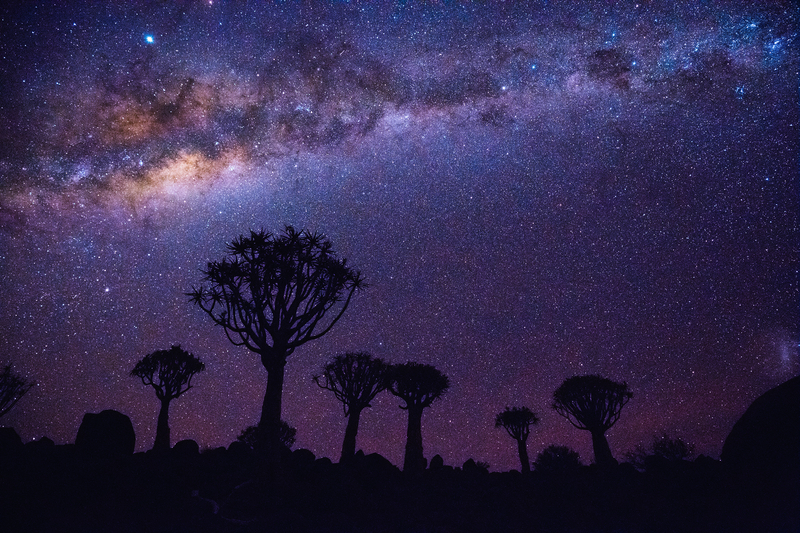
As dusk settles over Namibia, the desert landscape changes with the fading light. Shadows stretch across the sand, the temperature begins to drop, and stars gradually emerge above the horizon.
- Why Namibia Is a Remarkable Desert Camping Destination
- The Best Places for Desert Camping and Stargazing in Namibia
- Sossusvlei and Namib-Naukluft National Park
- Spitzkoppe: Granite Peaks and Open Skies
- Damaraland: Remote Landscapes and Desert-Adapted Wildlife
- NamibRand Nature Reserve: A Destination for Dark-Sky Enthusiasts
- The Skeleton Coast: Desert Scenery Beside the Atlantic
- What to Bring for Desert Camping and Stargazing
- Best Time of Year for Desert Camping in Namibia
- What You Can See in Namibia’s Night Sky
- Responsible Desert Camping in Namibia
- Staying Safe While Camping in the Desert
- Make the Most of Namibia’s Desert Nights
Desert camping and stargazing in Namibia bring together striking landscapes, remote accommodation and opportunities to observe the night sky far from major sources of artificial light. From the towering dunes of Sossusvlei to the granite formations of Spitzkoppe and the wide-open spaces of Damaraland, each destination offers a different way to experience Namibia after sunset.
Whether you prefer a simple campsite or a comfortable desert lodge, this guide explores where to stay, what to bring, when to visit and how to enjoy Namibia’s night skies responsibly.
Why Namibia Is a Remarkable Desert Camping Destination
Namibia’s vast landscapes and relatively low population density make many areas attractive for travelers seeking quiet surroundings and dark skies. Conditions vary by region, but the country offers options ranging from established campsites to remote lodges with guided astronomy experiences.
What makes the experience distinctive?
- Dark night skies: Remote areas with limited artificial lighting can provide excellent conditions for observing stars and the Milky Way.
- Open desert horizons: Sand dunes, gravel plains and rocky mountains create varied settings for sunset and night-sky photography.
- Desert-adapted wildlife: Depending on the region, visitors may encounter oryx, jackals, springbok and other animals adapted to arid environments.
- Different accommodation styles: Options range from self-catering campsites to tented lodges and guided wilderness stays.
- Seasonal contrasts: Clear, dry periods can be excellent for astronomy, although cold nights and changing weather require preparation.
Namibia’s desert environments are not empty spaces. They support wildlife, fragile ecosystems and local communities, all of which deserve consideration when planning an overnight stay.
The Best Places for Desert Camping and Stargazing in Namibia
Sossusvlei and Namib-Naukluft National Park
Located in the Namib Desert, Sossusvlei is known for its towering dunes, striking colors and dramatic desert scenery. It is one of Namibia’s most recognizable destinations for landscape photography and overnight desert trips.
Nearby accommodation around Sesriem provides access to the Sossusvlei area, including Deadvlei and Dune 45. Camping options include Sesriem Campsite, while nearby private properties offer alternatives such as Desert Quiver Camp. These accommodations differ in location, facilities and access arrangements.
Key highlights include:
- Sunrise and sunset views across the Namib’s dunes.
- Opportunities to photograph the changing colors of the sand and surrounding mountains.
- Dark-sky viewing on clear nights away from unnecessary artificial lighting.
- Access to desert walks and excursions around Sossusvlei and Deadvlei.
Helpful planning tips:
- Book ahead: Campsites and accommodation can fill quickly during popular travel periods.
- Check park access: Staying inside or outside the Sesriem entrance area can affect how early you can enter the park.
- Plan for the final stretch: The route to Sossusvlei includes a sandy section where vehicle access arrangements can vary. Check current rules and shuttle availability before travelling.
- Allow more than one night: An extra night gives you more flexibility for sunrise visits, sunset photography and evening stargazing.
This region is particularly suitable for photographers and first-time visitors who want to combine classic Namib Desert scenery with a night outdoors.
Spitzkoppe: Granite Peaks and Open Skies
The Spitzkoppe rock formations rise dramatically above the surrounding plains in central-western Namibia. Their distinctive granite shapes make the area a popular destination for landscape photography, walking and camping.
The designated campsites offer a more basic experience than many desert lodges, with the surrounding rock formations providing a striking setting after dark.
Key highlights include:
- Granite peaks, rocky outcrops and natural arches.
- Open views across the surrounding plains.
- Opportunities for sunset photography and night-sky observation.
- A choice of designated camping areas, subject to local rules and availability.
Helpful planning tips:
- Bring sufficient drinking water and supplies appropriate to your campsite.
- Check which facilities are available at your chosen site rather than assuming all camps offer the same services.
- Carry warm clothing for after sunset and before sunrise.
- Use a headlamp carefully and avoid shining bright lights toward other campers.
- Follow local guidance about walking routes and access to sensitive rock formations.
Spitzkoppe suits travelers who value a relatively simple camping experience, dramatic geology and the opportunity to spend an evening outdoors beneath a clear sky.
Damaraland: Remote Landscapes and Desert-Adapted Wildlife
Damaraland is known for rugged mountains, rocky plains, ancient rock engravings and landscapes shaped by an arid climate. It offers a different experience from the tall sand dunes around Sossusvlei.
Accommodation ranges from campsites to remote lodges, including properties such as Mowani Mountain Camp and Brandberg White Lady Lodge. These are accommodation options rather than interchangeable public campsites, so check their facilities and booking requirements before planning an overnight stay.
Key highlights include:
- Dramatic rock formations and wide desert valleys.
- Opportunities to learn about the area’s geology and cultural heritage.
- Guided wildlife excursions in suitable areas, where desert-adapted animals may be seen.
- Clear night skies at locations with limited artificial lighting.
Helpful planning tips:
- Bring warm layers because temperatures can fall considerably after sunset.
- Arrange guided visits to sites such as Twyfelfontein, known for its rock engravings.
- Confirm road conditions and travel times before setting out across remote areas.
- Ask your accommodation whether stargazing activities are offered and whether equipment or a guide is included.
Damaraland is a good option for travelers who want to combine desert camping in Namibia with geology, cultural heritage and wildlife experiences.
NamibRand Nature Reserve: A Destination for Dark-Sky Enthusiasts
The NamibRand Nature Reserve in southern Namibia is an internationally recognized destination for protecting natural darkness. Designated an International Dark Sky Reserve in 2012, it is particularly well suited to travelers who want to observe the stars in a carefully managed natural environment.
Accommodation in the reserve includes camps and lodges such as those operated by Wolwedans. These properties generally offer a different experience from ordinary self-camping, with accommodation, activities and access arrangements determined by the operator.
Key highlights include:
- Very dark skies in areas protected from excessive artificial lighting.
- Broad views across dunes, gravel plains and distant mountains.
- Opportunities to observe constellations, planets and the Milky Way when conditions are favorable.
- Accommodation options designed around the surrounding desert environment.
Helpful planning tips:
- Reserve accommodation in advance and confirm whether guided astronomy sessions are available.
- Bring binoculars if you want to explore star clusters and other celestial objects.
- Ask about photography conditions and any restrictions on lighting.
- Do not assume that all areas of the reserve are open for independent camping or unrestricted night-time access.
The NaDEET Centre also operates in the reserve as an environmental education facility. It should not be treated as a standard public campsite or lodge; access and overnight arrangements need to be confirmed directly.
For travelers who prioritize stargazing in Namibia, NamibRand offers an especially strong combination of conservation and night-sky viewing.
The Skeleton Coast: Desert Scenery Beside the Atlantic
The Skeleton Coast combines arid landscapes with the cold Atlantic Ocean, creating scenery that differs sharply from Namibia’s inland dunes. Coastal fog, wind and shifting weather can produce dramatic conditions, but they can also affect visibility and comfort.
Accommodation options include properties such as Shipwreck Lodge. This is a lodge experience, not a general-purpose public campsite, and access to the surrounding protected areas is subject to local rules.
Key highlights include:
- A distinctive meeting of desert terrain and ocean scenery.
- Coastal fog and changing light for photography.
- Opportunities to explore selected areas through authorized operators.
- A quieter atmosphere in locations away from heavily visited settlements.
Helpful planning tips:
- Check access and permit requirements for the exact area you plan to visit.
- Bring warm, wind-resistant clothing even when inland temperatures are high.
- Confirm whether your accommodation includes excursions and transport.
- Do not assume that camping is permitted wherever the landscape appears accessible.
The Skeleton Coast is best for travelers interested in remote coastal scenery. For astronomy, conditions may be less predictable than in some inland areas because of fog and cloud cover.
What to Bring for Desert Camping and Stargazing
Preparing for both daytime heat and nighttime cold is essential for a comfortable Namibia desert camping trip. Your packing list will depend on whether you are staying at a serviced campsite, travelling in a rooftop tent or booking a lodge.
Essential Camping Gear
- A suitable tent or rooftop tent, where permitted and appropriate for the site.
- A sleeping bag rated for the expected overnight temperatures.
- An insulated sleeping mat for additional warmth and comfort.
- Warm layers, including a jacket for evenings and early mornings.
- Sufficient drinking water for the planned route and duration.
- A portable stove and cooking equipment if your campsite permits self-catering.
- A first-aid kit and any personal medication.
- Rubbish bags so that all waste can be carried out.
- A reliable map or offline navigation system for remote areas.
Check what your campsite provides before packing. Some sites have shared facilities, while others offer limited services and require greater self-sufficiency.
Equipment for Stargazing
- Binoculars: A useful, portable option for observing star clusters and the Moon.
- Camera and tripod: Helpful for photographing the Milky Way and wide desert landscapes.
- Red-light torch: Red lighting can help preserve night vision when used carefully.
- Stargazing apps: Tools such as Stellarium can help identify constellations and planets.
- Lens cloth and dust protection: Useful for keeping camera equipment clean in dry, sandy conditions.
- Power bank: Helps keep phones and other small devices charged.
A telescope is optional rather than essential. Many memorable observations can be made with the naked eye, particularly when the sky is dark and the weather is clear.
Optional Comforts
- A lightweight reclining chair for longer observing sessions.
- An extra blanket for cold nights.
- A thermos for hot drinks.
- A notebook for recording observations or planning photographs.
- A compact cushion for sitting on rocky or uneven ground.
Pack according to your itinerary and accommodation type. Travelers staying at a lodge may not need to carry the same equipment as those camping independently.
Best Time of Year for Desert Camping in Namibia
Namibia’s seasons influence temperatures, rainfall, road conditions and visibility. The best time for desert camping and stargazing depends on whether you prioritize comfortable daytime travel, wildlife viewing, night-sky photography or fewer visitors.
- June to August: These dry-season months often bring clear skies and cooler nights. Warm clothing and a sleeping bag suitable for low temperatures are important.
- September to November: Conditions become warmer as the dry season progresses. Plan outdoor activities around the heat, especially toward the end of this period.
- December to March: This period can bring summer heat and seasonal rainfall, particularly in some inland areas. Clouds and thunderstorms may affect stargazing, although clear nights are still possible.
- April and May: Conditions vary as the wetter season ends. The landscape may be greener in some regions, and nights can become cooler.
The dry winter period is often a good choice for travelers seeking reliable conditions, but no season guarantees clear skies. Regional weather can differ, and a cloudy night can occur even during the dry months.
For the best experience, check the local forecast, allow several nights if astronomy is a priority and plan around the Moon. A bright Moon can wash out fainter stars and reduce the visibility of the Milky Way.
What You Can See in Namibia’s Night Sky
Namibia’s location in the Southern Hemisphere allows visitors to observe celestial features that are less familiar to travelers from northern latitudes. What you see depends on the season, time of night, horizon, weather and level of artificial light.
Possible highlights include:
- The Milky Way: Its bright central region is a major attraction for astrophotographers. Visibility depends on the season, the Moon and cloud conditions.
- The Southern Cross: A recognizable southern constellation that has long been used as a navigational reference.
- The Magellanic Clouds: Two nearby dwarf galaxies that can be seen with the naked eye under suitably dark skies.
- Bright planets: Jupiter, Saturn and other planets are visible when they are above the horizon and their positions are favorable.
- Meteor showers: Events such as the Eta Aquariids and Geminids can produce visible meteors, though activity and viewing conditions vary.
A few simple steps can improve your experience:
- Allow your eyes time to adjust to the darkness.
- Keep phone and vehicle lights to a minimum.
- Check a reliable astronomy calendar before travelling.
- Choose an authorized viewing area with an unobstructed horizon.
- Be patient, since faint celestial objects can take time to notice.
You do not need expensive equipment to enjoy the night sky. A dark location, a clear forecast and time to look upward are often the most important ingredients.
Responsible Desert Camping in Namibia
Namibia’s desert environments are fragile, and responsible travel helps protect the landscapes and wildlife that make these destinations special.
Follow these practices during your trip:
- Use designated campsites: Camp only in areas where overnight stays are permitted, particularly in national parks, private reserves and protected coastal areas.
- Leave no trace: Take rubbish with you and avoid leaving food scraps or other waste behind.
- Protect the night sky: Use low-level lighting only when necessary and avoid shining bright lights toward wildlife or other campers.
- Respect wildlife: Observe animals from a safe distance and never feed or approach them.
- Follow fire rules: Use a fire only where explicitly permitted and follow local restrictions, especially during dry or windy conditions.
- Support local conservation: Choose responsible operators and accommodation providers that respect the environment and local communities.
- Respect cultural sites: Follow access rules at archaeological locations and do not disturb rock engravings or other historic features.
Responsible camping is not only about keeping a site clean. It also means minimizing disturbance to wildlife, respecting access restrictions and preserving the darkness that makes stargazing possible.
Staying Safe While Camping in the Desert
Remote desert travel requires preparation, particularly when mobile coverage, fuel supplies and assistance may be limited.
Practical safety measures include:
- Share your route and expected return time with your accommodation or a trusted contact.
- Check fuel availability and road conditions before travelling between remote destinations.
- Carry sufficient water, food and emergency supplies for the planned journey.
- Use reliable navigation and consider satellite communication when travelling beyond dependable mobile coverage.
- Secure food and rubbish to reduce the chance of attracting wildlife.
- Avoid walking far from camp in darkness unless you know the area and have suitable lighting.
- Check weather forecasts and follow local guidance about storms, heat and road access.
- Keep a warm layer accessible, even after a hot day.
If you are driving yourself, do not assume that every desert road is suitable for an ordinary vehicle. Some routes require a high-clearance vehicle or four-wheel drive, and conditions can change after rain. Confirm the requirements for your particular destination before setting off.
Make the Most of Namibia’s Desert Nights
Desert Camping and Stargazing in Namibia offers an opportunity to experience the country’s landscapes after the daytime heat begins to fade. From the famous dunes around Sossusvlei to the granite peaks of Spitzkoppe and the protected dark skies of NamibRand, each destination offers its own setting for an evening outdoors.
Choose accommodation that suits your experience level, prepare for cold nights and confirm access rules before travelling to remote areas. With thoughtful planning, a few nights in Namibia can combine desert scenery, quiet camps and memorable views of the southern sky.