
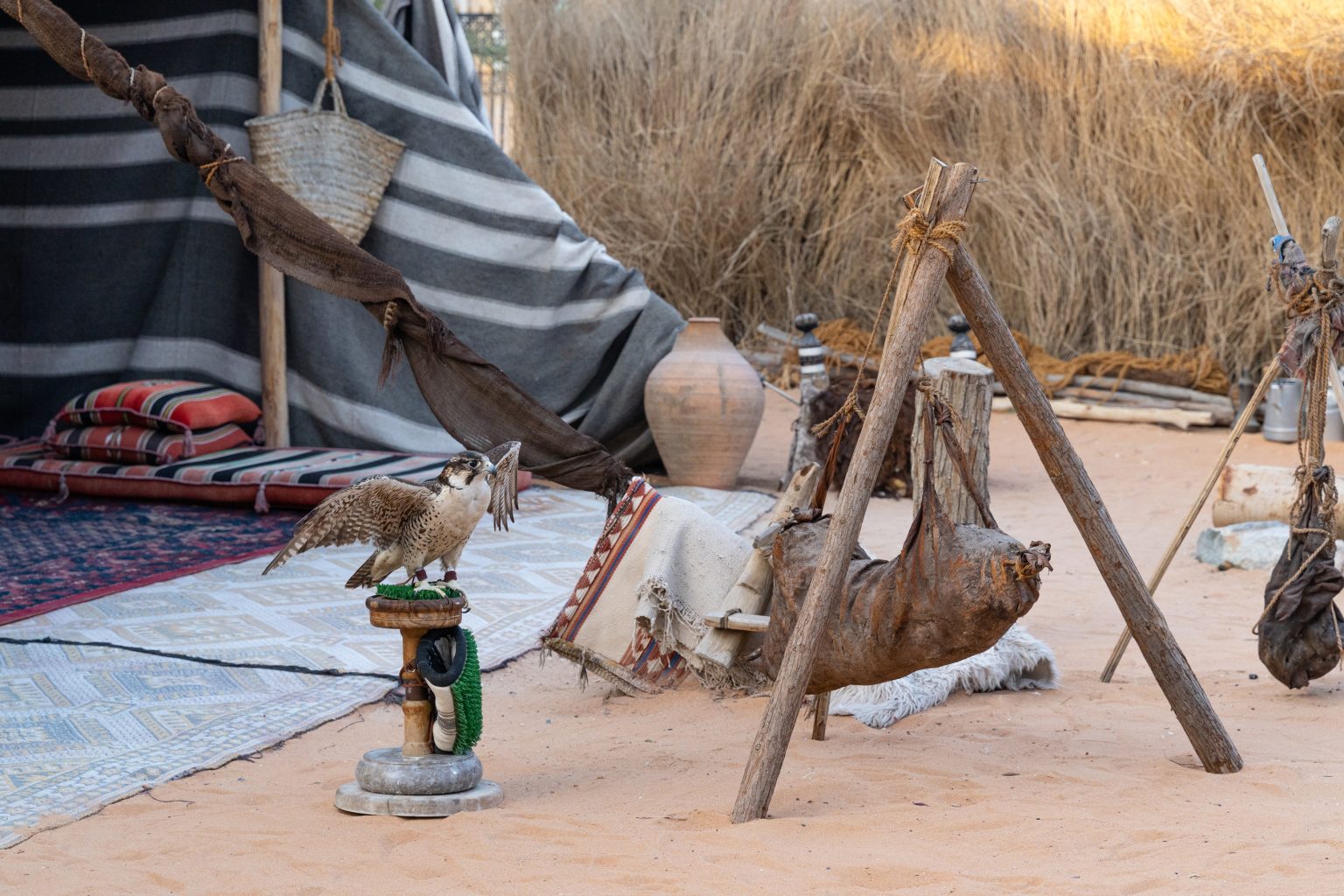
Bedouin culture in Qatar reflects a heritage shaped by desert travel, family ties, poetry, and hospitality. Long before modern Doha developed along the coast, Bedouin communities adapted to the challenges of an arid environment, relying on camels, seasonal movement, and knowledge passed between generations. Today, traditional Qatari heritage remains visible in the majlis, camel racing, Sadu weaving, and cultural celebrations. Exploring Bedouin life in Qatar offers visitors a way to understand the country’s past while discovering how its traditions continue to evolve.
- Who Are the Bedouins of Qatar?
- The Bedouin Way of Life in Qatar
- Qatari Hospitality and the Majlis
- The Bedouin Tent: A Home Adapted to the Desert
- Poetry, Music, and Oral Storytelling
- The Camel: A Central Part of Desert Heritage
- The Role of Women in Bedouin Heritage
- Experiencing Bedouin Culture in Qatar Today
- Best Time to Explore Bedouin Heritage in Qatar
- Respectful Travel Tips for Discovering Qatari Traditions
- Discover the Living Heritage of Qatar’s Desert
Who Are the Bedouins of Qatar?
The Bedouins, known in Arabic as Al Badu, are traditionally associated with nomadic and semi-nomadic communities across the Arabian Peninsula. In Qatar, some Bedouin groups historically moved through inland areas in search of grazing and water, while other communities maintained closer connections with settlements and the coast.
Their livelihoods depended on the environment, the availability of resources, and relationships with neighboring communities. Camels, tents, livestock, and knowledge of desert routes played important roles in daily life.
Several elements help explain this way of life:
- The tent: A portable shelter suited to communities that moved between locations.
- Camels and livestock: Important sources of transport, food, materials, and wealth.
- Knowledge of the environment: Familiarity with weather, water sources, grazing areas, and routes across the desert.
- Hospitality: Welcoming guests and sharing refreshments became important expressions of social responsibility.
- Oral traditions: Poetry, stories, and shared memories helped preserve knowledge and cultural identity.
Not all Qataris historically lived as nomads. Fishing, pearling, maritime trade, and settled agriculture also shaped the country’s history. Bedouin heritage is one important part of a broader national story.
The Bedouin Way of Life in Qatar
Traditional Bedouin life was influenced by family relationships, cooperation, mobility, and the practical demands of living in an arid landscape. These experiences helped shape customs that remain visible in Qatari society, although their expression varies between families and generations.
Important cultural values include:
- Honor and trust: Reputation and personal responsibility played important roles in relationships between individuals and families.
- Generosity: Offering food, coffee, and shelter to guests remains a recognized expression of hospitality.
- Patience and resilience: Living with limited water and changing environmental conditions required careful planning and adaptability.
- Poetry and expression: Oral poetry provided a way to communicate pride, affection, social commentary, and memories.
- Community ties: Family connections and cooperation helped people respond to the practical challenges of desert life.
These traditions have not remained frozen in the past. Modern Qatar combines rapid urban development with cultural institutions, sporting events, crafts, and family customs that preserve selected elements of its heritage.
Qatari Hospitality and the Majlis
Hospitality is one of the most recognizable features of traditional Qatari culture. A guest may be welcomed with Arabic coffee and dates, followed by conversation in a majlis, a gathering space that has long played an important role in social life.
Traditional hospitality includes several customs:
- Arabic coffee (qahwa): Prepared with coffee beans and aromatic ingredients, often including cardamom, and served from a distinctive pot called a dallah.
- Dates: Commonly offered alongside coffee as a sign of welcome.
- The majlis: A place for receiving guests, exchanging news, discussing community matters, and sharing stories.
- Conversation and poetry: Gatherings can provide opportunities to exchange memories, discuss current affairs, and preserve oral traditions.
Serving Arabic coffee is more than a refreshment ritual. It communicates welcome and respect through established customs, including the order in which guests are served and the way the coffee is offered.
The majlis has also been recognized on UNESCO’s Representative List of the Intangible Cultural Heritage of Humanity as a social practice shared by several countries in the region. Its precise arrangements vary between households and occasions.
Visitors interested in experiencing this tradition can look for cultural programs or guided visits that explicitly include a traditional majlis. A general desert safari does not necessarily provide this experience.
The Bedouin Tent: A Home Adapted to the Desert
The traditional Bedouin tent, often called bait al-sha’ar, takes its name from the animal hair used in its construction. Goat hair, sheep wool, and camel hair have all been used in traditional weaving across different communities, with materials varying according to local resources.
The tent was designed to meet practical needs in an environment where shelter sometimes had to be moved and reassembled.
Its main characteristics included:
- Portable construction: Woven panels and supporting poles could be assembled or dismantled when a household moved.
- Climate adaptation: The woven fabric provided shade and shelter, while its behavior changed with weather conditions.
- Flexible interior arrangements: Different areas could be designated for family activities, sleeping, storage, or receiving guests.
- Textile decoration: Rugs, cushions, and woven panels could feature geometric patterns associated with regional craft traditions.
The interior of a tent was not simply a place to sleep. It could serve as a family home, a setting for preparing food, and a space for receiving visitors.
Today, traditional tents may appear at heritage festivals, cultural demonstrations, and some desert camps. Modern visitor tents are not necessarily constructed using traditional materials or methods, so travelers interested in the craft should ask whether a camp offers an authentic demonstration.
Poetry, Music, and Oral Storytelling
Poetry has a long history across the Arabian Peninsula, including Qatar. In traditional communities, spoken verse could preserve memories, express emotions, celebrate achievements, and comment on relationships between individuals and groups.
Cultural expression took several forms:
- Nabati poetry: A form of vernacular Arabic poetry associated with the Arabian Peninsula and often performed orally.
- Oral storytelling: Stories and recollections passed between generations helped preserve family and community memories.
- Traditional songs: Songs accompanied social gatherings, work, and celebrations in different communities.
- Folk performances: Music, rhythmic movement, and group singing continue to appear at cultural events in Qatar.
Specific musical styles and instruments vary across the Gulf and the wider Arabian Peninsula. It is therefore more accurate to discuss Qatar’s poetry and performance traditions in their local context rather than assume that every instrument or musical form is shared by all Bedouin communities.
Visitors can encounter traditional performances at selected festivals, cultural venues, and national celebrations. Programs change throughout the year, so check the event schedule before planning a visit around a particular performance.
The Camel: A Central Part of Desert Heritage
The camel played an important role in traditional desert life across Qatar and the Arabian Peninsula. Its ability to travel through arid environments made it valuable to communities that depended on livestock and long-distance movement.
Camels contributed to daily life in several ways:
- Transport: They carried people and supplies across desert routes.
- Milk: Camel milk provided nourishment in communities that kept camels.
- Materials: Camel hair could be used in textiles and other practical items.
- Economic value: Camels represented livestock wealth and were important in trade and social life.
- Cultural identity: Camel knowledge, breeding, and racing became established parts of regional heritage.
Camel racing remains a prominent tradition in Qatar. At Al Shahaniya Camel Racetrack, visitors can learn about this sport and, when available, watch racing or training. Modern races use remote-controlled robotic jockeys rather than the traditional human riders of earlier periods.
Professional camel racing began in Qatar in 1972, and Al Shahaniya became a major center for the sport. Race schedules vary by season, with regular events generally taking place during the cooler months and major races sometimes scheduled later in the season.
Check the official schedule before visiting, since races are not held every day. Even when a race is not taking place, training may offer an opportunity to observe the animals, subject to venue access arrangements.
The Role of Women in Bedouin Heritage
Women have made important contributions to household life, textile production, family knowledge, and cultural continuity in Bedouin communities. Their responsibilities varied according to the household, local customs, economic circumstances, and historical period.
One particularly significant tradition is Al-Sadu weaving, a craft practiced by Bedouin women and recognized in Qatar’s cultural heritage.
Its traditional uses include:
- Tent textiles: Woven panels helped form the fabric used in traditional shelters.
- Rugs and cushions: Textiles provided practical household furnishings.
- Animal equipment: Woven materials were used for items such as saddle bags and other accessories.
- Geometric designs: Patterns and colors reflected craft traditions and the materials available to the weaver.
- Knowledge transfer: Skills were passed between generations through practice and instruction.
Al-Sadu weaving commonly uses wool or animal hair, including materials from sheep, goats, and camels. The preparation process can involve cleaning, spinning, dyeing, and weaving the fibers.
Although traditionally associated with Bedouin women, the craft is now practiced and promoted more widely in Qatar. Cultural workshops and exhibitions can help visitors understand its techniques and significance.
It is important not to reduce women’s historical roles to a single description. Their experiences differed between communities, and contemporary Qatari women participate in a wide range of professional, cultural, and public activities.
Experiencing Bedouin Culture in Qatar Today
Visitors can explore aspects of Qatari desert heritage through organized activities, museums, cultural venues, and traditional sporting events. The best choice depends on whether you are interested in desert landscapes, craftsmanship, hospitality, or living traditions.
Experiences to consider include:
- Desert excursions: Visit the Sealine area and Khor Al Adaid with a reputable operator offering suitable 4×4 transport and clear safety arrangements.
- A traditional majlis: Look for a cultural experience that includes Arabic coffee, dates, and an explanation of local hospitality customs.
- Camel racing: Visit Al Shahaniya when the venue is open to visitors or a suitable event is scheduled.
- Sadu weaving: Explore demonstrations, exhibitions, or workshops that explain the materials and techniques used in traditional weaving.
- Katara Cultural Village: Check its program for exhibitions, performances, and events related to Qatari and regional heritage.
- Souq Waqif: Explore traditional market architecture, local products, and cultural activities in one of Doha’s best-known historic-style marketplaces.
Khor Al Adaid, also known as the Inland Sea, is especially notable for its combination of dunes and coastal scenery. Access to the area generally requires suitable 4×4 transport and careful route planning. Visitors should book with a responsible operator rather than assume that an ordinary rental car can safely reach the destination.
Modern cultural venues can provide valuable introductions to Qatari traditions, but they are different from visiting a traditional household or participating in a community-led experience. Choose activities that clearly explain what is included and who leads them.
Best Time to Explore Bedouin Heritage in Qatar
Qatar’s desert climate strongly influences outdoor activities. The cooler months are generally more comfortable for visiting desert landscapes, attending outdoor events, and exploring traditional sites.
- November to March: Usually the most comfortable period for desert excursions, camping, and outdoor cultural activities.
- December to February: Often particularly pleasant for spending time outside, although evenings and nights can be cool.
- April and May: Temperatures rise, so shorter excursions and activities scheduled for the morning or late afternoon may be preferable.
- June to September: Extreme heat and humidity can make outdoor desert activities uncomfortable or unsafe. Indoor cultural venues are often a more practical choice during the hottest part of the day.
- October: Conditions begin to improve as the hotter season gives way to cooler weather, although temperatures can remain high.
For most travelers, December to February offers a useful balance for combining cultural sightseeing with outdoor desert experiences. However, event dates and operating schedules vary, so confirm details before making a reservation.
Respectful Travel Tips for Discovering Qatari Traditions
A respectful approach helps visitors understand local customs without treating cultural heritage as a performance staged solely for tourists.
Keep these practical points in mind:
- Dress appropriately: Choose modest clothing when visiting cultural sites or attending traditional gatherings, and follow any venue-specific requirements.
- Accept hospitality graciously: If coffee or dates are offered, a polite response is appreciated. You can decline respectfully if you do not wish to accept.
- Ask before taking photographs: Obtain permission before photographing people, private gatherings, or culturally sensitive activities.
- Learn a few Arabic expressions: A greeting such as as-salamu alaykum can be a courteous way to begin an interaction.
- Support local craftspeople: Consider purchasing authentic handmade items from reputable sellers or participating in workshops led by local practitioners.
- Follow desert safety guidance: Use appropriate transport, carry sufficient water, and respect protected areas and wildlife.
- Choose transparent cultural experiences: Ask who organizes an activity, what it includes, and whether it is led by local practitioners.
Respectful travel is not about memorizing every custom. It is about listening, asking thoughtful questions, and allowing local people to decide how their traditions are shared.
Discover the Living Heritage of Qatar’s Desert
Qatar’s cities have changed dramatically, but its cultural heritage remains visible in the majlis, Arabic coffee rituals, Sadu textiles, camel racing, poetry, and desert excursions. These traditions connect contemporary life with the experiences of earlier generations without suggesting that the country or its communities have remained unchanged.
For travelers, the most rewarding way to explore Bedouin culture in Qatar is to combine an understanding of its history with respectful encounters in the present. Visit a cultural exhibition, learn about traditional weaving, attend a camel race when one is scheduled, or explore the dunes with a responsible local guide. Each experience offers a different perspective on a heritage shaped by the desert, the coast, and the people who have called Qatar home.