
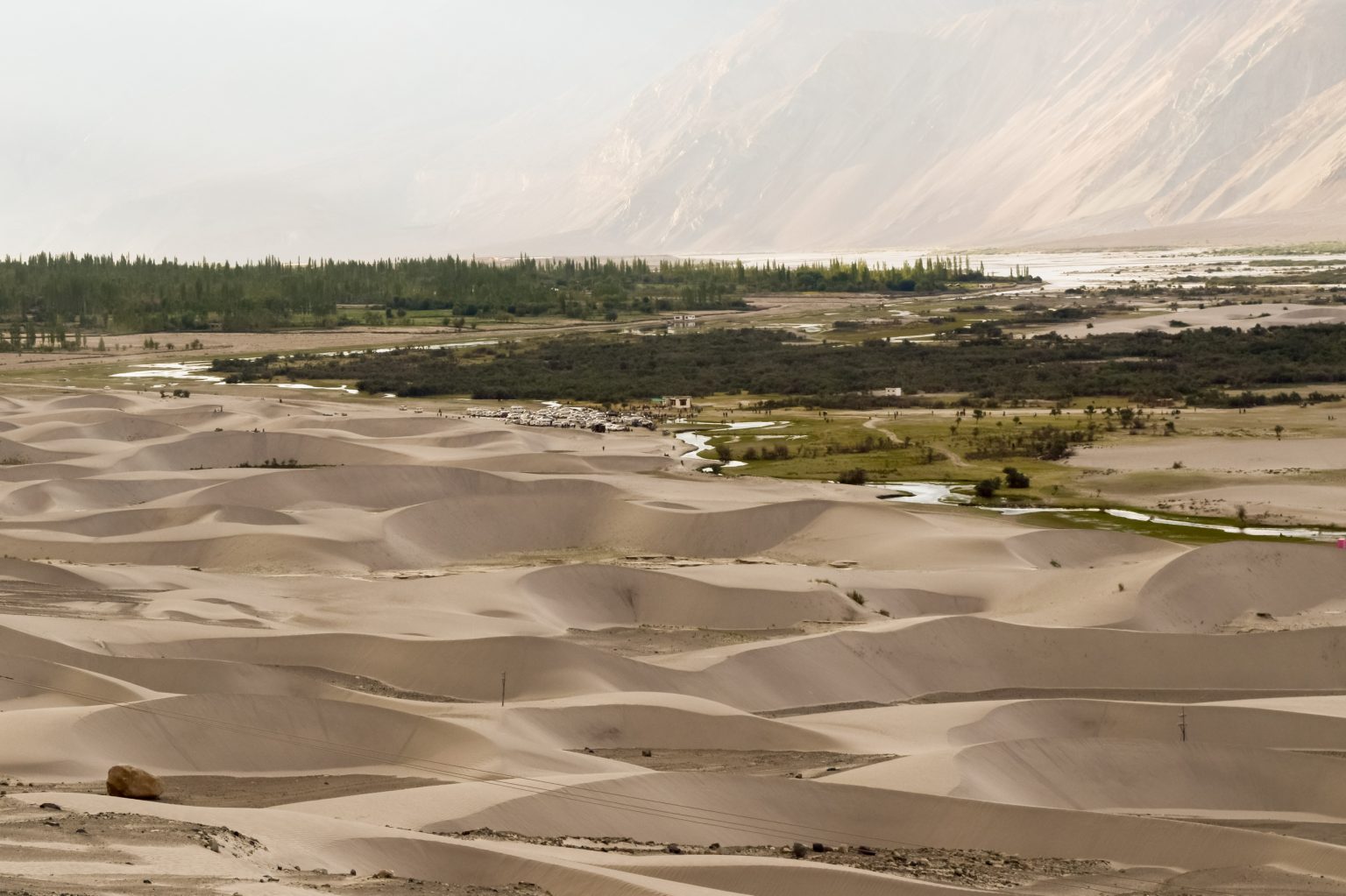
The Cold Desert of Ladakh is a high-altitude desert shaped by extreme elevation, low precipitation, strong winds, and long winters. Unlike hot deserts, its landscape can remain covered in snow for much of the year, while glaciers, barren mountains, and dry valleys replace the familiar image of sand dunes.
- Where Is the Cold Desert of Ladakh Located?
- Why Ladakh Is a Desert Despite the Snow
- Landscape of Rock, Ice, and High Mountains
- Climate of Extremes
- Flora: Survival at High Altitude
- Fauna of the Cold Desert
- People and Culture: Life in a High-Altitude Desert
- Trade Routes and Historical Legacy
- Top Things to Do in the Cold Desert of Ladakh
- Explore Leh
- Visit Nubra Valley
- See Pangong Lake
- Trek in Zanskar and Markha Valley
- Experience Monastery Festivals
- Where to Stay
- Suggested 2-Day Ladakh Desert Itinerary
- Hidden Gems of Ladakh’s Cold Desert
- Practical Travel Tips
- A High-Altitude Desert Unlike the Classic Sahara
Known as the “Land of High Passes,” Ladakh is one of the highest inhabited regions in the world. Its dry climate, dramatic mountain scenery, Buddhist heritage, and traditional communities make it one of Asia’s most distinctive cold-desert environments.
The region combines high mountain plateaus with river valleys where settlements and agriculture are possible. This contrast between extremely dry terrain and narrow cultivated corridors is one of the defining features of Ladakh.
Where Is the Cold Desert of Ladakh Located?
Ladakh lies in northern India within the Union Territory of Ladakh. It borders the Tibetan Plateau to the east, the Pakistan-administered region of Gilgit-Baltistan to the west, and Himachal Pradesh to the south.
Geographically, Ladakh forms part of the Trans-Himalayan region, between the Karakoram Range and the Himalayas.
Important areas include:
- Leh, the main urban and tourism center
- Kargil, an important town in western Ladakh
- Nubra Valley, north of Leh
- Zanskar Valley, known for its remote mountain terrain
- Changthang Plateau, a high-altitude region associated with nomadic communities
The region lies at elevations that commonly exceed 3,000 meters, with many valleys and plateaus rising well above 4,000 meters.
Why Ladakh Is a Desert Despite the Snow
Ladakh is classified as a cold desert because it receives very little precipitation. The surrounding mountain ranges create a rain-shadow effect that limits the amount of moisture reaching the region from the Indian monsoon.
Annual precipitation is generally very low, although conditions vary between locations and elevations. Much of the winter precipitation falls as snow.
Several factors contribute to Ladakh’s desert climate:
- High elevation, which produces cold temperatures and thin air
- Rain-shadow effect, caused by surrounding mountain ranges
- Low humidity and limited precipitation
- Long, cold winters
- Strong solar radiation and large temperature differences between day and night
This combination creates an arid environment despite the presence of extensive snow and glaciers at higher elevations.
Landscape of Rock, Ice, and High Mountains
Ladakh’s landscape is dominated by mountains, high plateaus, dry valleys, glaciers, and river systems rather than extensive sand dunes.
Many areas rise above 4,000 meters, with barren slopes shaped by wind, frost, erosion, and seasonal temperature changes. Mountain passes such as Khardung La, Chang La, and Zoji La connect different parts of the region.
The main rivers include:
- Indus River
- Zanskar River
- Shyok River
These waterways create narrow green corridors where villages, fields, orchards, and poplar groves can survive.
Higher mountain areas contain glaciers, including the Drang-Drung Glacier in Zanskar. The Siachen Glacier lies in the eastern Karakoram and is part of the wider high-altitude environment of the region, although it is not a conventional tourist destination.
Climate of Extremes
Ladakh has a cold, dry mountain climate with strong seasonal variation.
Typical conditions include:
- Summer daytime temperatures: often around 15–25°C in lower valleys
- Winter temperatures: can fall well below freezing, with some areas reaching around −20°C or lower
- High solar radiation: caused by the region’s elevation and clear skies
- Large day-night temperature differences
- Very low humidity, particularly outside the short summer season
Best Time to Visit
For most travelers, May to September offers the most practical conditions for visiting Ladakh.
During this period:
- Major roads are more likely to be open.
- Mountain passes are generally more accessible.
- Trekking conditions are more favorable.
- Villages and high-altitude areas are easier to reach.
- Many cultural festivals take place during the warmer months.
Winter travel is possible but requires much more preparation because of snow, freezing temperatures, and road closures.
Flora: Survival at High Altitude
Vegetation is sparse across much of Ladakh, but river valleys and irrigated settlements support a surprising variety of plants.
Common vegetation includes:
- Alpine grasses on suitable slopes and meadows
- Willow trees along rivers and streams
- Poplar trees around villages and cultivated areas
- High-altitude shrubs and herbs adapted to dry conditions
- Medicinal plants used in traditional Himalayan and Tibetan practices
Agriculture is concentrated around irrigated valleys. Barley is one of the most important traditional crops because it can tolerate Ladakh’s short growing season and cool climate.
Other crops grown in suitable areas include wheat, peas, potatoes, and various vegetables.
Fauna of the Cold Desert
Ladakh supports a range of animals adapted to high elevations, cold temperatures, and limited vegetation.
Important wildlife includes:
- Snow leopard, one of Ladakh’s most famous species
- Tibetan wolf
- Himalayan ibex
- Blue sheep, also known as bharal
- Kiang, or Tibetan wild ass
- Himalayan marmots
- Pika and other small mountain mammals
Domesticated animals are also important to local communities:
- Yaks, used for transport, milk, meat, and other resources
- Changthangi goats, traditionally raised for their exceptionally fine wool used in pashmina production
Birdlife is particularly important around high-altitude wetlands and river systems. Species found in the region include:
- Black-necked crane
- Golden eagle
- Bearded vulture
- Other high-altitude waterbirds and birds of prey
People and Culture: Life in a High-Altitude Desert
Ladakh’s cultural identity has been strongly influenced by Tibetan Buddhism, particularly in central and eastern parts of the region. Ladakhi communities have developed farming, trade, architecture, and religious traditions adapted to a demanding high-altitude environment.
The region is also home to Changpa pastoralists, particularly across the Changthang Plateau. Their traditional livelihoods include raising goats, sheep, yaks, and other livestock.
Important cultural experiences include:
- Visiting historic Buddhist monasteries
- Exploring traditional villages and farm settlements
- Learning about Changpa pastoral traditions
- Attending monastery festivals
- Observing traditional music, dance, and religious ceremonies
Monasteries such as Hemis, Thiksey, and Diskit are among Ladakh’s best-known cultural sites. Prayer flags, mani walls, chortens, and traditional architecture are common features of the landscape.
Trade Routes and Historical Legacy
Ladakh historically occupied an important position between South Asia, Tibet, Central Asia, and China. Its mountain valleys and passes formed part of long-distance trade networks crossing the Himalayas and Karakoram.
Caravans transported goods such as:
- Salt
- Wool
- Silk
- Spices
- Textiles
- Other regional commodities
Leh developed into an important trading center, while forts, palaces, monasteries, and old settlements preserve evidence of the region’s commercial and political history.
Although modern transport has replaced most caravan trade, the old routes remain an important part of Ladakh’s cultural heritage.
Top Things to Do in the Cold Desert of Ladakh
Explore Leh
Leh is the main starting point for most trips to Ladakh. Visitors can explore its historic palace, markets, monasteries, and surrounding viewpoints.
Visit Nubra Valley
Nubra combines high mountain scenery with broad valleys, sand dunes, and the famous Bactrian camels, which are associated with the region’s historic trade routes.
See Pangong Lake
Pangong Lake is a high-altitude lake extending across India and China. Its changing colors, surrounding mountains, and remote setting make it one of Ladakh’s best-known natural attractions.
Trek in Zanskar and Markha Valley
Trekking routes through Zanskar and the Markha Valley offer views of high passes, villages, river valleys, and rugged mountain terrain.
Experience Monastery Festivals
Seasonal monastery festivals feature masked dances, music, religious ceremonies, and gatherings that provide insight into Ladakh’s Buddhist traditions.
Where to Stay
Accommodation varies considerably between Leh and remote mountain areas.
- Guesthouses and hotels in Leh: The widest range of facilities and services.
- Village homestays: A good way to experience local food, architecture, and daily life.
- Eco-lodges: Available in some tourism areas, including parts of Nubra and the Pangong region.
- Mountain camps: Used on some trekking and remote travel routes.
Facilities become more limited as you travel farther from Leh, so remote stays should be arranged in advance.
Suggested 2-Day Ladakh Desert Itinerary
A two-day itinerary is extremely short for Ladakh because altitude acclimatization and travel distances need to be taken seriously. A safer short visit would focus on the Leh area rather than immediately crossing several high passes.
Day 1: Leh and Nearby Heritage
- Arrive in Leh and allow time for acclimatization
- Explore Leh’s historic center
- Visit a nearby monastery such as Thiksey
- Spend the night in Leh
Day 2: Local Mountain Landscape
- Visit nearby viewpoints and villages
- Explore the Indus Valley
- Visit a monastery or local cultural site
- Return to Leh for an overnight stay
Travelers with more time can then continue toward Nubra, Pangong, or other high-altitude areas after proper acclimatization.
Hidden Gems of Ladakh’s Cold Desert
Beyond the best-known attractions, Ladakh contains many quieter places that reveal its natural and cultural diversity.
- Remote cliffside monasteries away from the main tourist routes
- High-altitude wetlands that attract migratory birds
- Changpa pastoral areas on the Changthang Plateau
- Traditional villages along the Indus and other river valleys
- Winter landscapes around frozen rivers and mountain valleys, accessible only with appropriate preparation and local guidance
Practical Travel Tips
Ladakh requires more preparation than a typical low-altitude desert destination.
- Acclimatize gradually after arriving in Leh to reduce the risk of altitude sickness.
- Drink water regularly and avoid excessive alcohol during the initial acclimatization period.
- Carry warm clothing even in summer, especially for early mornings and high-altitude areas.
- Use sun protection because ultraviolet exposure is strong at high elevation.
- Check road conditions before traveling between regions.
- Remember that some roads and mountain passes are seasonal and weather-dependent.
- Respect local customs, monasteries, religious sites, and wildlife.
- Avoid approaching wild animals or disturbing breeding and nesting areas.
- Carry essential medicines and personal supplies when traveling into remote areas.
A High-Altitude Desert Unlike the Classic Sahara
The Cold Desert of Ladakh demonstrates that a desert does not need hot temperatures or vast sand dunes. Its aridity comes from high elevation, limited precipitation, and the rain-shadow effect of the surrounding mountains.
Rocky plateaus, dry valleys, glaciers, snow-covered peaks, and narrow irrigated settlements define the landscape. At the same time, Buddhist monasteries, Changpa pastoral traditions, historic trade routes, and high-altitude wildlife give the region a strong cultural and ecological identity.
Ladakh is therefore best understood as a high-altitude cold desert shaped by mountains, climate, rivers, and human adaptation. Its distinctive character comes from the way these elements exist together across one of the world’s most demanding inhabited environments.