
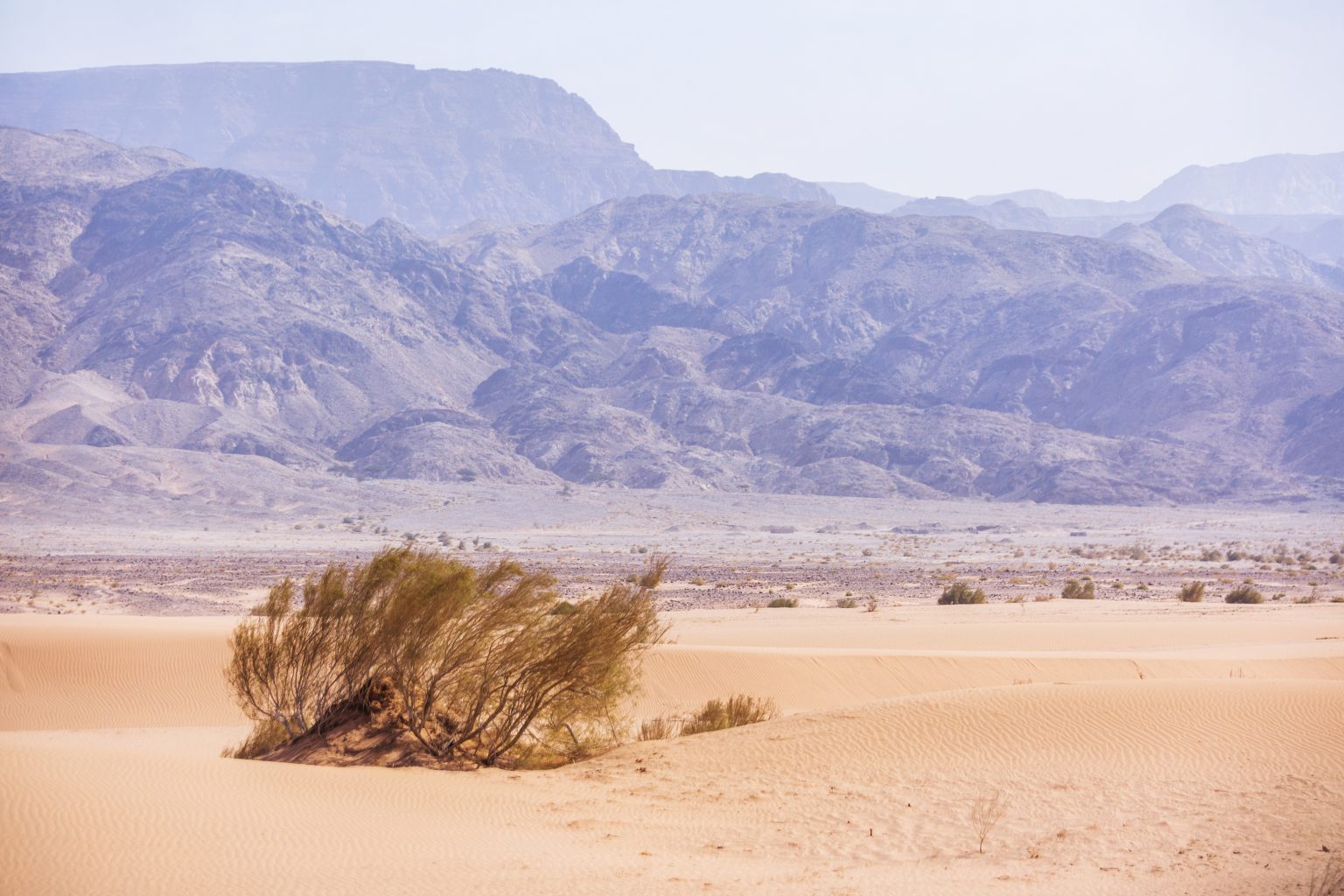
Stretching quietly between the Dead Sea in the north and the Red Sea (Aqaba) in the south, Wadi Araba is one of Jordan’s most dramatic and least understood desert landscapes. This vast valley is not just a passage of sand and stone, but a living corridor where geology, history, and desert life intersect.
- Where Is Wadi Araba Located
- A Landscape of Color and Contrast
- Climate: Heat by Day, Clarity by Night
- Vegetation: Life Rooted in Dryness
- Wildlife of Wadi Araba
- Culture and History in the Desert
- Top Things to Do in Wadi Araba
- Explore Dana and Feynan Biospheres
- Visit Petra and the Edom Mountains
- Camel and Jeep Safaris
- Stay at Feynan Ecolodge
- Camping and Stargazing
- 2-Day Wadi Araba Itinerary
- Where to Stay
- Helpful Travel Tips
- Hidden Gems of Wadi Araba
- The Desert Between Earth and Sky
Running for more than 170 kilometers along the Jordan Rift Valley, Wadi Araba forms part of the immense Great African Rift System, a tectonic scar that links Syria to Mozambique. Here, oases emerge from arid plains, salt flats shimmer under the sun, and ancient trade routes echo with stories of Edomites, Nabataeans, and Bedouin caravans. Wadi Araba does not demand attention. It rewards those who slow down and listen.
Where Is Wadi Araba Located
Wadi Araba continues south from the Dead Sea through southwest Jordan until it reaches the Gulf of Aqaba, forming a natural bridge between two seas and two worlds.
Geographic position: 30°30′N, 35°20′E
Natural boundaries
North: the southern shore of the Dead Sea
South: the Red Sea at Aqaba
East: the Edom Mountains near Petra
West: the Negev Desert and Arava Valley in Israel
Main access points
Aqaba in the south
Petra and Wadi Musa in the east
Feynan and Ghor Safi in the north
One of Wadi Araba’s most striking features is its elevation contrast, ranging from -200 meters near the Dead Sea to +200 meters near Aqaba, creating a desert of shifting perspectives and dramatic geological transitions.
A Landscape of Color and Contrast
Wadi Araba unfolds as a constantly changing mosaic, where each stretch of desert reveals a different personality.
The Rift Valley Floor
A vast, open plain marked by gravel flats, dry riverbeds, and soft sand, stretching endlessly toward the horizon.
The Edom Mountains
Rising to the east, these red sandstone mountains mirror the colors of Petra, glowing copper and crimson at sunrise and sunset.
Salt Flats and Sabkhas
Near the Dead Sea, evaporated minerals form white, mirror-like surfaces that shimmer intensely in the sunlight.
Southern Red Dunes
Closer to Aqaba, dunes turn warmer in tone, glowing in shades of gold, amber, and red, shaped by desert winds.
Every kilometer tells a different geological story, making Wadi Araba one of Jordan’s most visually diverse deserts.
Climate: Heat by Day, Clarity by Night
Wadi Araba’s climate is unmistakably desert, yet softened by elevation changes and marine influences.
Annual rainfall: 50–100 mm
Summer temperatures: 42–46°C
Winter temperatures: 8–12°C
The best time to visit is from October to April, when days are warm but manageable and nights are cool and crystal clear. After rare spring rains, small bursts of green briefly transform the valley before the desert reclaims its stillness.
Vegetation: Life Rooted in Dryness
Despite its harsh conditions, Wadi Araba supports resilient desert plant life, especially around wadis and oases.
Acacia trees, central to Bedouin culture, offer shade and nourishment
Tamarisk and saltbush thrive in mineral-rich soils
Seasonal grasses appear briefly after rainfall
Palm groves flourish around Feynan and Ghor Safi
These plants form the backbone of desert survival for both wildlife and human communities.
Wildlife of Wadi Araba
Wadi Araba links African and Arabian ecosystems, creating a surprising diversity of animal life.
Mammals
Arabian oryx and gazelles in protected zones
Wolves, red foxes, and rock hyraxes
Camels, still central to Bedouin life
Birdlife
Part of the Rift Valley Flyway, one of the world’s most important migration routes
Hoopoes, falcons, eagles, and migrating raptors
Reptiles
Lizards, agamas, and desert snakes adapted to extreme heat
The desert may appear silent, but beneath the stillness, life moves with patience and purpose.
Culture and History in the Desert
Ancient Trade Routes
Wadi Araba once formed part of the Nabataean Incense Route, carrying frankincense, spices, and gold between Arabia and the Mediterranean. Known in biblical texts as the land of Edom, it was a crossroads of empires.
Bedouin Heritage
Tribes such as the Howeitat continue to live here, herding livestock, maintaining oral traditions, and welcoming guests with tea, bread, and stories.
Modern Sustainability
Projects like Feynan Ecolodge blend Bedouin traditions with eco-tourism, proving that desert life and sustainability can thrive together.
Wadi Araba remains a landscape shaped not only by time, but by human resilience.
Top Things to Do in Wadi Araba
Explore Dana and Feynan Biospheres
Hike from the green highlands of Dana down into the arid plains of Feynan, witnessing a dramatic ecological transition.
Visit Petra and the Edom Mountains
Combine Petra’s ancient architecture with Wadi Araba’s vast open spaces for a deeper understanding of Jordan’s landscape.
Camel and Jeep Safaris
Travel between Feynan, Ghor Safi, and Aqaba by camel or 4WD, stopping to photograph dunes, wildlife, and salt flats.
Stay at Feynan Ecolodge
Enjoy guided walks, Bedouin cuisine, and candle-lit evenings under a star-filled sky.
Camping and Stargazing
Camp in the open desert with expert guides and experience some of Jordan’s darkest and clearest night skies.
2-Day Wadi Araba Itinerary
Day 1: History and Horizon
Morning travel from Petra or Dana to Feynan
Afternoon exploring Bedouin villages and ancient copper mines
Evening dinner and tea at sunset
Day 2: Sand and Silence
Morning camel or jeep safari across dunes
Afternoon visit to Edomite ruins and salt flats near Ghor Safi
Evening camp under the stars or continue to Aqaba
Where to Stay
Luxury: Feynan Eco-Luxury Lodge
Mid-range: Dana Guesthouse, Bedouin desert camps
Adventure: Guided wild camping with permits
Each option offers uninterrupted views of Jordan’s open desert horizons.
Helpful Travel Tips
Best season: October to April
Distance: 2 hours from Petra, 3–4 hours from Amman
Vehicle: 4WD recommended
Essentials: Water, sunscreen, hat, camera, light clothing
Permits required only in protected areas
Hidden Gems of Wadi Araba
Feynan Copper Mines from the Bronze Age
Ghor Safi (Zoar), a biblical settlement near the Dead Sea
Humeima, a buried Nabataean-Roman city
Wadi Ghuweir, a cool canyon of palms and flowing water
The Desert Between Earth and Sky
Wadi Araba is not simply a route between two seas. It is a journey through time, color, and silence. Here, salt glitters white, sandstone burns red, and horizons seem endless.
Walking through Wadi Araba means standing between earth and sky, past and future. Each grain of sand carries a story of endurance, balance, and quiet beauty. This is Jordan’s desert at its most honest, where silence becomes poetry and the land speaks without words.