
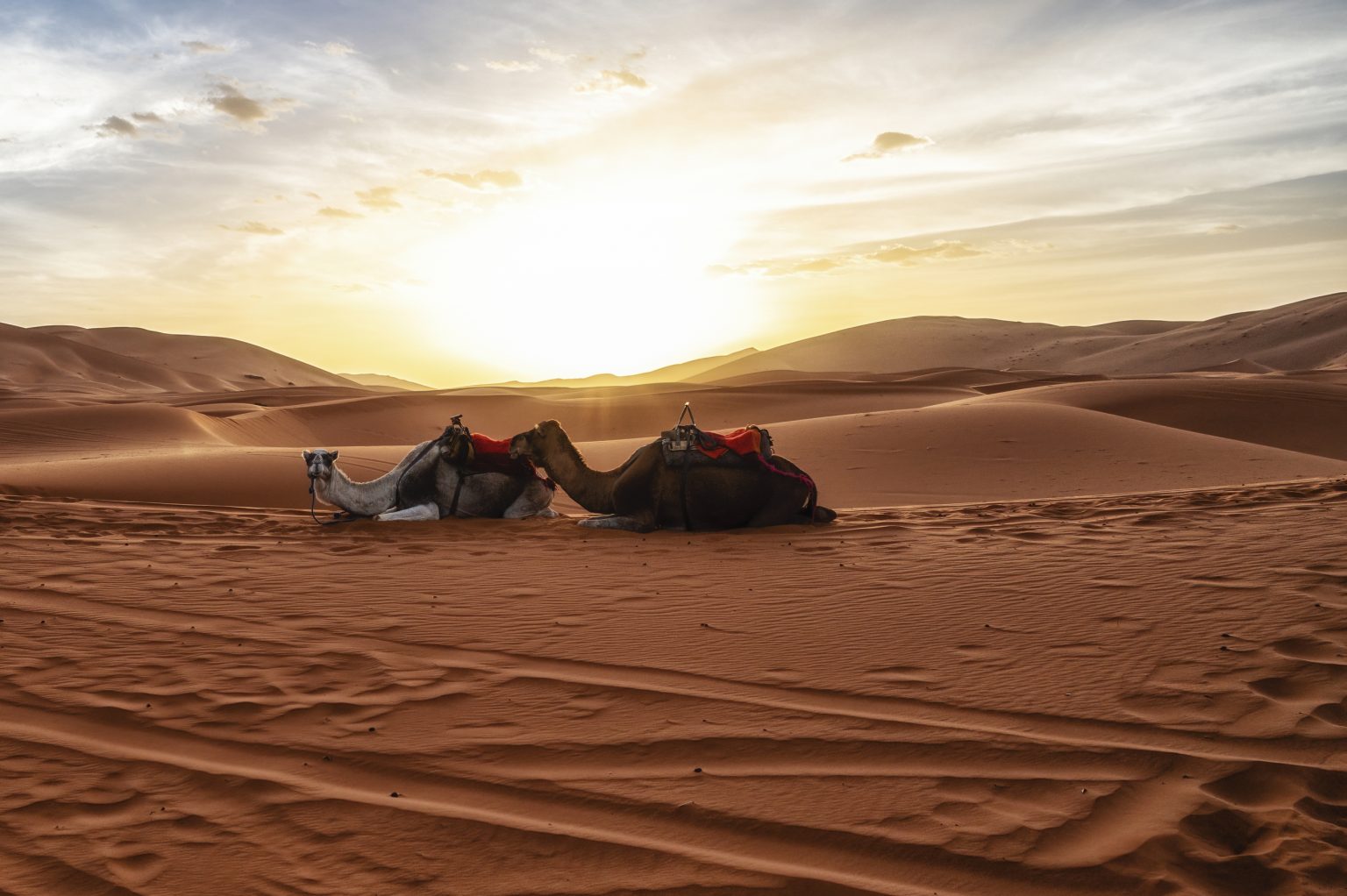
In the far southeast of Morocco, near the Algerian border, the Sahara begins to reveal its true face. Here lies Merzouga, the most iconic gateway to the Moroccan Sahara, where golden dunes, ancient caravan routes, and star-filled skies shape an experience that feels timeless.
- Where Is Merzouga Located
- The Landscape: Time Sculpted in Gold
- Merzouga Desert Climate: Beauty with Extremes
- Life in the Sands: Plants and Wildlife
- Culture and People: The Heart of Merzouga
- Top Things to Do in Merzouga
- Camel Trekking into Erg Chebbi
- Overnight Desert Camping
- Quad Biking and Sandboarding
- Visit Dayet Srji Lake
- Explore Rissani
- Meet the Gnawa Musicians of Khamlia
- 2-Day Merzouga Itinerary
- Where to Stay in Merzouga
- Practical Travel Tips
- Hidden Gems Near Merzouga
- The Soul of the Moroccan Sahara
Merzouga is not only a destination; it is a state of being. Camels still trace the paths of old traders, the Erg Chebbi dunes rise like frozen waves, and the desert wind carries stories older than memory. Travelers arrive seeking adventure, yet often leave with something deeper: clarity, humility, and awe.
Where Is Merzouga Located
Merzouga is situated in Errachidia Province, in southeastern Morocco, close to the historic towns of Erfoud and Rissani. It marks the western edge of the Sahara Desert and the beginning of the legendary Erg Chebbi dune field.
The village lies at 31.1°N, 4.0°W, at an elevation of around 700 meters (2,300 ft) above sea level.
The Erg Chebbi dunes stretch for about 28 km (17 miles) in length and up to 7 km (4.3 miles) in width, making them one of the largest and most dramatic dune systems in Morocco.
Distances from Merzouga
Marrakech: 560 km
Fez: 470 km
Erfoud: 50 km
The Landscape: Time Sculpted in Gold
Merzouga’s soul lives in the Erg Chebbi dunes, some rising over 150 meters (500 feet) high. These dunes are constantly reshaped by Saharan winds, giving the desert a sense of motion even in silence.
At sunrise, the sand glows in shades of rose and gold. By sunset, it deepens into amber and scarlet, and at night the dunes dissolve into the vastness of the stars.
Beyond the dunes, the landscape unfolds into striking contrasts:
Hamadas (rocky deserts)
Dayet Srji, a seasonal salt lake that attracts flamingos
Palm groves fed by underground water
Traditional Amazigh villages built from sun-baked clay
This is a land shaped by time, wind, and patience, not by human hands.
Merzouga Desert Climate: Beauty with Extremes
The Sahara climate in Merzouga is dramatic and uncompromising.
Annual rainfall is less than 100 mm (4 inches).
Summer temperatures often reach 45–50°C (113–122°F).
Winter nights can drop to 5–10°C (41–50°F).
The best time to visit Merzouga is from October to April, when days are warm and nights are cool and clear. This is the season of camel treks, desert camps, and stargazing.
Life in the Sands: Plants and Wildlife
Despite the harsh conditions, the Merzouga Desert supports resilient life.
Plant life includes tamarisk trees, hardy shrubs, and date palms thriving near settlements and valleys. These plants stabilize the sand and provide shelter for wildlife.
Animal life is subtle but fascinating:
Dromedary camels, the silent ships of the desert
Fennec foxes, active under moonlight
Geckos and desert lizards warming on sunlit stones
Flamingos and storks visiting Dayet Srji after seasonal rains
The desert may seem empty, but it is quietly alive.
Culture and People: The Heart of Merzouga
Merzouga is home to Amazigh (Berber) communities, guardians of desert knowledge passed down through generations. Hospitality here is not a gesture; it is a way of life.
Guests are welcomed with mint tea, stories shared under open skies, and music that echoes ancient trade routes. In nearby Khamlia, Gnawa musicians perform hypnotic rhythms rooted in African and Saharan heritage.
The desert here is not lonely; it is deeply human.
Top Things to Do in Merzouga
Camel Trekking into Erg Chebbi
Ride a camel across the dunes with experienced Amazigh guides. Learn traditional desert travel, watch the sun sink into the sand, and reach a desert camp far from all noise.
Overnight Desert Camping
Sleep in a Saharan bivouac beneath thousands of stars. Enjoy a traditional dinner, Berber drumming, and storytelling before resting in a private desert tent.
Quad Biking and Sandboarding
Explore the dunes by quad bike or try sandboarding on tall slopes, guided by local experts with safety instructions provided.
Visit Dayet Srji Lake
Best seen between November and March, this seasonal lake hosts flamingos and migratory birds, especially at dawn and dusk.
Explore Rissani
A historic caravan town and the birthplace of Morocco’s Alaouite dynasty, famous for its traditional market.
Meet the Gnawa Musicians of Khamlia
Experience spiritual music tied to Saharan history and freedom traditions.
2-Day Merzouga Itinerary
Day 1
Morning: Arrival via Erfoud or Rissani and local exploration
Afternoon: Camel trek into the Erg Chebbi dunes
Evening: Dinner, music, and stargazing at a desert camp
Day 2
Morning: Sunrise over the dunes
Afternoon: Visit Dayet Srji and Khamlia village
Evening: Relax at a desert riad with couscous and mint tea
Where to Stay in Merzouga
Luxury Desert Camps
Merzouga Luxury Desert Camp, Sahara Stars Camp
Mid-Range
Kasbah Hotel Tombouctou, Riad Madu
Budget
Nomad Palace, Les Roches Auberge
Each offers a unique way to experience the Sahara, from comfort to simplicity.
Practical Travel Tips
Best season: October to April
Access: From Marrakech or Fez, crossing the Atlas Mountains
Bring light clothing, scarf, sunglasses, and warm layers for nights
Always greet locals with Salam Alaikum
Hidden Gems Near Merzouga
Tisserdmine Oasis, known for fossils
Taouz, a remote village with ancient rock art
Rissani Market, vibrant with spices, carpets, and camels
Temporary desert lakes forming after rain
The Soul of the Moroccan Sahara
The Merzouga Desert is not just a place you visit; it is a place that stays with you. It teaches silence, reveals beauty without excess, and reminds you of what truly matters.
Here, time slows. The heart listens. And even after you leave, the dunes follow you.
Merzouga is not only the gateway to the Sahara. it is a doorway inward.