
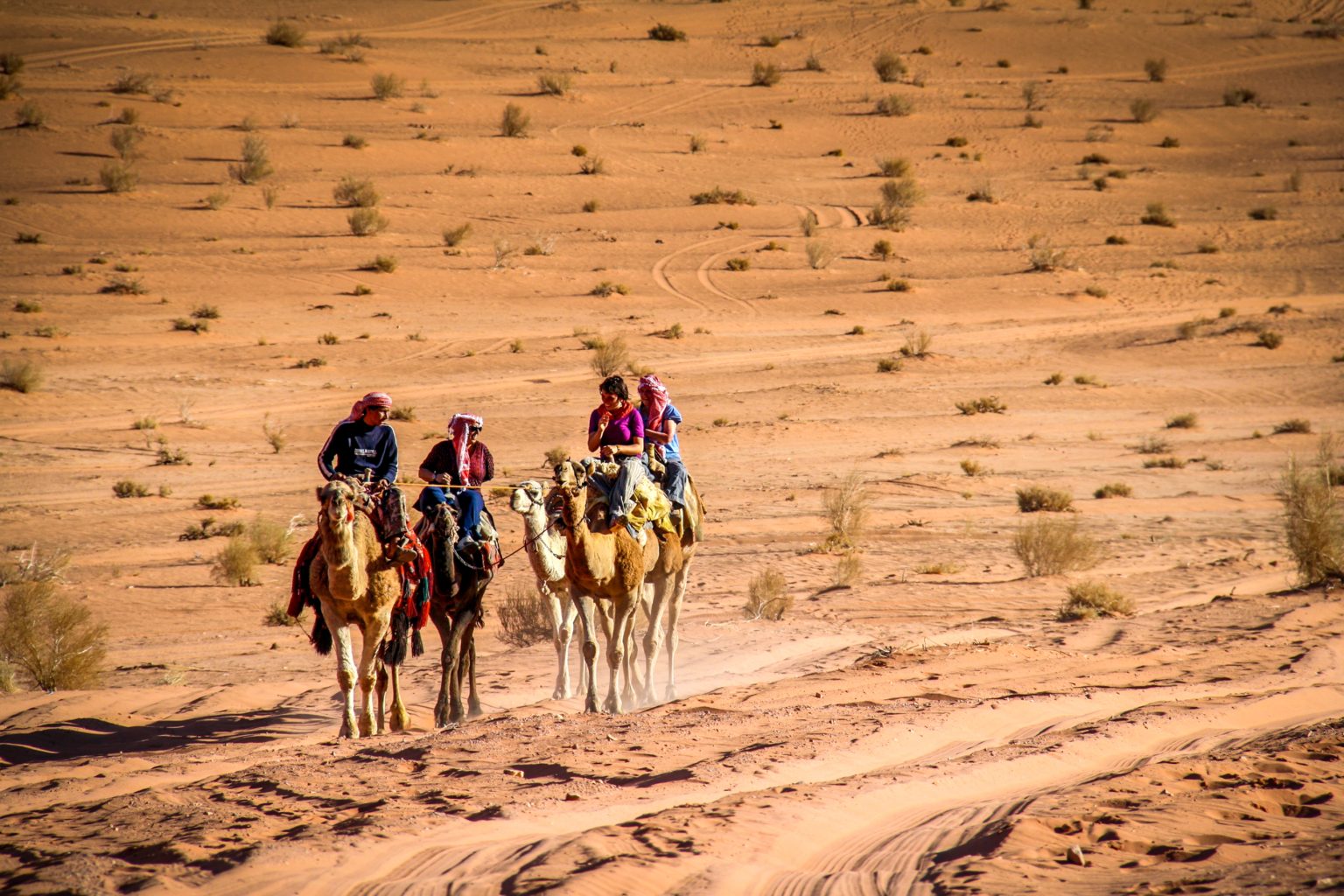
The sand beneath your feet still holds the day’s warmth. The air grows still, and time seems to loosen its grip. As the wind moves gently across ancient red rock formations, your camel rises slowly, guided by a rhythm older than memory.
- Wadi Rum, the Red Heart of Jordan
- Why Camel Trekking in Wadi Rum Is So Meaningful
- The Best Camel Trekking Routes in Wadi Rum
- From Lawrence’s Spring to Wadi Rum Village
- From Khazali Canyon to Lawrence’s House
- From Burdah Rock Bridge to the Red Sand Dunes
- The Al-Disah Valley Circuit
- Camel Trek Options and Duration
- What to Expect During a Camel Trek
- What to Bring for Camel Trekking in Wadi Rum
- Best Time for Camel Trekking in Wadi Rum
- The Bedouin Experience, More Than a Ride
- Responsible and Respectful Desert Travel
- A Sample Two-Day Camel Trek in Wadi Rum
- Why Camel Trekking in Wadi Rum Is Unforgettable
This is Wadi Rum, Jordan’s legendary Red Desert. A place where silence speaks clearly, landscapes carry stories, and every journey feels timeless from the first step.
For centuries, Bedouins have crossed Wadi Rum by camel, moving with the land rather than against it. Camel trekking in Wadi Rum is not simply an activity. It is a passage through history, space, and inner calm, shaped by patience and presence.
Wadi Rum, the Red Heart of Jordan
Located in southern Jordan near Aqaba, Wadi Rum is one of the world’s most striking desert landscapes and a UNESCO World Heritage Site. Often called The Valley of the Moon, it is defined by vast red sands, towering sandstone mountains, and narrow canyons carved by wind and time.
What defines Wadi Rum
• Expansive red desert stretching across hundreds of square kilometers
• Elevations ranging from open valleys to dramatic sandstone cliffs
• Cool, quiet nights and intensely warm summer days
• A landscape featured in films such as Lawrence of Arabia and The Martian
Beyond its cinematic fame, Wadi Rum remains a living desert, home to Bedouin families who continue to protect its traditions, knowledge, and spirit.
Why Camel Trekking in Wadi Rum Is So Meaningful
Camels have always been essential to desert life. In Wadi Rum, they are respected companions, symbolizing patience, endurance, and harmony with nature.
Why the experience stays with you
• Slow movement creates a deep connection with the landscape
• Access to remote areas unreachable by vehicles
• Travel along ancient Bedouin trade and migration routes
• Absolute silence, free from engines and crowds
A camel ride in Wadi Rum aligns you with the desert’s pace, where the journey itself becomes more important than the destination.
The Best Camel Trekking Routes in Wadi Rum
From Lawrence’s Spring to Wadi Rum Village
This classic route begins near Wadi Rum Village and crosses open red sands toward Lawrence’s Spring, a natural water source linked to T.E. Lawrence.
Key highlights
• Wide desert panoramas
• Ancient rock inscriptions near the spring
• Ideal for short camel rides
Perfect for first-time visitors and half-day experiences.
From Khazali Canyon to Lawrence’s House
Starting near the village, this route passes through Khazali Canyon, known for its Nabataean carvings, before continuing toward Lawrence’s House.
Key highlights
• Ancient rock writings and symbols
• Shaded valleys where Bedouins pause for tea
• Optional sandboarding nearby
Ideal for travelers interested in history and culture.
From Burdah Rock Bridge to the Red Sand Dunes
This deeper desert route leads to Burdah Rock Bridge, one of Wadi Rum’s most impressive natural arches.
Key highlights
• Deep red sand dunes
• Excellent sunrise and sunset photography spots
• No climbing required to enjoy the views
Best suited for photographers and explorers.
The Al-Disah Valley Circuit
The Al-Disah Valley offers a quieter, less-visited part of Wadi Rum with hidden greenery and natural springs.
Key highlights
• Fewer visitors and deeper solitude
• Small Bedouin settlements
• Occasional wildlife sightings
Ideal for travelers seeking off-the-beaten-path experiences.
Camel Trek Options and Duration
Common trekking formats
• Short rides suitable for families and beginners
• Half-day treks with tea and photo stops
• Full-day journeys covering major landmarks
• Multi-day treks with desert camping and stargazing
Multi-day camel treks offer the most immersive way to experience Wadi Rum and authentic Bedouin hospitality.
What to Expect During a Camel Trek
• A steady, gentle pace that encourages reflection
• Regular stops for rest, tea, and photography
• Comfortable saddles and breaks on longer journeys
• Simple Bedouin meals prepared over open fire
At night, the desert sky fills with stars, creating a sense of balance, stillness, and quiet wonder.
What to Bring for Camel Trekking in Wadi Rum
Essentials
• Light, breathable clothing
• A keffiyeh for sun and sand protection
• Reusable water bottle
• Sunscreen and sunglasses
• Camera or phone with dust protection
Optional items
• Small cushion for longer rides
• Flashlight for evening walks
• Power bank
Tip: Bedouins are happy to show visitors how to properly wrap a traditional keffiyeh, a gesture rich in meaning and practicality.
Best Time for Camel Trekking in Wadi Rum
Seasonal overview
• Spring brings mild temperatures and subtle desert blooms
• Summer is hot, with rides limited to early morning or evening
• Autumn offers ideal conditions for longer treks
• Winter is cooler, quiet, and perfect for photography
The most comfortable months are spring and autumn, when skies are clear and temperatures are balanced.
The Bedouin Experience, More Than a Ride
Camel trekking in Wadi Rum is shaped by the people who guide it. Bedouin hosts share routes, stories, music, and traditions passed down through generations.
Cultural moments you may experience
• Bedouin tea infused with sage or cardamom
• Zarb, traditional food cooked beneath the sand
• Evening gatherings with stories and oud music
In Wadi Rum, visitors are welcomed not as tourists, but as honored guests.
Responsible and Respectful Desert Travel
• Choose operators who treat camels ethically
• Reduce plastic use with reusable bottles
• Ask permission before photographing people
• Leave no trace in the desert
• Move slowly and respectfully
The desert remembers every step.
A Sample Two-Day Camel Trek in Wadi Rum
First day
• Ride from Wadi Rum Village toward Lawrence’s Spring
• Continue through Khazali Canyon
• Sunset at the red sand dunes
• Dinner and overnight at a Bedouin camp
Second day
• Sunrise tea in the desert
• Morning trek toward Burdah Rock Bridge
• Return across open valleys
Two days that feel far longer than time suggests.
Why Camel Trekking in Wadi Rum Is Unforgettable
In Wadi Rum, the desert teaches patience and presence. As your camel moves forward, the world slows down and silence gains meaning.
You do not simply cross the desert here.
You become part of its rhythm, its history, and its quiet power.